Sunday, July 21, 2019

The Devil's Bible

The Devil's Bible, also referred to as the Codex Gigas, is an ancient book with quite a history. The following description comes from Wikipedia.com:
Image result for devil's bibleThe Codex Gigas (English:Giant Book) is the largest extant medieval illuminated manuscript in the world, at a length of 92 cm (36 in). 
It is also known as the Devil's Bible because of a very unusual full-page portrait of the devil, and the legend surrounding its creation. It was created in the early 13th century in the Benedictine monastery of Podlažice in Bohemia, which is a region in the modern-day Czech Republic. 
It contains the complete Vulgate Bible as well as other popular works, all written in Latin. Between the Old and New Testaments are a selection of other popular medieval reference works: Josephus's Antiquities of the Jews and De bello iudaico, Isidore of Seville's encyclopedia Etymologiae, the chronicle of Cosmas of Prague, and medical works; these are an early version of the Ars medicinae compilation of treatises, and two books by Constantine the African. 
Eventually finding its way to the imperial library of Rudolf II in Prague, the entire collection was taken as spoils of war by the Swedish in 1648 during the Thirty Years' War, and the manuscript is now preserved at the National Library of Sweden in Stockholm, where it is on display for the general public. Very large illuminated bibles were a typical feature of Romanesque monastic book production, but even within this group the page-size of the Codex Gigas is exceptional.

**************************************************************************

According to Bookriot..com, the Codex Gigas are summed up in the following article by Erika Harlitz-Kern  (07-15-15)

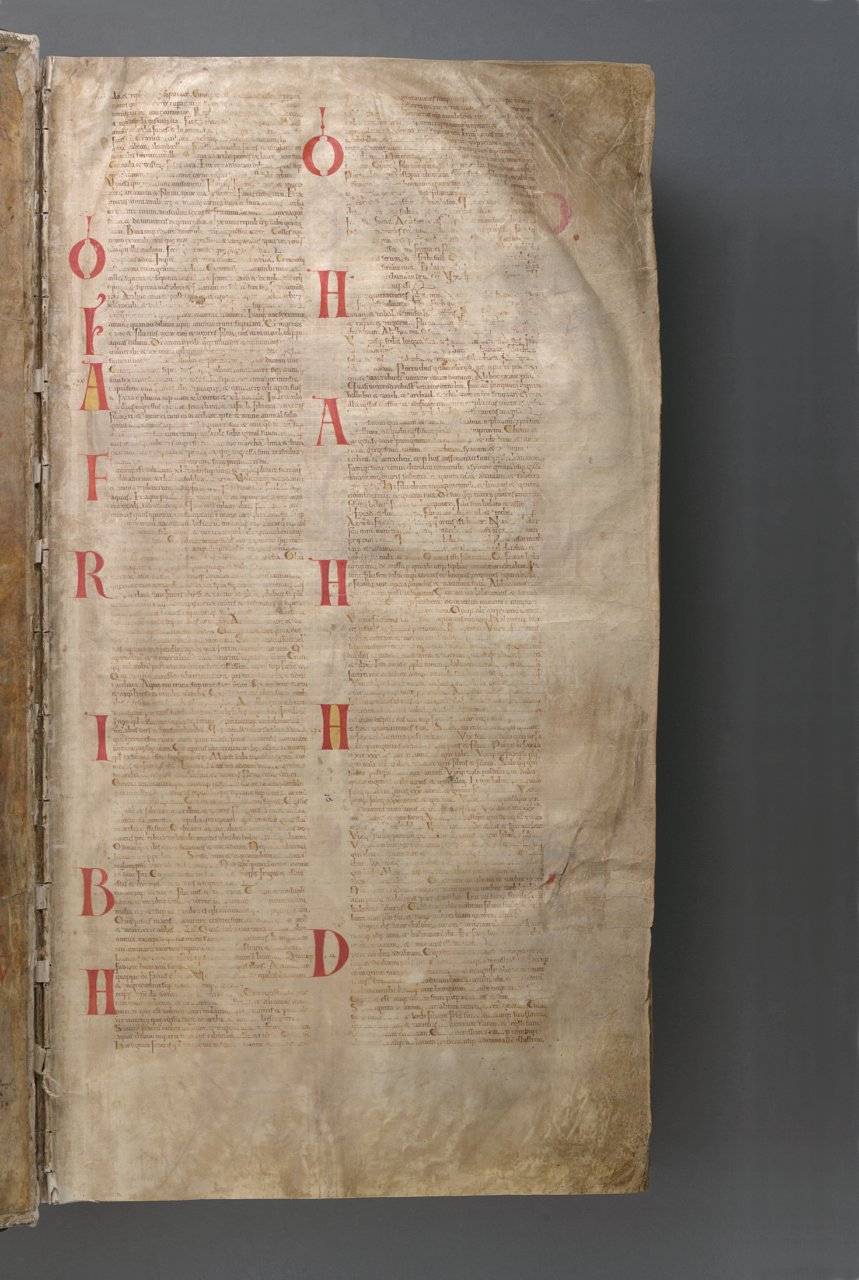
National Library of Sweden, Codex gigas, or The Devil's Bible, Book of Genesis, 2 r.
National Library of Sweden, Codex Gigas, 
or The Devil’s Bible, Book of Genesis, 2 r.

10 Things You Should Know About The Devil’s Bible (Or Codex Gigas)
by Erika Harlitz-Kern  


In July 1648, during the final clashes of the Thirty Years’ War, the Swedish army looted the city of Prague. Among the treasures they stole and brought with them when they returned home was a book called Codex Gigas.

Not only is Codex Gigas famous for being the largest medieval book in the world, but because of its contents, it is also known as The Devil’s Bible.


10 things you should know about the Codex Gigas, or The Devil’s Bible

1) The Devil’s Bible is 36 inches tall, 20 inches wide, and 8.7 inches thick.

2) The Devil’s Bible contains 310 pages made from vellum from 160 donkeys. Originally, The Devil’s Bible contained 320 pages, but at some point in time the last ten pages were cut out and removed from the book.

3) The Devil’s Bible weighs 165 lbs.

4) The Devil’s Bible was meant to be a work of history. That’s why it contains the Christian Bible in its entirety, The Jewish War and Jewish Antiquities by Flavius Josephus (37–100 C.E.), an encyclopedia by St. Isidor of Seville (560–636), and The Chronicle of Bohemia written by a Bohemian monk named Cosmas (1045–1125). In addition to these texts, there are a number of shorter texts included as well, e.g. on medical practices, penitence, and exorcism.

5) The identity of the scribe who created The Devil’s Bible is unknown. Scholars believe that the book is the creation of one person, most likely a monk living in Bohemia (today a part of the Czech Republic) during the first half of the thirteenth century.

6) Based on the amount of text and the details of the illuminations, it has been estimated that it took as long as thirty years to finish the book. In other words, the anonymous scribe seems to have dedicated the most part of his life to creating The Devil’s Bible.

7) In 1594, The Devil’s Bible was brought to Prague from the Broumov monastery, where it had been kept since the year 1420. King Rudolph II (1576–1612) asked to borrow The Devil’s Bible. He promised the monks that when he was finished with the book, he would return it. Which he of course never did.

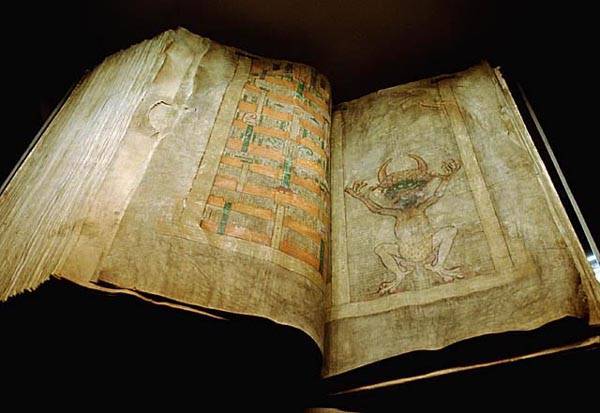
8) The Devil’s Bible has been given its name because of a full-size portrait of the Devil. Portraits of the Devil were common during the Middle Ages but this particular portrait is unique. Here, the Devil is portrayed alone on the page. The image is very big—nineteen inches tall. The Devil is crouching and facing forward. He is naked apart from an ermine loincloth. Ermine is worn as a sign of royalty. It is believed that the Devil wears ermine in this image to demonstrate that he is the Prince of Darkness.

9) There are several myths surrounding the creation of The Devil’s Bible, and they all involve the Devil. One of the most famous myths is that the scribe traded his soul to the Prince of Darkness so that he could complete the book in one night.
Codex gigas, or The Devil's Bible. The Heavenly City (289 v.) and the Devil (290 r).
Codex Gigas, or The Devil’s Bible. 
The Heavenly City (289 v.) and the Devil (290 r).

10) On the opposite page of the portrait of the Devil is an image of the Heavenly City. This has been interpreted as the Heavenly Jerusalem mentioned in the Book of Revelation. It was common in the Middle Ages to leave book spreads on display to convey a message to those who saw it. It is believed that the message intended here is to show the rewards of a God-fearing life on one page and the horrors of a sinful life on the other.


If you’d like to read more about The Devil’s Bible, please visit the book’s official home page at the National Library in Stockholm, Sweden.

Related Articles

https://en.wikipedia.org/wiki/Codex_Gigas


Tuesday, July 9, 2019

End Times Update

The following article was obtained through End Times News

WARNING: An innumerable host of evil angels are spreading over the earth. They are not only crowding government institutions, but also the churches. They are doing Satan's work, and soon they will perform great 'signs and wonders' to deceive the whole world. The policies of the Papal 'Beast' of Rome are being pushed and the whole world is soon to be deceived into giving their allegiance to the fallen churches and the Vatican, rather than our Creator God. Our ONLY safety is to anchor our lives upon the Word of God. Please submit your life to Jesus Christ today!

When we seek and learn the truth and then live according to it, the enemy's deceptions become useless, because we then come under the Spirit and power of God, which Satan CANNOT penetrate. This is why it is so important to seek and learn the truth in these end times we live in. The news is full of prophecy fulfilling images today. All the Biblical signs of the end have been fulfilled like never before in history, and we are living during the last "hours". Just take a look at the prophecy fulfilling news events below:

"Human civilisation as we know it may have already entered its last decades, a worrying new report examining the likely future of our planet's habitability warns. The increasingly disastrous impacts of the climate crisis, coupled with inaction to tackle it are sending our planet down a bleak path towards an increasingly chaotic world which could overwhelm societies around the globe, the report's authors contend."

Satan knows that Jesus is coming back soon. He knows that judgments from God and the 7 last plagues are to fall soon. So what does he do? Convince the world that the world will end due to 'climage change' if everyone doesn't UNITE to combat it and 'save the planet.' So what will the world think when the plagues start falling? They will be deceived into thinking that climate change has caused them and Satan will deceive the world into believing that God's remnant people, who will NOT unite with the world are the ones to blame!

Revelation 12:17 ...'And the dragon was wroth with the woman, and went to make war with the remnant of her seed, which keep the commandments of God, and have the testimony of Jesus Christ.'


"Despite some new tensions, 'practically the whole of Christianity is in a process of advancing beyond the controversies and competition of the past, toward greater understanding, trust and solidarity,' said Bishop Brian Farrell, secretary of the Pontifical Council for Promoting Christian Unity."

It is so sad to see how God's people have turned away from the Lord and are embracing that 'mother of harlots' in this ecumenical movement. And all for the sake of what? 'Peace and safety!' But what did the Lord say would happen to those who seek 'peace and safety' instead of TRUTH? 'Sudden destruction' (1 Thess.5:3). Notice the bishop says that Christians are now 'advancing beyond the past controversies' and are now embracing unity. Oh how deluded the professed Christian world is today (2 Thess.2:11). The Protestant reformation was a movement of TRUTH from God. We must NOT forget the past but EMBRACE it.

Jeremiah 6:16-19 ...'Thus saith the Lord, stand ye in the ways, and see, and ask for the old paths, where is the good way, and walk therein, and ye shall find rest for your souls. But they said, we will not walk therein. Also I set watchmen over you, saying, hearken to the sound of the trumpet. But they said, We will not hearken. Therefore hear, ye nations, and know, O congregation, what is among them. Hear, O earth: behold, I will bring evil upon this people.'

"After a long and severe conflict, the faithful few decided to dissolve all union with the apostate church if she still refused to free herself from falsehood and idolatry. They saw that separation was an absolute necessity if they would obey the Word of God. They dared not tolerate errors fatal to their own souls ... If unity could be secured only by the compromise of truth and righteousness, then let there be difference, and even war. Well would it be for the church and the world if the principles that actuated those steadfast souls were revived in the hearts of God's professed people. There is an alarming indifference in regard to the doctrines which are the pillars of the Christian faith. The opinion is gaining ground, that, after all, these are not of vital importance. This degeneracy is strengthening the hands of the agents of Satan, so that false theories and fatal delusions which the faithful in ages past imperiled their lives to resist and expose, are now regarded with favor by thousands who claim to be followers of Christ." (Great Controversy, p.45)

HEED THE WARNING - Come OUT OF HER My People!


"Dr. Smadja's daring plan calls for an international day of rest (about 53 days per year) plus approximately 15 'holidays' where cumulatively there would be a cessation of all productive activity for approximately 70 days, or about 20percent of the year. These days of 'non-activity' would help achieve the shared goal outlined in the Paris Climate Conference (COP21) of a 20 percent reduction of pollution globally by 2050, with the aim of keeping global warming below 2 degreesC ... This frantic race to go faster and faster makes us forget essential things, such as loving ourselves, others and also our earth ... the result is a global disaster, whose ecological impact is more and more obvious. A Sabbath for ourselves, our industry and our environment is a corrective to these failures." (see also here)

Now what day do you think they would choose to 'shut down' each week? Sunday! We were saying this would happen, just before the pope's climate encyclical came out. I mean, what better way to 'help the planet' than to have a law that makes businesses shut down one day a week. Ok, this is just someone suggesting it, but the Sunday law plan is now moving in darkness, concealed behind this climate agenda, and the leaders are concealing their true purpose. But God's people can see right through their plans, because everything is exposed when you are walking in the light of God.

The Sunday law is coming friends. The systems are being put in place, as you can see from the news item below, ready for the enforcement of the Sunday law. But should we wait for this to happen to get ready? NO! God forbid! We must BE ready now. If we keep putting off getting ready, then the Lord WILL pass us by and give our crown to someone else! The reason why things have not wrapped up by now, is because God's people have slumbered and slept. But the shaking is taking place now. The Spirit of the Lord is falling. People all over the world are waking up and the final events are soon to take place just before the Lord returns. Time to BE ready friends!

Revelation 3:11 ...'Behold, I come quickly: hold that fast which thou hast, that no man take thy crown.'

And PLEASE do not rely upon your church leaders to keep you informed. As they have joined hands with Babylon and will lead you down the wide road to destruction! We must stop following the churches, and follow Jesus Christ alone (Revelation 14:1-5)


"Donald Trump's nomination of Brett Kavanaugh to the Supreme Court is a gift to evangelical Christians ... Simply put, the Supreme Court is the reason that many Evangelicals voted for Trump ... Evangelical leader Franklin Graham (Billy Graham's son) posted to his Facebook page a month before the 2016 election: 'The most important issue of this election is the Supreme Court' ... In an interview on NPR, another evangelical American, Karen Swallow Prior of Liberty University, concurred with Graham as she explained how easy it was for Christian conservatives to become Trump's bedfellows in order to make long-term gains on the Supreme Court."

Revelation 13 tells us that the second beast (America), would make an image to the first beast (the Papacy), and what is the Papacy? It is a uniting of church and state, with the church directing the affairs of the state. And that is what we see going on in America today. The image of the beast is already set up in America, and all it needs now is POWER to 'spead and cause' the world to take the mark of the Papal beast - the Sunday law in honour of their false trinity god. And that is why the Evangelicals are trying to get their people, whether they be Catholic or Protestant, into the hot seat in the Supreme Court. And it matters not whether they are Catholic or Protestant, because they have all united into the same team of "fallen Babylon".

The signs are all around for us to see that we are in the very end times. So it is time to BE READY in Jesus Christ. We must surrender ALL to Him now, so that He can live His life in us and make us ready for heaven.

Tuesday, June 18, 2019

The Tower of Babel (Gen 11:1-9)

The following article was obtained through BibleOdyssey.org and written by Jan Christian Gertz

Together with Solomon’s temple, the tower of Babel may be the best-known building in the Hebrew Bible. The notion of a tower reaching toward heaven is deeply inscribed in our cultural memory. As a result, readers often overlook the fact that Gen 11:1-9 reports little about the actual tower. For example, the story only implies that the workers stopped building the tower. The tower’s destruction, though often read into the story, is never stated. Instead of being the central interest of the story, the tower functions as a symbolic motif.

The people who built the tower of Babel were driven by fundamental human concerns. They preferred settlement to the uncertainties of dispersion, uniformity to diversity, fame and power to obscurity and weakness. But in the account in Gen 11:1-9, God denies their preferences. At the center of the story is humanity’s transition from speaking one language and living in one location to speaking several languages and living in multiple locations across the world.

What is God’s problem with the tower? 

The standard answer is that the project of building a tower reaching the heavens is a symbol of humanity’s arrogant pursuit of fame and power—ideas closely linked in the ancient Near East. It is true that God expresses some concern about safeguarding the line between the human and divine spheres, perhaps even suggesting that the people pose some kind of threat to the divine realm (Gen 11:6, Job 42:2). The tower, then, is a symbol of humanity’s ability and propensity to cross boundaries and of God’s endeavor to check such behavior.

The tower itself, however, is a minor motif—something mentioned twice and only in passing (see Gen 11:4-5). The narrative’s conclusion focuses on the real issue at hand: God’s dissolution of humanity’s linguistic unity, an act that results in dispersion and that reflects the historical experience of the Israelites in the exilic and postexilic periods. The story ends with an etiology (an origin story) connecting the name of the city with the confusion (balal) of languages and identifying the city as the origin point for the dispersion of humanity (Gen 11:9).

How and when was the tower of Babel story written? 
Scholars often assume that the story of the tower of Babel was stitched together from different sources or that it underwent stages of literary development. As evidence, they point to subtle tensions, apparent repetitions, and the seemingly large number of motifs. Since none of the individual elements are superfluous, however, such reconstructions are hardly convincing. Literary and historical analysis may suggest that a poem mocking Babel was the core tradition of the story.

The story of the tower of Babel concludes the biblical primeval narrative (Gen 1-11), whose origin is often explained by assuming a combination of two previously independent sources. Here, our story is generally attributed to the earlier source. But as the story meshes well with the genealogies of the second, later source, this argument is questionable. Additionally, the Babel story seems to have in view the stories about Abraham and Sarah, both of whom are from Mesopotamia (see Gen 11:31). All this would seem to suggest that Gen 11:1-9 was composed after the strands of the primeval history and the ancestral narrative were combined, which likely happened fairly late (sixth century B.C.E.). Even so, the age of a story whose author we do not know remains difficult to determine. Gen 11:1-9 is a myth set in primeval times, but this setting indicates neither that the text was written at the same time the “events” occurred nor that it is later.

Here, the tower can help us. Because the story mentions Babel and is also set in the land of Shinar (Gen 11:2), scholars argue that the text’s author was thinking of the ziggurat Etemenanki, which is located in ancient Babylon. The imagery of a building reaching the heavens supports this suggestion (Gen 11:4). If this is correct, then Gen 11:3 provides further evidence for the time of writing: the oldest ziggurat was originally built with mud bricks. Only at the latest building stage, in the seventh century B.C.E., did it receive a sheathing of fired bricks. It is also possible that the notion of an “unfinished” tower is connected with the extensive damage done by the Persian king Xerxes (518–465 B.C.E.) to religious buildings in Babylon. All things considered, the tower of Babel story is likely a postexilic addition to the primeval history.


<<<<<<<<<<<<<<<<***>>>>>>>>>>>>>>>>

The tower of Babel, probably a postexilic addition to the primeval history, is a symbol of the human ability and propensity to cross boundaries and of God’s endeavor to halt such behavior.

Did you know…? 

The story of the tower of Babel describes the diversity of languages and people.

The tower of Babel is only mentioned in Gen 11:4-5.

Some scholars dispute the identification of the tower mentioned in Gen 11:1-9 with the ziggurat Etemenanki because the Hebrew word migdal can describe every form of tower and the expression “city and tower” could also refer to the city and its acropolis. However, as the story is located in Babylon, the identification with Etemenanki is reasonable.

The use of fired bricks and bitumen for mortar was unknown in ancient Israel and introduces local Babylonian building techniques and color into the story.
The literary and archaeological evidence suggests that the postexilic period is the most plausible setting for an author to write such a story.

Wednesday, June 5, 2019

How OLD Are the Religions?

The following article was posted by Reed Hall on Beliefnet.com

In a previous series of blog entries, I addressed a common basic question: How MANY religions are there?

In my immediately preceding blog entries, I addressed a follow-up question: How BIG are the religions?

In this blog entry, I’d like to round out this preliminary overview of the global religious landscape by addressing another follow-up question: How OLD are the religions?
 

For the major world religions, the simple answer is: pretty old. Most of them are 2000+ years old.


This bar graph presents the relative ages (in years) of each of the major world faiths. Hinduism is the oldest, with roots stretching back some 4000 years, or more; Sikhism is the youngest, being only about 500 years old.

As the chart indicates, among the very oldest religions are Hinduism, Judaism, and (possibly) Zoroastrianism. The roots of Hinduism stretch back at least to India’s Vedic era, and perhaps even further back, into pre-Vedic times (2000 BC, or earlier). The roots of Judaism stretch back to the time of the patriarch Abraham, traditionally dated at around 1800 BC. The precise age of Zoroastrianism, the religion of ancient Persia, remains a matter of some controversy; conflicting dates suggested for the era of its founding prophet Zoroaster range from the 18th to the 6th centuries BC.

A number of major religions seem to have all gotten their start, in different places around the globe, at roughly the same time: the 6th century BC. Jainism, Buddhism, Confucianism, and possibly Zoroastrianism (if one favors a later rather than an earlier date for Zoroaster) were each born in that religiously creative century. The Tao Te Ching, the foundational text of Taoism, is also traditionally attributed to a 6th-century-BC sage known as Lao Tzu, but more recently scholars have suggested a somewhat later date for its composition.

Christianity, of course, is right at about 2000 years old, having gotten started with the life and teachings of Jesus of Nazareth (and his apostles, such as Paul) during the 1st century AD. Indeed, our Western (Gregorian, Christian) calendar revolves around the presumed date of the birth of Christ as the axis point which divides all of time and history into two eras, referred to as B.C. (“Before Christ”) and A.D. (Anno Domini, Latin for “In the Year of the Lord”).

As religions go, then, Christianity (at only 2000 years of age) is one of the younger ones. And Islam is even younger still (by about 600 years). Although Muslims point out that the Arabic term islam merely means “submission” to the will of God, and further holds that Adam, Noah, Abraham, and Moses were among the first such “submitters,” Islam as a distinctive religious movement did not appear on the scene until the prophet Muhammad established it in Arabia in the 7th century AD, making Islam in this sense some 1400 years old.

The precise origin of Shinto, the indigenous traditional religion of Japan, is a bit hazy to date with precision; many place its origins at somewhere roughly around perhaps the 8th century AD (or at least that is when written records pertaining to Shinto beliefs and practices first appeared in Japan).

Sikhism, the youngest of the world’s major faiths, was founded in India by Guru Nanak right around 1500 AD.

So, that’s it, at least as far as the major religions are concerned. But what about some of the other, perhaps smaller but nevertheless well-known religions — religions such as Baha’i, Christian Science, Mormonism, Rastafarianism, Scientology, Wicca, or the Unification Church? How old are they?

For them, the simple answer is: not very old. All of those aforementioned faiths are not only far smaller than the major faiths, but also far younger, each of them having been born as recently as the 19th or 20th centuries.

Baha’i was founded by Baha’u’llah in Persia in the mid-to-late 1800s. Christian Science was founded in Boston by Mary Baker Eddy in the late 1800s. Mormonism was founded by Joseph Smith in western New York in the early 1800s. Rastafarianism was founded in Jamaica around 1930. Scientology was founded by L. Ron Hubbard in New Jersey in 1953. Wicca is a modern revival or reconstruction of ancient European forms of indigenous paganism, whose varying traditions began to emerge in Britain in the early to mid-1900s. And the Unification Church was founded in South Korea by Sun Myung Moon in 1954.

Most of today’s well-known “alternative” religions are of far more recent vintage than the larger, longer-established faiths — which count their own ages in terms of many centuries, even millennia, rather than in mere decades (or at most a couple of centuries).
However, it is perhaps also wise to remember that even the largest and longest-enduring major religions of today must have also started out at one time as small, young “minority religions” themselves, during their own early formative eras.

Monday, May 20, 2019

Is Satan the Father of Cain?

Multiple narratives are featured on the internet with a common question, "Is Satan the father of Cain?". It has produced a series of commentaries and debates on this particular subject throughout cyberspace. Most scholars agree the theory of Satan siring Cain stems from extra-canonical texts, such as the Zohar and the Book of Enoch.

Related image

According to Hank Hanegraaff (aka: Bible Answer Man), his theory of Satan being Cain's father extends to his research of William Branham on the subject:
“Here is what really happened in the Garden of Eden. The Word says that Eve was beguiled by the serpent. She was actually seduced by the serpent….He was so close to being human that his seed could, and did mingle with that of the woman and cause her to conceive. When this happened, God cursed the serpent.” — William Branham

Branham (1909–65), a proponent of Oneness theology, taught the so-called serpent seed interpretation of Genesis 3, with adherents of this view often citing Genesis 3:15 in support of their position: “And I will put enmity between you [the serpent] and the woman, and between your offspring and hers; he will crush your head, and you will strike his heel” (ESV).

The crux of the serpent seed view is that Eve and Satan engaged in sexual relations. Consequently, sin is viewed as sexual in nature, as opposed to the traditional interpretation of the fall as sin being disobedience to God. In addition to Branham, other serpent seed interpretations of Genesis 3:15 are found in the teachings of the Christian Identity movement, as well as, for instance, in the teachings of Arnold Murray (1929–2014) of Shepherd’s Chapel and also the Unification Church.

The Identity movement’s serpent seed interpretation clearly leads to racism, as one expert explains: “As early as the mid-1940s, Identity preachers were building a new doctrine: the Serpent Seed theory. It is a fairly simple and straightforward belief: Jews are the physical descendants of a sexual union between ‘Mother Eve’ and ‘the serpent’ (Gen. 3). The serpent is variously identified as either Satan, or a demonic representative of Satan. As such, Jews are literally ‘Children of the Devil.’ Most Identity believers claim the serpent was a physical manifestation of Satan himself.” Furthermore, Identity teachers add that Cain is the offspring of a union of the serpent and Eve, while Abel is said to be the result of the union of Adam and Eve.

Even if the serpent seed doctrine does not overtly lead to racism, the interpretation remains problematic and unwarranted.

For further reading, please visit the link: Did Eve Have Sex With Satan (Bible Answer Man)
^*^*^*^*^*^*^*^*^*^*^*^*^*^*^*^*^*^*^*^*^*^*^*^


Another similar view comes from the website, Sefaria: A Living Library of Jewish Texts. This particular text comes from the Midrash: The Legend of the Jews by Louis Ginzberg (1909) - Volume 1:3.

THE BIRTH OF CAIN - There were ten generations from Adam to Noah, to show how long-suffering is the Lord, for all the generations provoked Him unto wrath, until He brought the deluge upon them. By reason of their impiousness God changed His plan of calling one thousand generations into being between the creation of the world and the revelation of the law at Mount Sinai; nine hundred and seventy-four He suppressed before the flood. Wickedness came into the world with the first being born of woman, Cain, the oldest son of Adam. When God bestowed Paradise upon the first pair of mankind, He warned them particularly against carnal intercourse with each other. But after the fall of Eve, Satan, in the guise of the serpent, approached her, and the fruit of their union was Cain, the ancestor of all the impious generations that were rebellious toward God, and rose up against Him. 

Cain's descent from Satan, who is the angel Samael, was revealed in his seraphic appearance. At his birth, the exclamation was wrung from Eve, "I have gotten a man through an angel of the Lord." Adam was not in the company of Eve during the time of her pregnancy with Cain. After she had succumbed a second time to the temptations of Satan, and permitted herself to be interrupted in her penance, she left her husband and journeyed westward, because she feared her presence might continue to bring him misery. Adam remained in the east. When the days of Eve to be delivered were fulfilled, and she began to feel the pangs of travailing, she prayed to God for help. But He hearkened not unto her supplications. "Who will carry the report to my lord Adam?" she asked herself. "Ye luminaries in the sky, I beg you, tell it to my master Adam when ye return to the east!" In that self same hour, Adam cried out: "The lamentation of Eve has pierced to my ear! Mayhap the serpent has again assaulted her," and he hastened to his wife. Finding her in grievous pain, he besought God in her behalf, and twelve angels appeared, together with two heavenly powers. All these took up their post to right of her and to left of her, while Michael, also standing on her right side, passed his hand over her, from her face downward to her breast, and said to her, "Be thou blessed, Eve, for the sake of Adam. Because of his solicitations and his prayers I was sent to grant thee our assistance. Make ready to give birth to thy child!" Immediately her son was born, a radiant figure. A little while and the babe stood upon his feet, ran off, and returned holding in his hands a stalk of straw, which he gave to his mother. For this reason he was named Cain, the Hebrew word for stalk of straw.

For further reading, please visit the link:  Legends of the Jews (3:1)


^*^*^*^*^*^*^*^*^*^*^*^*^*^*^*^*^
While there are those that contend Satan is the father of Cain, biblical scholar, Dr. Michael Heiser passionately disagrees. In his article, Was Cain Fathered by the Devil? No, Wait — Extraterrestrials (2008), he put forth his theory in the following excerpt: 

Here’s the truth about this particular web gem. I’ll unpack each point briefly.
1. Genesis 4:1 was NOT found among the textual remains of the Hebrew Bible among the Dead Sea Scrolls. It is important to realize that much of the biblical material from Qumran is partial and fragmentary. Only the book of Isaiah can be said to be virtually complete (99% of it was found at Qumran). There are portions and scraps of every other OT book except Esther. Genesis 4:1, the account of Can’s birth, is not in the Dead Sea Scroll material. Therefore, the Dead Sea scrolls don’t preserve this weird view of Cain’s lineage. Readers can check on what I’m saying through two relatively inexpensive sources: 

David L. Washburn, A Catalog of Biblical Passages in the Dead Sea Scrolls (Sbl – Text-Critical Studies, 2) (Sbl – Text-Critical Studies, 2) 
Martin Abegg, Peter Flint, and Eugene Ulrich, The Dead Sea Scrolls Bible: The Oldest Known Bible Translated for the First Time into English (Harper, 1999). 
2. Since we already know the name doesn’t occur in the biblical scrolls (the point above), I thought I’d look for it among the other scrolls material – sometimes the other material has commentaries on the biblical material. A computer search for “Sammael” (or the alternate spelling Samael) yields ZERO occurrences in the non-biblical texts from the Dead Sea Scrolls. This is more proof that this “account” is not only absent in the biblical Dead Sea Scrolls; it isn’t present in the scrolls that covered other subjects besides copying and commenting on the Hebrew Bible. You can watch a video of me doing this search so you know I’m not making it up. (Turn your speakers up and use high speed – it’s 29 MB).

3. I knew that I wouldn’t find the name Sammael or Samael in any of the scrolls. The name does occur among the Pseudepigrapha. The video I made above includes this search and its results. Sorry, no sex between the serpent / Sammael and Eve. Boring, I know. Outside the name Sammael/Samael, and some pseudepigraphic material (4 Maccabees 18:8) the serpent gets blamed for all sexual sin, but that’s a lot different than fathering Cain.

4. Some rabbinic material does have the devil fathering Cain. Targum Pseudo-Jonathan has this idea. This translation, though, does NOT have the variant that includes Samael. The other Targums do not have this reading. Targum Pseudo-Jonathan is dated by Aramaists at roughly the sixth century A.D., or between 1500-2000 years AFTER Genesis was written (the date range depends on when one thinks Genesis was written). The Talmud relates a story that Yonatan ben Uziel, a student of Hillel (roughly contemporary with Jesus), fashioned an Aramaic translation of the Prophets. That translation is considered by some to be Targum Pseudo-Jonathan. However, the story makes no mention of any translation by him of the Torah, and so it cannot be argued that Targum Pseudo-Jonathan of Genesis 4:1 is as old as Jesus’ day. The sixth century A.D. is all the evidence allows. Targums can be very elastic translations, adding material quite freely with no Hebrew manuscript evidence at all. Everyone who does Aramaic knows this about the Targums - they can play pretty fast and loose with the text of the Bible; they INSERT all kinds of things into the translation, without regard to any prior textual manuscript history for support. IN plain language, the Targums often add made up material to the biblical text. Having Samael in Genesis 4:1 is a classic example – it was added at least 1500 years after the fact, and no other prior ancient Jewish material supports it.

To read this article in its entirety, visit this link: Was Cain Fathered by the Devil? No, Wait — Extraterrestrials

^*^*^*^*^*^*^*^*^*^*^*^*^*^*^*^*^

It would seem the debate about "Satan being the father of Cain" will continue among the scholars and theologians with no common consensus being reached on this subject. But, it does leave one wondering ... Who's ? Right.

Saturday, May 4, 2019

The Return of Paganism

Maybe there actually is a genuinely post-Christian future for America.

By Ross Douthat, Opinion Columnist

Dec. 12, 2018

Here are some generally agreed-upon facts about religious trends in the United States. Institutional Christianity has weakened drastically since the 1960s. Lots of people who once would have been lukewarm Christmas-and-Easter churchgoers now identify as having “no religion” or being “spiritual but not religious.” The mainline-Protestant establishment is an establishment no more. Religious belief and practice now polarizes our politics in a way they didn’t a few generations back.

What kind of general religious reality should be discerned from all these facts, though, is much more uncertain, and there are various plausible stories about what early-21st century Americans increasingly believe. The simplest of these is the secularization story — in which modern societies inevitably put away religious ideas as they advance in wealth and science and reason, and the decline of institutional religion is just a predictable feature of a general late-modern turn away from supernatural belief.

A Brooklyn bookstore gathered witches, Wiccans and local residents to perform a hex ritual.
(Photo Credit: Emily Molli/NurPhoto, via Getty Images)

But the secularization narrative is insufficient, because even with America’s churches in decline, the religious impulse has hardly disappeared. In the early 2000s, over 40 percent of Americans answered with an emphatic “yes” when Gallup asked them if “a profound religious experience or awakening” had redirected their lives; that number had doubled since the 1960s, when institutional religion was more vigorous. A recent Pew survey on secularization likewise found increases in the share of Americans who have regular feelings of “spiritual peace and well-being.” And the resilience of religious impulses and rhetoric in contemporary political movements, even (or especially) on the officially secular left, is an obvious feature of our politics.

So perhaps instead of secularization it makes sense to talk about the fragmentation and personalization of Christianity — to describe America as a nation of Christian heretics, if you will, in which traditional churches have been supplanted by self-help gurus and spiritual-political entrepreneurs. These figures cobble together pieces of the old orthodoxies, take out the inconvenient bits and pitch them to mass audiences that want part of the old-time religion but nothing too unsettling or challenging or ascetic. The result is a nation where Protestant awakenings have given way to post-Protestant wokeness, where Reinhold Niebuhr and Fulton Sheen have ceded pulpits to Joel Osteen and Oprah Winfrey, where the prosperity gospel and Christian nationalism rule the right and a social gospel denuded of theological content rules the left.

I wrote a whole book on this theme, but in the years since it came out I’ve wondered if it, too, was incomplete. There has to come a point at which a heresy becomes simply post-Christian, a moment when you should just believe people who claim they have left the biblical world-picture behind, a context where the new spiritualities add up to a new religion.

Which is why lately I’ve become interested in books and arguments that suggest that there actually is, or might be, a genuinely post-Christian future for America — and that the term “paganism” might be reasonably revived to describe the new American religion, currently struggling to be born.

A fascinating version of this argument is put forward by Steven D. Smith, a law professor at the University of San Diego, in his new book, “Pagans and Christians in the City: Culture Wars From the Tiber to the Potomac.” Smith argues that much of what we understand as the march of secularism is something of an illusion, and that behind the scenes what’s actually happening in the modern culture war is the return of a pagan religious conception, which was half-buried (though never fully so) by the rise of Christianity.

What is that conception? Simply this: that divinity is fundamentally inside the world rather than outside it, that God or the gods or Being are ultimately part of nature rather than an external creator, and that meaning and morality and metaphysical experience are to be sought in a fuller communion with the immanent world rather than a leap toward the transcendent.

This paganism is not materialist or atheistic; it allows for belief in spiritual and supernatural realities. It even accepts the possibility of an afterlife. But it is deliberately agnostic about final things, what awaits beyond the shores of this world, and it is skeptical of the idea that there exists some ascetic, world-denying moral standard to which we should aspire. Instead, it sees the purpose of religion and spirituality as more therapeutic, a means of seeking harmony with nature and happiness in the everyday — while unlike atheism, it insists that this everyday is divinely endowed and shaped, meaningful and not random, a place where we can truly hope to be at home.

In popular religious practice there isn’t always a clean line between this “immanent” religion and the transcendent alternative offered by Christianity and Judaism. But clearly religious cultures can tend toward one option or the other, and you can build a plausible case for a “pagan” (by Smith’s definition) tradition in Western and American religion, which in his account takes two major forms.

First, there is a tradition of intellectual and aesthetic pantheism that includes figures like Spinoza, Nietzsche, Emerson and Whitman, and that’s manifest in certain highbrow spiritual-but-not-religious writers today. Smith recruits Sam Harris, Barbara Ehrenreich and even Ronald Dworkin to this club; he notes that we even have an explicit framing of this tradition as paganism, in the former Yale Law School dean Anthony Kronman’s rich 2016 work “Confessions of a Born-Again Pagan.”

At the Avebury Neolithic henge monument, eager people wait to see the sun rise on the summer solstice. Image by Matt Cardy/Getty Images
Hundreds of druids, pagans and revelers gathered in June at the Avebury Neolithic henge monument in England for sunset and sunrise during the summer solstice. (Photo Credit: Matt Cardy/Getty Images)

Second, there is a civic religion that like the civic paganism of old makes religious and political duties identical, and treats the city of man as the city of God (or the gods), the place where we make heaven ourselves instead of waiting for the next life or the apocalypse. This immanent civic religion, Smith argues, is gradually replacing the more biblical form of civil religion that stamped American history down to the Protestant-Catholic-Jew 1950s. Whether in the social-justice theology of contemporary progressive politics or the transhumanist projects of Silicon Valley, we are watching attempts to revive a religion of this-world, a new-model paganism, to “reclaim the city that Christianity wrested away from it centuries ago.”

These descriptions are debatable, but suppose Smith is right. Is the combination of intellectual pantheism and a this-world-focused civil religion enough to declare the rebirth of paganism as a faith unto itself, rather than just a cultural tendency within a still-Christian order?

It seems to me that the answer is not quite, because this new religion would lack a clear cultic aspect, a set of popular devotions, a practice of ritual and prayer of the kind that the paganism of antiquity offered in abundance. And that absence points to the essential weakness of a purely intellectualized pantheism: It invites its adherents to commune with a universe that offers suffering and misery in abundance, which means that it has a strong appeal to the privileged but a much weaker appeal to people who need not only sense of wonder from their spiritual lives but also, well, help.

However, there are forms of modern paganism that do promise this help, that do offer ritual and observance, augury and prayer, that do promise that in some form gods or spirits really might exist and might offer succor or help if appropriately invoked. I have in mind the countless New Age practices that promise health and well-being and good fortune, the psychics and mediums who promise communication with the spirit world, and also the world of explicit neo-paganism, Wiccan and otherwise. Its adherents may not all be equally convinced of the realities that they’re trying to appeal to and manipulate (I don’t know how many of the witches who publicly hexed Brett Kavanaugh really expected it to work), but their numbers are growing rapidly; there may soon be more witches in the United States than members of the United Church of Christ.

What ancient paganism did successfully was to unite this kind of popular supernaturalism with its own forms of highbrow pantheism and civil-religiosity. Thus the elites of ancient Rome might reject the myths about their pantheon of deities as just crude stories, but they would join enthusiastically in public rituals that assumed that gods or spirits could be appealed to, propitiated, honored, worshiped.

To get a fully revived paganism in contemporary America, that’s what would have to happen again — the philosophers of pantheism and civil religion would need to build a religious bridge to the New Agers and neo-pagans, and together they would need to create a more fully realized cult of the immanent divine, an actual way to worship, not just to appreciate, the pantheistic order they discern.

It seems like we’re some distance from that happening — from the intellectuals whom Smith describes as pagan actually donning druidic robes, or from Jeff Bezos playing pontifex maximus for a post-Christian civic cult. The 1970s, when a D.C. establishment figure like Sally Quinn was hexing her enemies, were a high-water mark for those kinds of experiments among elites. Now, occasional experiments in woke witchcraft and astrology notwithstanding, there’s a more elite embarrassment about the popular side of post-Christian spirituality.

That embarrassment may not last forever; perhaps a prophet of a new harmonized paganism is waiting in the wings. Until then, those of us who still believe in a divine that made the universe rather than just pervading it — and who have a certain fear of what more immanent spirits have to offer us — should be able to recognize the outlines of a possible successor to our world-picture, while taking comfort that it is not yet fully formed.


*********************************************************************

Ross DouthatRoss Douthat has been an Opinion columnist for The NY Times since 2009. He is the author of several books, most recently, 

To Change the Church: Pope Francis and the Future of Catholicism.”

You can follow him on Twitter: @DouthatNYT