Valentine's Day is observed on February 14 and celebrated in many countries around the world. This day began as a liturgical celebration of one or more early Christian saints named Valentinus. Although the history of Valentine's Day is somewhat sketchy, it has been celebrated as a "day of love" or a "day for lovers" for many centuries. In ancient Rome, February was the official beginning of spring and was considered a time for purification. Valentine symbols used today include: heart-shaped outlines, doves, chocolate candy, roses and figures of the winged Cupid. Since the 19th century, handwritten valentines have given way to mass-produced greeting cards.
History of the Various St. Valentines'
(from Wikipedia.com)
 The most popular martyrology associated with Saint Valentine was Valentinus who was imprisoned for performing weddings for soldiers who were forbidden to marry and for ministering to Christians, who were persecuted under the Roman Empire; during his imprisonment, he is said to have healed the daughter of his jailer, Asterius. Legend states that before his execution he wrote her a letter "from your Valentine" as a farewell.
Another legend states that the day was first associated with romantic love in the circle of Geoffrey Chaucer in the High Middle Ages, when the tradition of courtly love flourished. By the 15th century, it had evolved into an occasion in which lovers expressed their love for each other by presenting flowers, offering confectionery, and sending greeting cards (known as "valentines").
Numerous early Christian martyrs were named Valentine. The Valentines honored on February 14 are Valentine of Rome and Valentine of Terni. Valentine of Rome was a priest who was martyred about AD 269 and buried on the Via Flaminia. The flower-crowned skull of St. Valentine is exhibited in the Basilica of Santa Maria in Cosmedin, Rome; other relics are found in the Basilica of Santa Prassede, also in Rome, as well as at Whitefriar Street Carmelite Church in Dublin, Ireland.
Valentine of Terni became bishop of Interamna about AD 197 and is said to have been martyred during the persecution under Emperor Aurelian. he is also buried on the Via Flaminia, but in a different location than Valentine of Rome. His relics are at the Basilica of Saint Valentine in Terni.
The Catholic Encyclopedia also speaks of yet another saint named Valentine who was mentioned in early martyrologies under the date of February 14. He was martyred in Africa with a number of companions, but nothing more is known about him. This Saint Valentine's head was preserved in the abbey of New Minster, Winchester, and very much venerated.
Valentine's Traditions and Legends
 |
| Parlement of Foules by Geoffrey Chaucer |
The first recorded association of Valentine's Day with romantic love is in Parlement of Foules (1382) by Geoffrey Chaucer. The poet wrote "For this was on seynt Volantynys day. Whan euery bryd comyth there to chese his make." Translated: "For this was on Saint Valentine's Day, when every bird cometh there to choose his mate." This poem was written to honor the first anniversary of the engagement of King Richard II of England to Anne of Bohemia. A treaty providing for a marriage was signed on May 2, 1381. (When they were married eight months later, they were each only 15 years old). However, there were three other authors who made poems about birds mating on Saint Valentine's Day around the same years: Otton de Grandson from Savoy, John Gower from England, and a knight called Pardo from Valencia. Chaucer most probably predated all of them, but, due to the difficulty of dating medieval works, we can't know for sure who of the four had the idea first and influenced the others.
The earliest surviving valentine is a 15th century rondeau written by Charles, Duke of Orléans to his wife, which commences - "Je suis desja d'amour tanné. Ma tres doulce Valentinée..." Translated: "I love desja tanned. My very doulce Valentine". At the time, the duke was being held prisoner in the Tower of London following his capture at the Battle of Agincourt in 1415.
The earliest surviving valentine in English appear to be those in the Paston Letters, written in 1477 by Margery Brewes to her future husband, John Paston "My right well-beloved Valentine".
Valentine's Day is also ruefully mentioned by Ophelia in Hamlet (1600-1601):
To-morrow is Saint Valentine's day,
All in the morning betime,
And I a maid at your window,
To be your Valentine.
Then up he rose, and donn'd his clothes,
And dupp'd the chamber-door;
Let in the maid, that out a maid
Never departed more.
All in the morning betime,
And I a maid at your window,
To be your Valentine.
Then up he rose, and donn'd his clothes,
And dupp'd the chamber-door;
Let in the maid, that out a maid
Never departed more.
—William Shakespeare, Hamlet, Act IV, Scene 5
The verse "Roses are red" echoes conventions traceable as far back as Edmund Spenser's epic The Faerie Queene (1590): She bath'd with roses red, and violets blew, And all the sweetest flowres, that in the forrest grew.
 The modern cliché Valentine's Day poem can be found in the collection of English nursery rhymes Gammer Gurton's Garland (1784):
The rose is red, the violet's blue,
The honey's sweet, and so are you.
Thou art my love and I am thine;
I drew thee to my Valentine:
The lot was cast and then I drew,
And Fortune said it shou'd be you
In 1797, a British publisher issued The Young Man's Valentine Writer, which contained scores of suggested sentimental verses for the young lover unable to compose his own. Printers had already begun producing a limited number of cards with verses and sketches, called "mechanical valentines," and a reduction in postal rates in the next century ushered in the less personal but easier practice of mailing Valentines. That, in turn, made it possible for the first time to exchange cards anonymously, which is taken as the reason for the sudden appearance of racy verse in an era otherwise prudishly Victorian.
Paper Valentines became so popular in England in the early 19th century that they were assembled in factories. Fancy Valentines were made with real lace and ribbons, with paper lace introduced in the mid-19th century. The reinvention of Saint Valentine's Day in the 1840s has been traced by Leigh Eric Schmidt. As a writer in Graham's American Monthly observed in 1849, "Saint Valentine's Day... is becoming, nay it has become, a national holyday." In the United States, the first mass-produced valentines of embossed paper lace were produced and sold shortly after 1847 by Esther Howland (1828–1904) of Worcester, Massachusetts. Ms. Howland was known as the Mother of the Valentine.
In the second half of the 20th century, the practice of exchanging cards was extended to all manner of gifts. Such gifts typically include roses and chocolates packed in a red satin, heart-shaped box. In the 1980s, the diamond industry began to promote Valentine's Day as an occasion for giving jewelry.
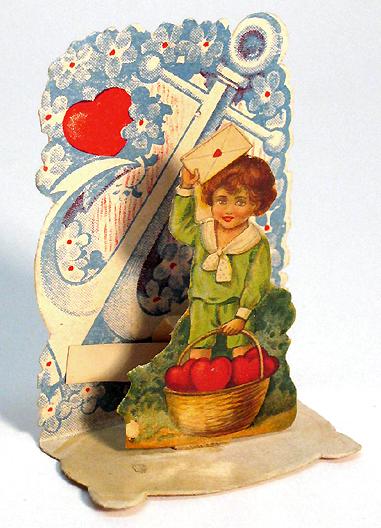 |
| A pop-up Valentine, c1920. |
The U.S. Greeting Card Association estimates that approximately 190 million valentines are sent each year in the USA. When you include the valentine-exchange cards made in school activities the figure goes up to 1 billion, and teachers become the people receiving the most valentines.
The rise of Internet popularity at the turn of the millennium is creating new traditions. Millions of people use, every year, digital means of creating and sending Valentine's Day greeting messages such as e-cards, love coupons or printable greeting cards. An estimated 15 million e-valentines were sent in 2010. Valentine's Day is considered by some to be a Hallmark holiday due to its commercialization.
*~*~*~*~*~*~*~*~*~*~*~*~*~*~*~*~*
The history of Valentine's Day — and its patron saints — are definitely shrouded in mystery. But we do know that February has long been a month of romance. In addition to the United States, Valentine's Day is celebrated in the United Kingdom, France, Australia, Canada and Mexico. Some East and Southeast Asian countries also celebrate a type of Valentine's Day known as the Qixi Festival and in Latin America the day of love is referred to as Día del Amor y la Amistad. Most all Islamic countries do not celebrate any type of Valentine's Day as they associate it with a Christian holiday and is harsly criticized by Islamic Teachers who see the celebrations as opposed to Islamic culture. St. Valentine's Day, as we know it today, contains vestiges of both Christian and ancient Roman tradition.
