Saturday, February 17, 2018

Islamic Apocalypse: 6 Things You Should Know

The following article was obtained from the Zwemer Center for Muslim Studies and written by Warren Larson.

Islamic Apocalypse: 6 Things You Should Know 

Related image1. Geography matters

An ancient prophecy quotes Muhammad as saying Dabiq (near Aleppo in Syria) will be where Islam defeats Christendom (Sahih-Muslim, Vol. 4, Ch. 41, 1501). Yet, only within the last year has ISIS linked that prophecy to its territorial ambitions, and even launched a digital publication under that name. This monthly magazine, filled with images of blood and gore, is a major means of recruitment. Though most Muslims reject such claims, the apocalyptic emphasis in Islam is only second in importance to tawhid (monotheism).

2. There Will be Signs and Wonders

Several Qur’anic verses describe the dramatic events leading up to “The Day”: “When the sun is folded up; when the stars fall, losing their luster" (81:1-2); “When the oceans are suffered to burst forth; and when the graves are turned upside down” (82:3-4); “What is the day of noise and clamor? … It is a day whereon men will be like moths scattered about and the mountains like carded wool” (56:4-6).

One Islamic website is entitled, “50 Signs of the Day of Judgment From the Words of Allah and His Messenger,” whereas a tradition mentions ten signs (Al-Muslim, Vol. 4, 1503f):

Thereupon he [Muhammad] said: “It will not come until you see ten signs before and (in this connection) he made mention of the smoke, Dajal [Anti-Christ], the beast, the rising of the sun from the west, the descent of Jesus son of Mary (Allah be pleased with him), the Gog and Magog, and land-slidings in three places, one in the east, one in the west and one in Arabia at the end of which fire would burn forth from the Yemen, and would drive people to the place of their assembly.

3. There Will be Moral Decay

Moral conditions at that time will be at an all-time low: “Narrated Anas Allah’s Apostle said, ‘From among the portents of the Hour are the following: Religious knowledge will be taken away by the death of religious learned men; Religious ignorance will prevail; Drinking of Alcoholic drinks will be very common; There will be prevalence of open illegal sexual intercourse’” (Al-Muslim, Vol. 4, 1503-1504).  And, “Women will increase in number and men will decrease in number so much so that fifty women will be looked after by one man  (Sahih al-Bukhari, Vol. 1, 68).  It is also said that musical instruments will precipitate much of the moral decay.

4. It Will be Terrifying

This is only one of many traditions describing the prevailing terror (Sahih al-Bukhari, Vol. 8, 354).

Narrated Abu Huraira, Allah’s Apostle said: “The people will sweat so profusely on the Day of Resurrection that their sweat will sink seventy cubits deep into the earth, and it will rise up till it reaches the people’s mouths and ears.”

If this isn’t bad enough, the most terrible moment will be when each person is handed a book of deeds done on earth, and these are then weighed upon a scale. The final obstacle is a bridge to be crossed–for al-Ghazali–the most frightful of all.  He referred to it as “The Traverse,” for it stretched over hell and was “sharper than a sword and thinner than a hair.”  The saved would cross over and enter the gates of paradise but the damned would slip off and be caught by the “angels of hell with their hooks and grapples.” (Al-Ghazzali: The Remembrance of Death and the Afterlife,  205-206).

5. Hellfire and Brimstone

Some Qur’anic verses seem to suggest no one will escape hell: “And for this did He create them: and the Word of thy Lord shall be fulfilled: “I will fill hell with jinns [spirits] and men all together” (11:119). And, “Not one of you but will pass over it; this is with thy Lord, a decree which must be accomplished”(19:71). Moreover, the  Hadith describes the extent to which people will suffer (Sahih al-Bukhari, Vol. 8, 368-369):

Narrated An-Nu man bin Bashir: “I heard the Prophet saying, ‘The least punished person of the hell fire on the Day of Resurrection will be a man under whose arch of the feet two smouldering embers will be placed, because of which his brain will boil just like Al-Mirajal (copper vessel) is boiling with water.”

6. Jesus has A Key Role

Muslim theologians often consider the return of Jesus to be the most significant event at that time (connected with eight of the fifty signs referred to above). When he returns he will slay the false Messiah (Anti-Christ, or dajjal), and establish peace and righteousness on earth. Qur’anic commentators usually link the this verse to Jesus: “And on the Day of Judgment He will be a witness against them” (Qur’an, 4:159).

Al-Bukhari  adds several other actions of Jesus (Vol. 3, 233-234).

Narrated Abu Huraira, Allah’s Apostle said, “By Him in whose hands my soul is, son of Mary, Jesus will shortly descend amongst you people (Muslims) as a just ruler and will break the cross and kill the pig and abolish the Jizya” (tax taken from the non-Muslims under the protection of the Muslim government).

For most Muslims, death and the grave speak of fear and uncertainty, whereas the Bible gives Christians ample assurance they can face the Judgment with confidence and hope. For example, “But we know that when he appears, we shall see him as he is.  Everyone who has this hope purifies himself, just as he is pure” (I John 3:2-3). We must, therefore, lovingly tell our Muslim friends that faith in Jesus as the crucified, risen and coming Messiah makes all the difference in this world–and the world to come.


Saturday, February 3, 2018

Ishmael and Isaac: The Sons of Abraham


Abraham, originally known as Abram, is the common patriarch of the three Abrahamic religions - Judaism, Christianity and Islam. In Judaism he is considered the founding father of the Covenant [or the special relationship between the Jewish people and God]; in Christianity, he is the prevalent prototype of all believers, Jewish or Gentile; and in Islam he is seen as a prevailing link in the chain of prophets that begins with Adam and culminates in Muhammad.  

When God changed a person's name and gave him a new name, it was usually to establish a new identity. God changed the name Abram [meaning "high father"] to “Abraham,” [meaning "father of a multitude"] (Genesis 17:5) and his wife's name from “Sarai,” [meaning “my princess,”] to “Sarah,” [meaning “mother of nations”] (Genesis 17:15–16).

According to the Jews, Christians, and Muslims, Ishmael was the firstborn son of Abraham and Sarah's handmaiden, Hagar. (Genesis 16:3-4). Most know the story of how Sarah grew impatient to bare the 'promised child' in her old age and insisted that Abraham take her Egyptian slave as a concubine to fulfill the Creator's promise to make Abraham a father of a great multitude. From the seed of this union would rise the modern Muslim nations.

In the Genesis account of the story:
"Seeing that Abraham shall surely become a great and mighty nation, and all the nations of the earth shall be blessed in him?" ~ Genesis 18:18
In the Qur'an, it states: 
"And remember that Abraham was tried by his Lord with certain commands, which he fulfilled: He said: "I will make thee an Imam to the Nations." He pleaded: "And also (Imams) from my offspring!" He answered: "But My Promise is not within the reach of evil-doers." (Surah Al-Baqara, 124)
The Book of Genesis and Islamic traditions consider Ishmael to be the ancestor of the Ishmaelites and patriarch of Qaydār. This is where the similarities stop between the Muslim, Jewish and Christian factions. According to Muslim tradition, many Islamic scholars portend the ancient Jews rewrote the holy scriptures of the Torah to state Isaac was the 'chosen' lineage to seal the Covenant with God, instead of Ishmael. Islam believes the Covenant was established exclusively with Ishmael, by way of his birthright as being the oldest son. 

In Judaism and Christianity, they disagree with the Islamic concept. They believe the sanctioned promise was given to Abraham and his wife, Sarah. In this aspect, Isaac also becomes a 'firstborn son'. From the seed of this union rose the modern Jewish nation. 


It is recorded in Genesis 17:19, the Covenant was established with Issac (Sarah's son), not Ishmael. But Abraham's oldest child was not forgotten by the Creator. In Genesis 17:20, God promised to make a great nation from Ishmael (Hagar's son) through 12 sons of his own. These sons, known as the 12 Tribes of Ishmael, include: Nebaioth, Kedar, Adbeel, Mibsam, Mishma, Dumah, Massa, Hadad, Tema, Jetur, Naphish, and Kedemah.


Another argument concerning the Ishmael and Issac debate is the "sacrifice of Abraham's son". While the Jews contend that Isaac was the one offered up for sacrifice by Abraham, the Muslims argue that it was Ishmael. 


The Encyclopedia Judaica, Volume 9, under the heading "Ishmael", describes:

"It is related that a renowned traditionalist of Jewish origin of the Qurayza tribe, and other Jewish scholars that converted to Islam, told Caliph Omar Abd al-Azizi (717-20) the Jews were well informed that Ishmael was the one bound for sacrifice, but they [the Jews] concealed this fact out of jealousy."
The strongest case for Ishmael is in the Qur'an, which decrees that directly after the sacrifice narrative, Abraham is told of the coming of Isaac's birth; therefore, it must be Ishmael who was about to be sacrificed if Isaac had not yet been born.

Since its beginnings Islam’s finest scholars have debated which son Abraham was commanded to sacrifice, yet both Judaism and Christianity host no such discussion. The reason for this is simple, the Torah names Isaac multiple times, while the Qur'an keeps the boy’s identity a secret. In the absence of a name Muslim scholars sought answers from those who walked with Muhammad. Incredibly, 38 of the companions of Muhammad confirm the Jewish narrative and are recorded as saying it was Isaac, not Ishmael, who became the sacrifice. 


In the Torah (Genesis 22:1–18)

"After these events, God tested Abraham. “Abraham!” He said. “Yes?”, “Take your son, your only one, whom you love – Isaac, and go away to the Moriah area. Bring him as a burnt offering on one of the mountains that I will designate to you”.
In the Quran (Suwar 39:99-113)
"And [then] he said, “Indeed, I will go to [where I am ordered by] my Lord; He will guide me. My Lord, grant me [a child] from among the righteous”. So We gave him good tidings of a forbearing boy. And when he reached with him [the age of] exertion, he said, “O my son, indeed I have seen in a dream that I [must] sacrifice you, so see what you think.”
So which view is authentic? Proving one opinion over the other is not as important as both views having a legitimate stance in both Jewish and Islamic traditions. And, modern Jews, Christians and Muslims may never come to terms with or agree upon the actual sacrifice and who was offered up to the Lord for a Covenant with their people. 

The only accepted and common narrative in the sacrifice story is that child sacrifice, which was a common practice during antiquity, was not an appropriate form of worshiping the Creator. Both the Jews and Muslims can agree on this.


Another thing Judaism and Christianity can agree upon is that both Ishmael and Isaac came to their father (Abraham) in his old age, right before his death. They stood united as brothers as they buried their father in the Cave of the Patriarchs [in modern-day Hebron, Palestine] (Genesis 25:8-9). For a moment in time, they presented one of the most fascinating stories of unity in the entire Bible/Tanakh.


Ishmael and his mother, Hagar, are said to be buried next to the Kaaba in Mecca (Saudi Arabia). According to the Genesis account, Ishmael died at the age of 137 (Genesis 25:17).


According to tradition, Isaac was buried in the Cave of the Patriarchs [in Canaan, present-day Hebron] at the age of 180. (Genesis 35:28-29)


Related Stories:

Abraham Sacrifices His Son
Chayei Sarah (5769) – On Judaism and Islam


Thursday, January 18, 2018

What's in a Name?

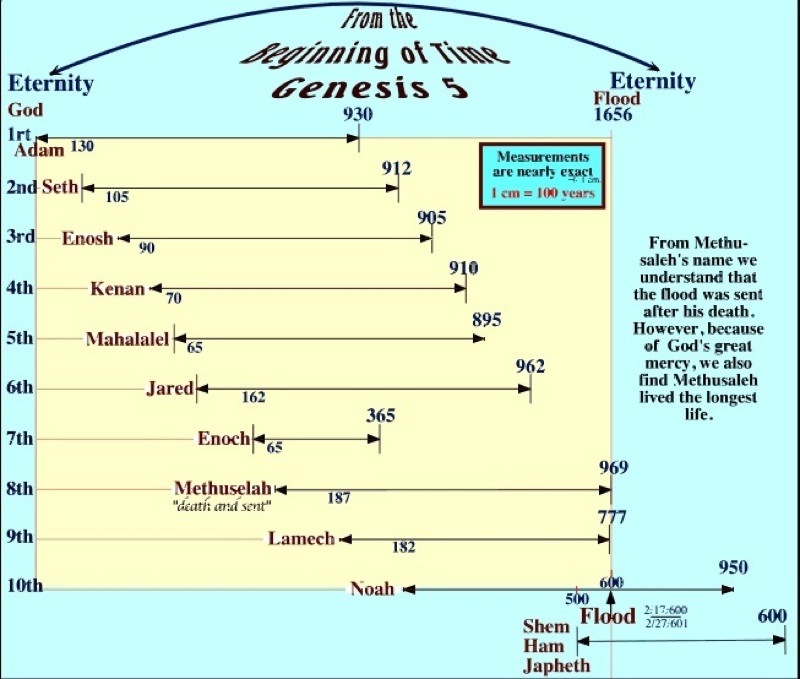
Some scholars of biblical studies have noted the ten generations from Adam to Noah, and the meaning of their names seem to be hiding a celestial message of sorts. While other biblical commentators brush it off as 'nonsense', many theologians question the significance of the cryptic story that seems to unfold as you read the name meanings in chronological order. It is a rather remarkable theory. 

Image result for lineage from adam to noah

Name                                                                                                        Meaning of Name

Adam --------------------------------------------------------------------------------------------- man
Seth -------------------------------------------------------------------------------------------  appointed
Enosh -------------------------------------------------------------------------------------------  mortal
Kenan ------------------------------------------------------------------------------------------- sorrow
Mahalalel --------------------------------------------------------------------------------- blessed God
Jared -------------------------------------------------------------------------------- shall come down
Enoch ----------------------------------------------------------------------------------------- teaching
Methusalah -------------------------------------------------------------------- his death shall bring
Lamech -------------------------------------------------------------------------------------  despairing
Noah ----------------------------------------------------------------------------------------------- rest

In reading the name meanings, the following sentences of doom emerge, "Man appointed mortal sorrow. Blessed God shall come down teaching. His death shall bring despairing rest."  Or it certainly appears a dark message of doom is hidden in the name meanings? Categorically, it seems the cryptic words indeed held a dire warning for the Pre-Flood world. 

While not many scholars have made mention of the name meanings from Noah to Jesus, this article will touch upon that subject and will include the known wives of these famous men mentioned in the Bible. Will there be a parallel to the names and their meanings like the first ten generations [of mankind] suggested to imply?

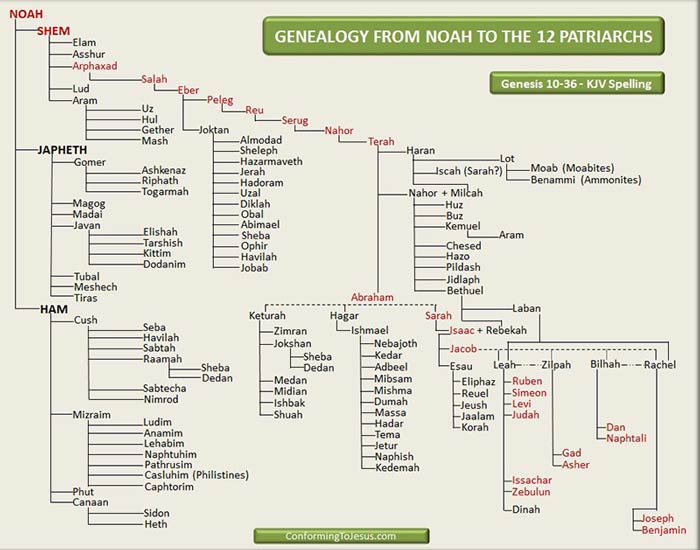
Bible Teachings - Genealogy Chart from Noah to the 12 Patriarchs. Descendants of Noah, Japheth, Shem, Ham, Abraham, Isaac and Jacob - ConformingToJesus.com

The following timeline of the patriarchs and matriarchs are based on the genealogy found in Matthew 1:1-16, which most biblical scholars believe is the lineage of Joseph, Jesus' earthly father.

Name                                                                                                        Meaning of Name

Abram ------------------------------------------------------------------------------------ high father 
[Abraham] ------------------------------------------------------------------------- many, multitude
      Sarai -------------------------------------------------------------------------------- my princess
     [Sarah] -----------------------------------------------------------  lady, princess, noblewoman
Isaac ----------------------------------------------------------------- he will laugh, he will rejoice
      Rebekeh -------------------------------------------------------------------------- join, tie, snare
Jacob -------------------------------------------------------------  holder of the heel or supplanter
[Israel] -------------------------------------------------------------------------------- God contended
      Leah ---------------------------------------------------------------------------------------- weary 
Judah -------------------------------------------------------------------------------------------- praise
      Daughter of Shua ---------------------------------------------------------------- Crying, saving
Perez ------------------------------------------------------------------------------ breach, burst forth
      Tamar-------------------------------------------------------------------- date palm or palm tree
Hezron ----------------------------------------------------------------------------- court or enclosure
Ram -----------------------------------------------------------------------------------------  exalted
Amminadab --------------------------------------------- my people/kinsman is generous/noble
Nahshon ----------------------------------------------------------- that foretells, that conjectures 
       Rehab ------------------------------------------------------------------ to be wide or spacious
Boaz ----------------------------------------------------------------------------------------- swiftness 
       Ruth ------------------------------------------------------------------------------------- friend
Obed ----------------------------------------------------------------------------- servant, worshipper
Jesse -------------------------------------------------------------------------------------------- gift
       Nitzevet (per the Talmud) ----------------------------------------------------- sound, healthy
David ----------------------------------------------------------------------------------------- beloved
       Bathsheba ----------------------------------------------------------------- daughter of the oath
Solomon --------------------------------------------------------------------------------------- peace
       Naamah --------------------------------------------------------------------------------- pleasant
Rehoboam ------------------------------------------------------------------  he enlarges the people
       Maacah -------------------------------------------------------- pressed down, worn, fastened
Abijah -------------------------------------------------------------------------- my father is Yahweh
       Annas -------------------------------------------------------------- One who answers; humble
Asa --------------------------------------------------------------------------------------------- healer
       Azubah --------------------------------------------------------------------------------- desolation
Jehoshaphat --------------------------------------------------------------------- Yahweh has judged
Joram -----------------------------------------------------------------------------  Jehovah is exalted
Uzziah ------------------------------------------------------------------------- my power is Yahweh
       Jerusha --------------------------------------------------- banished, possession, inheritance
Jotham ----------------------------------------------------------------------------- Yahweh is upright
Ahaz ------------------------------------------------------------------------------------------- has held
       Abijah ------------------------------------------------------------------- the Lord is my father
Hezekiah ----------------------------------------------------------------------- Yahweh strengthens
       Hephzibah -------------------------------------------------------------------- she is my delight
Manasseh -------------------------------------------------------------------------- causing to forget
       Meshullemeth ------------------------------------------------------- to be unbroken or whole
Amon -------------------------------------------------------------- secret; faithful; roaring stream
       Jedidah -----------------------------------------------------------------------------------  beloved
Josiah ------------------------------------------------------------------------------- Yahweh supports
       Zebudah -------------------------------------------------------------------- endowed, endowing
Jeconiah -------------------------------------------------------------------- established by Yahweh
Shealtiel ------------------------------------------------------------------------- I have asked of God
Here it is suggested by some scholars that Shealtiel died childless; his brother, Pedaiah, married Shealtiel's widow, hence the biological father of Zerrubabel is [Pedaiah] ----------------------------------------------------------------------------  redemption of the Lord
Zerubbabel -------------------------------------------------------------------------- seed of Babylon
Abiud -------------------------------------------------------------------------------- Father of praise
Eliakim -------------------------------------------------------------------------------------- God rises 
Azor ----------------------------------------------------------------------------- resurrection of God 
Zadok ---------------------------------------------------------------------------------------  righteous
Achim --------------------------------------------------------------- he whom Jehovah has set up
Eliud ------------------------------------------------------- God is grandeur or God is my praise
Eleazar ------------------------------------------------------------------------------- God has helped
Matthan ------------------------------------------------------------------- gift, or hope, of the Lord
      Esther (per Sextus Julius Africanus) ----------------------------------------------------- star 
Jacob-------------------------------------------------------------- holder of the heel or supplanter
Joseph ------------------------------------------------------------- may Jehovah add/give increase
      Mary ----------------------------------------------------------------------------- wished-for child
Jesus (Yeshua) ----------------------------------------------------------------- to rescue; to deliver 
who is called Christ -------------------------------------------------------------- the anointed one 
and Emmanuel ------------------------------------------------------------------------- God with us  

"So all the generations from Abraham to David are fourteen generations, from David until the captivity in Babylon are fourteen generations, and from the captivity in Babylon until the Christ are fourteen generations." ~ Matthew 1:17

Remarkably, it appears as if another celestial message develops throughout the name meanings listed in the Post-Flood world of the ancient patriarchs and matriarchs. From Abram to Perez the following sentences materialize, "[The] high father of many multitudes will laugh, he will rejoice.  [He will be a] supplanter; God contended. [Give] praise, [let it] burst forth." Likewise from Sarai to Tamar, "[His wife is a] princess and noblewoman. [She will] join, tie and snare. [Making] weary; crying. [Let us] save [the] palm tree." Palm trees were mentioned several places within the Bible, and its branches are usually symbols of victory and overcoming hardship. Whether you read the male and female names separately or read them consecutively, a story definitely unfolds that presents promises, warnings and instruction. 

"the mystery that has been kept hidden for ages and generations, but is now disclosed to the Lord's people." Colossians 1:26 (NIV)

     Image result for biblical chart - perez to jesus


Thursday, January 4, 2018

Birth Pains: The Beginning of Sorrows

"For nation shall rise against nation, and kingdom against kingdom: and there shall be earthquakes in divers places, and there shall be famines and troubles: these are the beginnings of sorrows." ~ Mark 13:8

Image result for world unrest 2018 statisticsIt is quite certain the first part of this particular bible verse is coming to fruition as there is so much unrest around the world today. Especially in the Middle East where fighting has been going on for decades (2 Chronicles 15:5). Then there is the North Korean conflict that is worrying many leaders around the world. That Kim Yong Un is threatening to "push the nuclear button" has many dignitaries scrambling to find a peaceful solution. 

And ISIS is one the most dominant renegade factions in the world today, killing anyone who gets in their way, including women and children (Isaiah 59:8). Even countries, such as America, France and Argentina are trying to find solutions to the civil unrest that is uprising in their nations. 

Image result for Birth Pains: The Beginning of SorrowsThe Christian Bible states that during the End Times there will be much turmoil in the world and Earth will be a testament to the events in the form of Mother Nature herself. We have wildfires spreading their destruction, earthquakes rumbling all around the globe, unprecentented hurricanes tearing up coastal cities and volcanoes that had lain dormant for hundreds of years coming to life. The prophets of the Old Testament were quite precise when talking about earthquakes during the End Times (Isaiah 24:18-20; Ezekiel 38:19,20; Joel 2:10(?); 3:16; Amos 9:5; Zechariah 14:4). The Roman Catholic priest, Padre Pio (who was born Francesco Forgione), was also quoted as stating that during the End Times the seasons would not know one another.
You will know when that time is approaching because the seasons will change so the only way you will know the seasons is by the leaves on the trees.” ~ Padre Pio
This quote comes from a translation of a copy of a personal letter written by Padre Pio and addressed to the Commission of Heroldsbach appointed by the Vatican that testifies to the truth and reality of these revelations on the "Three Days of Darkness" given by the Lord Creator to Padre Pio, a Capuchin priest who bore the stigmata.  
"Nation will rise against nation, and kingdom against kingdom. There will be famines and earthquakes in various places. All these are the beginning of birth pains." ~ Matthew 24:7-8 
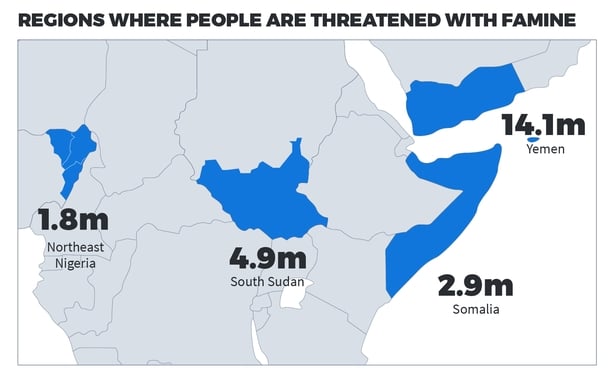
Image result for famineIn the last decade alone, famine has become a major concern around the globe like has never been seen before. (Jeremiah 8:13) According to a United Nations report conducted in 2017 there are over 20 million people suffering from famine, including an estimated 1.4 million children. 

While famine is being experienced in a number of nations around the world, the major countries that are being affected are northern Nigeria, Somalia, Yemen and South Sudan. Sadly, these famines are not being caused by natural disasters like crop failure or droughts, but rather are "man-made" -- the direct result of bloody wars and insurgencies that are raging in these countries. (Ezekiel 30:12)

Among holy scripture, one the most controversial and debated prophetic subjects is Matthew 24, which is also referred to as "The Olivet Discourse". The debate primarily revolves around the timing of the fullfillment of the prophecy. There are some scholars of religion that maintains the prophecies in the Apocalypse have already been fulfilled during the events that surrounded the destruction of Jerusalem in 70 A.D. 

Other theologians disagree and believe that Jesus was speaking about the "End Times", which was to happen in mankind's future, not during the dawning of a new epoch (changing from the B.C. era to the A.D. era). Then there are yet other biblical commentators that see some portions of the prophecy as having been fullfilled in 70 A.D. and other sections referring to the "End Times" that are to occur in the future. C.A. Carson, a brilliant biblical scholar, outlines the passage as follows:
vv. 4-14: General prophetic warnings for all of history.  
vv. 15-28: Prophecy concerning the events of 70 A.D. 
vv. 29-31: Prophecy concerning the second coming. 
vv. 32-35: Prophecy concerning the great tribulation. 
vv. 36-44: Timing here is unclear.
Most scholars and theologians of religion find Carson’s outline of the passage both confusing and confused, arguing Jesus meant the passage to be more literal than subjective. Yet this is what prophecy is made of - a race to unravel an understanding of the Creator's meaning of prophetic words. 

Related Topics:

Birth Pains are Increasing

Tracking the Birth Pangs

What the Bible Says About the Beginning of Birth Pains

Monday, December 18, 2017

What is the relationship between Jesus Christ and Santa Claus?


The following article was obtained from Quora.com and written by Jon Davis, American Southern Baptist.  

What is the relationship between Jesus Christ and Santa Claus?     


They are definitely related. 

So first let's talk Santa and why most people think he is just a big myth. One story I sadly remember is of my nephew. When he was three he informed us that Santa Claus wasn't real. His Neanderthal daddy told him that, (please read with a white trash accent) ”We don’t worship pagan symbols ’round here.” 


Well as the good uncle I sat my nephew down and reaffirmed to him that no, Santa Claus was not a pagan and he is indeed real.

At the very least he was indeed a real person. He actually did go by the name of Nicholas, his Greek name when he was a monk in the early Christian church around what is today Myra, Turkey. He lived in the 300′s and became famous for his great acts of charity. One story speaks of him giving dowries to three young, pious, impoverished girls so that they could be wed, and not go into other forms of lifestyle. Another speaks of him saving three wrongly prosecuted men from being put to death. For these and other reasons he was made a saint in the church. 

In his native home of Myra there is the first church dedicated to Saint Nicholas and many more have risen in Europe since the 7th century. Some historical accounts have him present at the Council of Nicaea which was convened to discuss the deity and co-eternality of Jesus as part of the Trinity–God the Father, Son, and Holy Spirit being co-equal. 

It is reported that as Arius asserted the heretical teaching that Jesus was less than God the Father, Nicholas became so agitated that he crossed the room and slapped Arius across the face! Not exactly the Santa we have grown to know, but from this we can assert that the real St. Nick upon whom our modern Santa Claus is based was an ardent defender of the orthodox view of Jesus Christ as fully God and fully man. 

He is also considered the patron saint of children and many others, like sailors (odd combo). His uniform is also of Christian decent as it is an evolution of the canonical robes worn by later Christian cardinals.

Add to this there is also the very real incorporation of some pagan elements. In many renditions he is seen as being a naturalist, hermit or general merry man. We can see these some of the pagan gods like Bacchus, the Roman god who was basically the party god. The reindeer are also reminiscent of the Norse god Odin. 

As Christianity spread, it absorbed the ideas and heroes of the people and cultures that came with it. Ironically, the real Nicholas himself participated in the most important meeting to ensure that this sort of thing did not happen to our understanding of Jesus and God, which he did well.

How all this turned into a strange man essentially breaking into the homes of little children to give presents in return for good deeds and tasty treats and an odd name change I can only guess, but I can promise you that Santa Claus is real. So be good for goodness sake.

So the relationship is that St. Nicholas was a Christian monk who worshiped Jesus. They both practiced and taught the importance of charity and forgiveness. He believed in Jesus and fought vehemently for the early Christian church to better understand him, even though today he is one of the most misunderstood characters in all of history.

Thanks for reading!

For more answers like this, check out The Modern Christian by Jon Davis.


Monday, December 4, 2017

What is the true meaning of Christmas?

The following article was obtained from the Christian Apologetics & Research Ministry website and written by Matt Slick.

~~~~~~~~~~~~~~~~~~~~~~~~~~~~~~~~~~~~~~~~~~~~~~~

The true meaning of Christmas is the celebration of the birth of Jesus who lived in Israel 2000 years ago and who died on the cross for our sins (1 Corinthians 15 1-4; 1 Peter 2:24). More specifically, when we use the word "meaning," we're talking about the purpose of his birth that Christmas is supposed to celebrate.  His purpose was to enter into the world and become one of us, that he might deliver us from our sins. Jesus is not just any man. He is God in flesh (John 1:1, 14; Colossians 2:9).  He is the second person of the Trinity who, by being born of the Virgin Mary, was made under the law (Galatians 4:4) and subject to the same temptations and limitations that we are. Christmas is the celebration of the historical event of where God entered into our world so that he might display the perfection and holiness of God and that through his work of living perfectly and also dying on the cross for our sins, that all who trust in him would be saved from the righteous judgment of God.
"For God so loved the world, that He gave His only begotten Son, that whoever believes in Him shall not perish, but have eternal life. For God did not send the Son into the world to judge the world, but that the world might be saved through Him," (John 3:16-17).
So, Christmas is supposed to be the time of year where we celebrate the birth of Christ. But, unfortunately, it's become a commercial holiday rather than a religious one. Is mostly known as a time for businesses to make money, for people to give gifts, for children to be excited, for parties, etc. The "reason for the season" is supposed to be Jesus, not gifts, not parties, and not watching "the big game."  Of course, having celebrations, attending parties, and watching the big game are not wrong. It's just that the meaning of Christmas is supposed to be a recognition of and appreciation of the birth of the one who loves us and died for in our place.
"Now the birth of Jesus Christ was as follows: when His mother Mary had been betrothed to Joseph, before they came together she was found to be with child by the Holy Spirit," (Matthew 1:18).
"Now in the sixth month the angel Gabriel was sent from God to a city in Galilee called Nazareth, to a virgin engaged to a man whose name was Joseph, of the descendants of David; and the virgin’s name was Mary. And coming in, he said to her, “Greetings, favored one! The Lord is with you.” But she was very perplexed at this statement, and kept pondering what kind of salutation this was. The angel said to her, “Do not be afraid, Mary; for you have found favor with God. “And behold, you will conceive in your womb and bear a son, and you shall name Him Jesus. “He will be great and will be called the Son of the Most High; and the Lord God will give Him the throne of His father David; and He will reign over the house of Jacob forever, and His kingdom will have no end," (Luke 1:26-33).
Jesus' birth place was prophesied in the Old Testament.
“But as for you, Bethlehem Ephrathah, too little to be among the clans of Judah, from you One will go forth for Me to be ruler in Israel. His goings forth are from long ago, from the days of eternity," (Micah 5:1-2).
Jesus' being born of a virgin was prophesied in the Old Testament.
"Therefore the Lord Himself will give you a sign: Behold, a virgin will be with child and bear a son, and she will call His name Immanuel," (Isaiah 7:14).
Jesus being God in flesh was prophesied in the Old Testament.
"For a child will be born to us, a son will be given to us; And the government will rest on His shoulders; And His name will be called Wonderful Counselor, Mighty God, Eternal Father, Prince of Peace," (Isaiah 9:6).
"I will pour out on the house of David and on the inhabitants of Jerusalem, the Spirit of grace and of supplication, so that they will look on Me whom they have pierced; and they will mourn for Him, as one mourns for an only son, and they will weep bitterly over Him like the bitter weeping over a firstborn," (Zechariah 12:10).
Jesus would be preceded by a great prophet was prophesied in the Old Testament.
A voice is calling, “Clear the way for the Lord in the wilderness; Make smooth in the desert a highway for our God," (Isaiah 40:3).
Jesus is the reason for the season. Jesus gives meaning to Christmas. Jesus who was God in flesh, perfect, pure, holy, and who died on the cross and rose from the dead, is the one who gives the true meaning to Christmas.