Sunday, January 27, 2019

Who's ? Right: Top 7 Old Testament Stories

While the Holy Bible's Old Testament is filled with a wide variety of collective stories, the following Top Seven narratives was chosen by the Who's ? Right blog to represent the most well known tales.

7 - Samson and Deliah ... 

Image result for samson and delilahSamson (Shimshon, in Hebrew) was a mighty judge who led and rescued the people of Israel from Philistine oppression. It is recorded in the Bible that Samson was the seventh judge. From the tribe of Dan, Samson was born to Moanoah and Zealphonis, in their old age, after they had been childless for many years. A Nazarite from birth, Samson was endowed by the Creator with herculean strength, which he used to fight the Philistines who were occupying the Land of Israel. He was a somewhat shy leader that took many matters into his own hands, preferring to deal with the Philistines himself, instead of asking his kinsmen for help. He is noted for killing a lion with his bare hands, killing 30 Philistines with the jawbone of that same lion, and taking Philistine wives; some Hebrews considered this an act of defiance, but Samson believed it was a wise political move.  Samson led the people for 20 years until he was betrayed by his second wife, Delilah, and captured by the Philistines. Learning that the source of his strength came from his long hair, Delilah was coerced into cutting the judge's hair. Later he was captured and blinded by gouging out his eyes. Calling upon his Hebrew god for forgiveness, Samson’s life ended when he was granted his remarkable strength one last time and knocked down the pillars supporting the building he had been taken to, killing himself and the thousands of Philistines inside. 

The story of Samson is recorded in the book of Judges, chapters 13-16.

6 - Jonah and the Whale ...

Image result for jonah whaleThis is the story of a reluctant prophet. Jonah, son of Amittai,  was an Israelite whom God had called to be a prophet but who refused to accept his divine mission of informing the people of Ninevah to repent of their sins. Not only was Nineveh known for its wickedness, but it was also the capital of the Assyrian empire, one of Israel's fiercest enemies. Instead, Jonah left on a sea voyage trying to escape the commandment of the Creator.  The Israelite god, seeing that Jonah was defecting, caused a great storm upon the sea. The sailors, realizing that Jonah's disobedience had caused the storm, hesitantly threw him overboard in an attempt to save their ship. Almost immediately the storm was calmed and Jonah was swallowed by a large fish; there he remained inside the belly of the whale for three days and three nights. While inside the great fish, Jonah himself repented and prayed to God in his affliction. On the third day the Creator commanded the whale, and it vomited the reluctant prophet onto dry land. This time Jonah obeyed his god. He walked through Nineveh proclaiming that in forty days the city would be destroyed. Surprisingly, the Ninevites believed Jonah's message and repented. The Israelite god had compassion on them and did not destroy them. Jonah became angry and questioned the god who had commanded him, asking why Israel's enemies had been spared. The story ends with God expressing concern even about the wicked. The purpose of this book is to show that the Creator is a merciful and gracious god. Although the wicked city of Nineveh deserved to be crushed immediately, God was patient towards them.

The story of Jonah and the whale is recorded in the book of Jonah, chapters 1-4.

5 -  David and Goliath ...

Image result for david and goliathDavid was the youngest of eight sons born to Jesse and descended from the tribe of Judah. For forty days and forty nights a Philistine giant known as Goliath taunted Saul, the king of Israel, daring his men to fight him and the winner would gain all the land of what later would become Judea. Saul's army was terrified of Goliath and all the warriors refused to volunteer their services of fighting the giant. When the Creator saw that the king of Israel was not obeying his commands to conquer the Philistine army, which included Goliath, the Israelite god asked the prophet Samuel to find a new king. David was chosen to be Saul's successor. David, a mere shepherd of his father's flock, was not intimidated by Goliath; he put all his faith in the Israelite god protecting him. Both sides of the impending armies were shocked when David accepted the challenge of fighting Goliath one-on-one. The giant thought this was a joke and accused King Saul of being weak. David did not find the situation amusing and proceeded to load a rock into a slingshot as Goliath moved to attack him. After a couple of rotations of the slingshot lassoing in circles, David let the rock fly from the sling and hit the giant between the eyes. Bringing the giant down, the young shepherd boy finished the battle by cutting off Goliath's head. David battling Goliath is one of the most striking scenes in the Bible. David thereupon became the greatest national hero of all the Israelite tribes; he would later go on to become the second king of Israel. 

The story of David and Goliath is recorded in the book of I Samuel, chapter 17.

4 -  Daniel in the Lion's Den ...
    
Image result for daniel in the lions denDaniel, whose lineage is somewhat sketchy in the Bible, was a notable prophet, who prospered during the reign of Darius and the reign of Cyrus the Persian. The narrative of Daniel in the lions' den tells how Daniel is raised to high office by his royal master Darius the Mede, but jealous rivals trick Darius into issuing a decree which condemns Daniel to death. Hoping for Daniel's deliverance, but unable to save him, the king has him cast into the pit of lions. At daybreak he hurries back, asking if God had saved his friend. Daniel replies that God had sent an angel to close the jaws of the lions, "because I was found blameless before him." The king has those who had conspired against Daniel, and their wives and children, thrown to the lions in his place, and commands to all the people of the whole world to "tremble and fear before the God of Daniel". It's interesting to note, the story of Daniel in the lions' den [in chapter 6] is paired with the tale of Shadrach, Meshach, and Abednego and the "fiery furnace" [in Daniel 3]. The parallels include the jealousy of non-Jews, an imperial edict requiring Jews to compromise their religion on pain of death, and divine deliverance. Each story climaxes with the king confessing the greatness of the God of the Jews and issuing an edict of royal protection. In each case life is preserved through divine presence in the fire or the pit.

The story of Daniel in the Lion's Den is recorded in the book of Daniel, chapter 6.

3 - Adam, Eve and the Garden of Eden ...
    
Image result for adam eve gardenThis story is commonly known to all three Abrahamic religions and all agree that Adam and Eve were the first historic people on the planet, created by a supreme being. These first humans were placed in a land that provided everything they needed to survive. This land was called the Garden of Eden. They were given free reign of this lush paradise and had only one rule to abide by... they were not to eat from a tree known as the Tree of Knowledge of Good and Evil. The newly formed humans were tricked into believing it was alright to eat from this forbidden tree by a serpent [snake] that suddenly appears out of nowhere! The snake is generally connected with Satan. Adam and Eve disobeyed the Creator and ate the forbidden fruit from the tree that was off-limits to them. As a result of their disobedience, this superior god evicted them from the Garden of Eden. Many Christians refer to this as the "original sin" that led to mankind's downfall, which has since produced many hardships. While the narrative is short, quick and to the point, it is one the most well-known stories of the Bible that leaves one wondering what really happened inside the Garden of Eden. It is interesting to note that the Garden of Eden has never been discovered by mankind unto this day.

The story of Adam, Eve & Garden of Eden is recorded in the book of Genesis, chap. 2.

2 - Moses and the Exodus ...
    
Image result for moses exodusMoses, who was the son of Amram and Yochebed of the tribe of Levi, is one of the most noteworthy characters in the Bible. His story begins when he is just an infant; his mother puts him in a basket and sets it afloat upon the Nile River to help him to escape from the slaughter of the Hebrew male children; the pharaoh of the time decreed and approved the killing of innocent children after learning that a powerful prophet would one day arrive and set his slaves free. Moses is found by the princess of Egypt and raised to manhood in the Pharaoh's palace. Skip ahead 40+ years and it is discovered that Moses could not handle watching the Hebrews being mistreated, having killed an Egyptian guard in defense of an Hebrew slave. He basically runs away to discard himself from Egypt's way of life. But the Creator had other plans for Moses. He was instructed to approach the pharaoh and demand that he let the enslaved gain their freedom. Moses was hesitant, but the Creator promised to be with him. Incorporating his brother [Aaron] to help him with this mission, they approach the pharaoh as instructed. When the pharaoh refused to set the people free, a series of supernatural events occurred. From the river turning to blood to the invasion of frogs and locusts, ten horrible plagues ensued. When the last plague happened, which killed all the firstborn sons of Egypt, the pharaoh finally relented and allowed the Hebrews (who would later become known as the Israelites) to gain their freedom. However, his agreement to set the slaves free did not last and the king pursued the captives to bring them back to Egypt. The most marvelous part of this story is when the Hebrews reached the Red Sea and thought themselves to be trapped until Moses was instructed to part the sea so the people could cross on dry land. With the Egyptians hot on their trail, the slaves were able to reach the other side of the sea safely; the Egyptians were not so lucky. When the last Hebrew slave was cleared from the sea, the Creator caused the waters of the deep to come crashing down upon the pursuers, thus killing the majority of the Pharaoh's army. Knowing he was defeated, the pharaoh of the exodus returned to Egypt. It was during this time that the Creator gave ten commandments for his people to follow.  Moses and his people would wander in the wilderness for 40 years before reaching the land that was promised to them. Sadly, Moses was not allowed to go into this promised land because he had disobeyed his god by catering to the wishes of the people he had saved. However, he was allowed to see the promise land before dying.

The story of Moses and the Exodus is recorded in the book of Exodus, chapters 2-40.

1 - Noah and the Great Flood ... 
     
Image result for noah floodThis is the most well-known story in the Bible and, besides the Abrahamic religions, almost all religions have heard this tale and even have narratives of their own about this great man named Noah. He was the son of Lamech and the tenth generation from Adam in the pre-flood world. When the Creator saw the wickedness of the people on the planet, he devised a plan which involved an unsuspecting Noah. The Lord who created everything came to Noah and instructed him to build a large boat. Finding this to be an odd request, Noah went ahead and erected the ark according to the specifications given unto him. Next he was instructed to collect a pair of animals [male and female], including birds and reptiles. Again obeying this command, Noah collected animals of all kinds and ushered them into the large boat. Whether he ever questioned the Creator or how the people reacted to him building this ark, it is not recorded in the Bible. Noah was 600 years old when his god sent forth rains that lasted 40 days and 40 nights, and thus flooded the entire world, killing everything on the planet as he had said He would do. They family of Noah remained upon the flood waters for 150 days. Three times Noah sent birds out of the ark to see if land was nearby. Twice the birds - the first one a raven, the second one a dove - came back to the ark. The third time, and seven days later, he sent out the dove again to which this time the bird returned with an olive branch in its beak. Again, Noah waited seven more days then sent the dove out again. This time the bird did not return to the ark. Knowing that land was nearby, he readied the family and animals for disembarking the boat. Noah was 601 years old when the ark landed on top on the mountains of Ararat. The Creator told Noah that his family needed to be fruitful and multiply to repopulate the world. After sacrificing a clean animal, as a means of thanking this god, the Creator made a covenant with Noah to never flood the world again. The result of this covenant, as well as a sign for mankind, is the rainbow we see in our skies today.

The story of Noah and the Ark is recorded in the book of Genesis, chapters 6-9.

Friday, January 4, 2019

The Prophet Muhammad and the Origins of Islam

The following article was obtained from www.metmuseum.org -

The rise of Islam is intrinsically linked with the Prophet Muhammad, believed by Muslims to be the last in a long line of prophets that includes Moses and Jesus. Because Muhammad was the chosen recipient and messenger of the word of God through the divine revelations, Muslims from all walks of life strive to follow his example. After the holy Qur'an, the sayings of the Prophet (hadith) and descriptions of his way of life (sunna) are the most important Muslim texts.

Early Life

Muhammad was born into the most powerful tribe in Mecca, the Quraysh, around 570 A.D. The power of the Quraish derived from their role as successful merchants. Several trade routes intersected at Mecca, allowing the Quraish to control trade along the west coast of Arabia, north to Syria, and south to Yemen.

Mecca was home to two widely venerated polytheistic cults whose gods were thought to protect its lucrative trade. After working for several years as a merchant, Muhammad was hired by Khadija, a wealthy widow, to ensure the safe passage of her caravans to Syria. They eventually married.

Divine Revelations

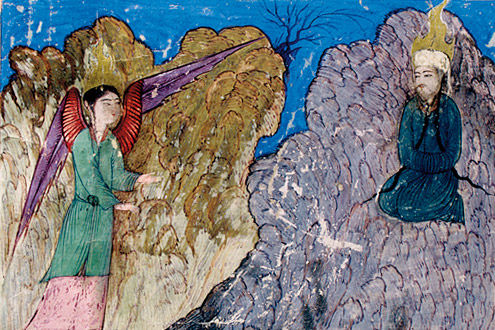
When he was roughly forty, Muhammad began having visions and hearing voices. Searching for clarity, he would sometimes meditate at Mount Hira, near Mecca. On one of these occasions, the Archangel Gabriel (Jibra'il in Arabic) appeared to him and instructed him to recite "in the name of [your] lord." This was the first of many revelations that became the basis of the Qur'an, the holy book of Islam. These early revelations pointed to the existence of a single God, contradicting the polytheistic beliefs of the pre-Islamic Arabian Peninsula.

Initially overwhelmed by the significance of what was being revealed to him, Muhammad found unflinching support in his wife and slowly began to attract followers. His strong monotheistic message angered many of the Meccan merchants. They were afraid that trade, which they believed was protected by the pagan gods, would suffer. From that point forward, Muhammad was ostracized in Mecca. For a time, the influence and status of his wife and his uncle, Abu Talib, the chief of the clan, protected Muhammad from persecution. After they died, however, Muhammad's situation in Mecca became dire.

The Hijra

Emigration became the only hope for Muhammad and his followers' survival. In 622, they headed to Medina, another oasis town, where they were promised freedom to practice their religion. The move from Mecca to Medina is known as the hijra—the flight—and marks year 1 of the Islamic, or hijri, calendar.

Spreading the Message of Islam

In Medina, Muhammad continued to receive divine revelations and built an ever-expanding community around the new faith. The conflict with the Quraish continued, but after several years of violent clashes, Mecca surrendered. Muhammad and his followers soon returned and took over the city, destroying all its pagan idols and spreading their belief in one God.

The Night Journey and Ascension of the Prophet

Accounts of the ascension (mi'raj ) of Muhammad have captured the imaginations of writers and painters for centuries. One night, while the Prophet was sleeping, the Archangel Gabriel came and led him on a journey. Mounted on the heavenly steed Buraq, Muhammad traveled from the Ka'bah in Mecca to the "Farthest Mosque," which Muslims believe to be the Al-Aqsa Mosque in Jerusalem. There he prayed with other prophets such as Moses, Abraham, and Jesus, and ascended to the skies, where he was led by Gabriel through Paradise and Hell, and finally came face to face with God. He then returned to earth to continue spreading the message of Islam. According to Islamic belief, Muhammad was the only person to see Heaven and Hell while still alive.

After the Prophet's Death: Emergence of Shi'i and Sunni Sects of Islam

When Muhammad died in 632, he had not named a successor. One faction, the Shi'a, believed that only individuals with direct lineage to the Prophet could guide the Muslim community righteously. They thought that 'Ali, Muhammad's closest surviving blood male relative, should be their next leader (caliph). The other faction, the Sunnis, believed that the Prophet's successor should be determined by consensus and successively elected three of his most trusted companions, commonly referred to as the Rightly Guided Caliphs (Abu Bakr, 'Umar, and 'Uthman), as leaders of the Muslim community; 'Ali succeeded them as the fourth caliph.

Today the Islamic community remains divided into Sunni and Shi'a branches. Sunnis revere all four caliphs, while Shi'as regard 'Ali as the first spiritual leader. The rift between these two factions has resulted in differences in worship as well as political and religious views. Sunnis are in the majority and occupy most of the Muslim world, while Shi'a populations are concentrated in Iran and Iraq, with sizeable numbers in Bahrain, Lebanon, Kuwait, Turkey, Pakistan, and Afghanistan.

Depictions of the Prophet Muhammad

Featured in this unit are several depictions of the Prophet Muhammad. These portrayals, while somewhat rare, are not unheard of as there were (and still are) many different attitudes toward depicting the Prophet, and humans in general, in the Islamic world. These attitudes varied dramatically from region to region and throughout history; the societies that produced the works discussed here are among those that allowed the depiction of the Prophet. Commissioned by Muslims for Muslims, these images appear in biographies of the Prophet and his family, world and local histories, and accounts of Muhammad's celestial journey (mi'raj), as well as in literary texts. In each context, they serve a distinct purpose. They illustrate a narrative in biographies and histories, while in literary texts they serve as visual analogues to written praises of the Prophet. An image of the Prophet Muhammad at the beginning of a book endows the volume with the highest form of blessing and sanctity. Thus, illustration of him was a common practice, particularly in the eastern regions of the Islamic world.

Muhammad's Call to Prophecy and the First Revelation: Folio from a manuscript of the Majma' al-Tavarikh
Depicted are Muhammad and the archangel Gabriel. c/1425 A.D. 

Saturday, December 15, 2018

Christmas Day and December 25th

 Why is Christmas Day on the 25th December? 

The following article comes from whychristmas.com ...

No one knows the actual birthdate of Jesus of Nazareth! No date is given in the Bible. So why do we celebrate it on the 25th December? The early Christians certainly had many arguments as to when it should be celebrated! The first recorded date of Christmas being celebrated on December 25th was in 336 A.D., during the time of the Roman Emperor Constantine (he was the first Christian Roman ruler). A few years later, Pope Julius I officially declared that the birth of Jesus would be celebrated on the 25th December.

However, there are many different traditions and theories as to why Christmas is celebrated on December 25th.

A very early Christian tradition states that the day when Mary was told that she would have a very special baby (Jesus) was on March 25th. Nine months after the 25th March is the 25th December! March 25th was also the day some early Christians thought the world had been made, and also the day that Jesus died on when he was an adult. The date of March 25th was chosen because people had calculated that was the day on which Jesus died as an adult (the 14th of Nisan in the Jewish calendar) and they thought that Jesus was born and had died on the same day of the year.

Some people also think that December 25th might have also been chosen because the Winter Solstice and the ancient pagan Roman midwinter festivals called 'Saturnalia' and 'Dies Natalis Solis Invicti' took place in December around this date - so it was a time when people already celebrated things.

The Winter Solstice is the day where there is the shortest time between the sun rising and the sun setting. It happens on December 21st or 22nd. To pagans this meant that the winter was over and spring was coming and they had a festival to celebrate it and worshipped the sun for winning over the darkness of winter. In Scandinavia, and some other parts of northern Europe, the Winter Solstice is known as Yule and is where we get Yule Logs from. In Eastern Europe the mid-winter festival is called Koleda.

The Roman Festival of Saturnalia took place between December 17th and 23rd and honoured the Roman god Saturn. Dies Natalis Solis Invicti means 'birthday of the unconquered sun' and was held on December 25th (when the Romans thought the Winter Solstice took place) and was the 'birthday' of the Pagan Sun god Mithra. In the pagan religion of Mithraism, the holy day was Sunday and is where get that word from!

The Roman emperor Aurelian created 'Sol Invictus' in 274. But there are records of early Christians connecting 14th Nisan to 25th March and so the 25th December go back to around 200!

The Jewish festival of Lights, Hanukkah starts on the 25th of Kislev (the month in the Jewish calendar that occurs at about the same time as December). Hanukkah celebrates when the Jewish people were able to re-dedicate and worship in their Temple, in Jerusalem, again following many years of not being allowed to practice their religion.

Jesus was a Jew, so this could be another reason that helped the early Church choose December the 25th for the date of Christmas!

Christmas had also been celebrated by the early Church on January 6th, when they also celebrated the Epiphany (which means the revelation that Jesus was God's son) and the Baptism of Jesus. Now Epiphany mainly celebrates the visit of the Wise Men to the baby Jesus, but back then it celebrated both things! Jesus's Baptism was originally seen as more important than his birth, as this was when he started his ministry. But soon people wanted a separate day to celebrate his birth.

Most of the world uses the 'Gregorian Calendar' implemented by Pope Gregory XIII in 1582. Before that the 'Roman' or Julian Calendar was used (named after Julius Caesar). The Gregorian calendar is more accurate than the Roman calendar which had too many days in a year! When the switch was made 10 days were lost, so that the day that followed the 4th October 1582 was 15th October 1582. In the UK the change of calendars was made in 1752. The day after 2nd September 1752 was 14th September 1752.

Many Orthodox and Coptic Churches still use the Julian Calendar and so celebrate Christmas on the 7th January (which is when December 25th would have been on the Julian calendar). And the Armenian Apostolic Church celebrates it on the 6th January! In some part of the UK, January 6th is still called 'Old Christmas' as this would have been the day that Christmas would have celebrated on, if the calendar hadn't been changed. Some people didn't want to use the new calendar as they thought it 'cheated' them out of 11 days!

Christians believe that Jesus is the light of the world, so the early Christians thought that this was the right time to celebrate the birth of Jesus. They also took over some of the customs from the Winter Solstice and gave them Christian meanings, like Holly, Mistletoe and even Christmas Carols!

St Augustine of Canterbury was the person who probably started the widespread celebration of Christmas in large parts of England by introducing Christianity to the regions run by the Anglo-Saxons in the 6th century (other Celtic parts of Britain were already Christian but there aren't many documents about if or how they celebrated the birth of Jesus). St Augustine of Canterbury was sent by Pope Gregory the Great in Rome and that church used the Roman Calendar, so western countries celebrate Christmas on the 25th December. Then people from Britain and Western Europe took Christmas on the 25th December all over the world!

So when was Jesus Born?

There's a strong and practical reason why Jesus might not have been born in the winter, but in the spring or the autumn! It can get very cold in the winter and it's unlikely that the shepherds would have been keeping sheep out on the hills (as those hills can get quite a lot of snow sometimes!).

During the spring (in March or April) there's a Jewish festival called 'Passover'. This festival remembers when the Jews had escaped from slavery in Egypt about 1500 years before Jesus was born. Lots of lambs would have been needed during the Passover Festival, to be sacrificed in the Temple in Jerusalem. Jews from all over the Roman Empire traveled to Jerusalem for the Passover Festival, so it would have been a good time for the Romans to take a census. Mary and Joseph went to Bethlehem for the census (Bethlehem is about six miles from Jerusalem).

In the autumn (in September or October) there's the Jewish festival of 'Sukkot' or 'The Feast of Tabernacles'. It's the festival that's mentioned the most times in the Bible! It is when Jewish people remember that they depended on God for all they had after they had escaped from Egypt and spent 40 years in the desert. It also celebrates the end of the harvest. During the festival, Jews live outside in temporary shelters (the word 'tabernacle' come from a Latin word meaning 'booth' or 'hut').

Many people who have studied the Bible, think that Sukkot would be a likely time for the birth of Jesus as it might fit with the description of there being 'no room in the inn'. It also would have been a good time to take the Roman Census as many Jews went to Jerusalem for the festival and they would have brought their own tents/shelters with them! (It wouldn't have been practical for Joseph and Mary to carry their own shelter as Mary was pregnant.)

The possibilities for the Star of Bethlehem seems to point either spring or autumn.

The possible dating of Jesus birth can also be taken from when Zechariah (who was married to Mary's cousin Elizabeth) was on duty in the Jewish Temple as a Priest and had an amazing experience. There is an excellent article on the dating of Christmas based on the dates of Zechariah's experience, on the blog of theologian, Ian Paul. With those dates, you get Jesus being born in September - which also fits with Sukkot!

The year that Jesus was born isn't known. The calendar system we have now was created in the 6th Century by a monk called Dionysius Exiguus. He was actually trying to create a better system for working out when Easter should be celebrated, based on a new calendar with the birth of Jesus being in the year 1. However, he made a mistake in his math and so got the possible year of Jesus' birth wrong!

Most scholars now think that Jesus was born between 2 BCE/BC and 7 BCE/BC, possibly in 4 BCE/BC. Before Dionysius's new calendars, years were normally dated from the reigns of Roman Emperors. The new calendar became more widely used from the 8th Century when the 'Venerable Bede of Northumbria' used it in his 'new' history book! There is no year '0'. Bede started dating things before the year 1 and used 1 BCE/BC as the first year before 1. At that time in Europe, the number 0 didn't exist in math - it only arrived in Europe in the 11th to 13th centuries!

So whenever you celebrate Christmas, remember that you're celebrating a real event that happened about 2000 years ago, that God sent his Son into the world as a Christmas present for everyone!

As well as Christmas and the solstice, there are some other festivals that are held in late December. Hanukkah is celebrated by Jews; and the festival of Kwanzaa is celebrated by some Africans and African Americans - takes place from December 26th to January 1st.


Sunday, December 2, 2018

History: The Hanukkah Story


The following article was obtained through ReformJudaism.org


Unlike many Jewish holidays, Hanukkah (also known as the Festival of Lights) is not mentioned in the Bible. The historical events upon which the celebration is based are recorded in Maccabees I and II, two books contained within a later collection of writings known as the Apocrypha. Although Hanukkah is considered a “minor” Jewish festival, today it ranks—along with Passover and Purim—as one of the most beloved Jewish family holidays.

In the year 168 B.C.E., the Syrian tyrant Antiochus Epiphanes sent his soldiers to Jerusalem. The Syrians desecrated the Temple, the holiest place for Jews at that time. Antiochus also abolished Judaism, outlawing the observance of Shabbat and the Festivals, as well as circumcision. Altars and idols were set up for the worship of Greek gods and he offered Jews two options: conversion or death.

On the 25th day of the Hebrew month of Kislev in 168 B.C.E., the Temple was renamed for the Greek god Zeus. A resistance movement— led by a priestly family known as the Hasmoneans, or Maccabees—developed against the cruelty of Antiochus. The head of the family was Mattathias, an elderly man. His son, Judah, became the chief strategist and military leader of the resistance. Though outnumbered, Judah Maccabee and his fighters miraculously won two major battles, routing the Syrians decisively.

Although historians debate the causes and outcomes of the war in which Judah Maccabee and his followers defeated the Syrian armies of Antiochus, there is no doubt that Hanukkah evokes stirring images of Jewish valor against overwhelming odds. Other themes rooted in the observance of the holiday include the refusal to submit to the religious demands of an empire practicing idolatry, the struggle against total assimilation into Hellenistic culture and loss of Jewish identity, and the fight for Jewish political autonomy and self-determination.

Hanukkah, which means “dedication,” is the festival that commemorates the purification and rededication of the Temple following the defilement caused by the Greeks during their occupation of that holy place. Today, the holiday reminds Jews to rededicate themselves to stand against forces that would destroy Judaism and to keep alive the flame of Jewish religion, culture, and peoplehood so that it may be passed on to the next generation.

Originally, the eight-day holiday was intended to parallel the eight-day festival of Sukkot. The Books of the Maccabees made no mention of the legend concerning a small jar of oil that unexpectedly lasted for eight days. Only centuries after the Maccabees’ defeat of the Syrians did the story of the jar of oil—which has come to be a part of Hanukkah—appear in the Talmud.

According to the legend, when the Maccabees entered the Temple and began to reclaim it from the Greeks, they immediately relit the ner tamid (eternal light), which burned constantly in the Temple and has a parallel in our synagogues to this day. In the Temple, they found a single jar of oil, which was sufficient for only one day. The messenger who was sent to secure additional oil took eight days to complete his mission, and miraculously, the single jar of oil continued to burn until his return. The rabbis of the Talmud attributed the eight days of Hanukkah to the miracle of this single jar of oil.  

Although the practice of lighting the menorah was common throughout much of the 19th century, North American Jews tended to neglect most of the other traditions and practices associated with the holiday. By the 1920s, however, Jews increasingly added gift-giving to their Hanukkah celebrations, prompting Christians to refer to Hanukkah as the "Jewish Christmas."

Like many aspects of Jewish religious practice, the transformation of Hanukkah was linked to the growth of North American Jewry within its unique environment. The elevation of Hanukkah to a major holiday was the result of Jews acculturating themselves to a North America that was overwhelmingly Christian in population and symbols.

Although Hanukkah had become an important holiday among North American Jews by the 1920s, it would be incorrect to regard it as an imitation of Christmas with an emphasis on the exchange of presents. Rather, North American Jews use this holiday as a celebration of family, reinforcing Jewish identity in a place whose population may be overwhelmingly Christian but in which Jews feel at home. Hanukkah, therefore, is a means for North American Jews to feel a kinship with their neighbors, while simultaneously asserting their Jewish distinctiveness.


Sunday, November 18, 2018

The Nonreligious (Agnostic/Atheist/Secular)

 "Despite voluminous study of religion, there has been very little direct research focusing on secular or nonreligious people and social forms. The idea of a social science of secularity or nonreligion is quite new. But what, actually, is the subject, and what should be the proper focus, content, and scope of such a field of study? Alternative approaches to the study of unbelief, irreligion, atheism, nonreligion, and secularity have been proposed in recent years. The strengths and weaknesses of each, particularly the study of nonreligion and secularity, are considered. The value of simultaneously pursuing multiple conceptions and approaches to the subject as this new field of study coalesces is proposed." (excerpt from The Study of Secularity and the Nonreligious by Phil Zuckerman, Luke W. Galen and Frank L. Pasquale)
Image result for non religiousThere term "non-religious" is not being associated or affiliated with any type of religion. 

When talking of mankind, non-religious [or: irreligious] would mean someone who does not belong to any religious domination. Unlike the atheist, the non-religious person can be a:
  • Theist - the belief in one God as the creator and ruler of the universe, without rejection of revelation.
  • Deist - belief in a God who created the world but has since remained indifferent to it. 
  • Pantheist - the doctrine that God is the transcendent reality of which the material universe and human beings are only manifestations: it involves a denial of God's personality and expresses a tendency to identify God and nature.
They need not be strictly secular, agnostic or atheist in this sense. However, most people associate the non-religious with such ideologies. According to a study, "as the ranks of the religiously unaffiliated continue to grow, they also describe themselves in increasingly secular terms," such as, "atheists," "agnostics," or "nothing in particular." Secular means "of or relating to the physical world and not the spiritual world" or just "not religious."

Agnostic is a position. That of not knowing if a god or gods exists. You can be agnostic theist, agnostic atheist, agnostic pantheist, agnostic deist, etc. Given the current lack of proofs for existence of, or against existence of god or gods, it is by far the most logical positions. Agnostics are those who haven't yet made a decision regarding God's existence; they are non-religious, but neither are they atheists. It means that non religious people might believe in God in future or they might remain as they are. Whereas Atheists have a conclusion that there is no God, an agnostic neither believes nor disbelieves in a god or religious doctrine. To complicate matters, atheists and agnostics are often confused with theists and deists. A theist is the opposite of an atheist. 

Atheist means someone who does not believe in any god, or someone who believes god does not exist. Both definitions work. First is logical; Second without proof is not. Its other counterparts are theists, deists, pantheists, etc. 

Here are seven of the most atheist countries in the world: 
  • China 
  • Japan 
  • Czech Republic 
  • France 
  • Norway 
  • Australia 
  • Iceland 

As far back as 1772, Baron d'Holbach said that "All children are born Atheists; they have no idea of God." Similarly, George H. Smith (1979) suggested that: "The man who is unacquainted with theism is an atheist because he does not believe in a god." According to sociologists Ariela Keysar and Juhem Navarro-Rivera's review of numerous global studies on atheism, there are 450 to 500 million positive atheists and agnostics worldwide (7% of the world's population), with China having the most atheists in the world (200 million convinced atheists).

Secular religion. ... Among systems that have been characterized as secular religions are capitalism, communism, anarchism, fascism, nationalism, Auguste Comte's Religion of Humanity and the Cult of Reason and Cult of the Supreme Being that developed after the French Revolution. Secularization refers to the declining influence of religion and religious values within a given culture. Secular humanism means, loosely, a belief in human self-sufficiency.

Secular things are not religious. Anything not affiliated with a church or faith can be called secular. Non-religious people can be called atheists or agnostics, but to describe things, activities, or attitudes that have nothing to do with religion, you can use the word secular.

Secularism in India means equal treatment of all religions by the state. With the 42nd Amendment of the Constitution of India enacted in 1976, the Preamble to the Constitution asserted that India is a secular nation. However, neither India's constitution nor its laws define the relationship between religion and state.

At the time the United States was founded, essentially all European nations had a state religion, and a monarch who ruled “by the grace of God,” or some similar formulation. When the United States chose not to enshrine a state religion, they became the original secular western nation. France, Germany, Italy, Spain, and many others would eventually follow this path of secularization, but they were following a trail originally blazed by the United States. 

A 2002 survey by Adherents.com estimates the proportion of the world's people who are "secular, non-religious, agnostics and atheists" at about 14%. According to Pew Research Center's 2012 global study of 230 countries and territories, 16% of the world's population is not affiliated with a religion, while 84% are affiliated.