Wednesday, October 14, 2015

Biblical Trees in the Garden

Trees have played a significant part in many of the world's religions, as well as mythologies and philosophies, and have been given various sacred meanings throughout the ages of mankind.

From Bereishit to Divrei HaYamim II in the Tanakh (Jewish Bible) and from Genesis to Revelation in the Christian Bible, the mention of trees are scattered throughout these ancient tomes. Trees are alluded to long before the creation of mankind and the trees in the Garden of Eden held a supreme importance, more than all other trees duly noted in the Holy Books.      
Tree of Life

The Tree of Life was one of two trees mentioned in the Book of Genesis as being located in the Garden of Eden. Not a lot of information is given about this tree other than the fact that it was sacred. The concept of a "tree of life" has been used in religion, philosophy and mythology. It suggests an interconnection of all life form on our planet and presented as a metaphor for common descent in the evolutionary sense. 

To the Ancient Egyptians, the Tree of Life represented the hierarchical chain of events that brought every thing into existence. The spheres of the Tree of Life demonstrate the order, process, and method of creation.

Christians view the tree as representing the immaculate state of humanity free from corruption and sin [before the "fall of mankind"]. In Judaism the 'tree' is associated with wisdom and calmness (Mishlei/Proverbs 3:13-18; 15:4). The non-canonical Book of Enoch states that in the time of the great judgment, God will give all those whose names are in the Book of Life fruit to eat from the Tree of Life. And, in Islamic literature the tree is referred to as the "Tree of Immortality", as alluded to in the Qur'an, Hadiths and Tafsir. However, unlike the biblical account [of the Christian], the Qur'an mentions only one tree in Eden which Allah specifically forbade Adam and Eve to eat from.

From figuratively being applied to the Torah itself to the Quranic symbolism of Adam disobeying Allah by eating from the sacred tree to the Christians ideology of the tree representing the "perfect man", the Tree of Life connects all three Abrahamic religions through its sacred branches.         
"Blessed are they that do his commandments, that they may have right to the tree of life, and may enter in through the gates into the city."~ Revelation 22:14                                                                          
Tree of Knowledge of Good and Evil

Image result for adam and eve in the garden of eden serpentThe Tree of the Knowledge of Good and Evil is the other tree mentioned in Bereishit/Genesis in the story of the Garden of Eden. According to Jewish tradition, the Tree of Knowledge [and the eating of its fruit] represents the beginning of good and evil together. Before the human expulsion from the Garden, the two were separate, and evil had only a indeterminate existence. While free choice did exist before eating the fruit, evil existed as an entity separate from the human psyche, and it was not in human nature to desire it. Eating and internalizing the forbidden fruit changed this and thus was born the Evil Inclination or Yeitzer Hara. In Rashi's notes on Bereishit/Genesis 3:3, the first sin came about because the woman (Eve) added an additional clause to the Divine command: Neither shall you touch it. By saying this, Eve added to the Creator's command and thereby came to detract from it, as it is written: "Do not add to His Words" (Mishlei/Proverbs 30:6).

In Christian theology, eating the fruit of the Tree of Knowledge of Good and Evil was the original sin committed by Adam and Eve that subsequently became known as the "Fall of Man" in Genesis 2-3.

In Catholicism, Augustine of Hippo taught that the sacred tree should be understood both symbolically and figuratively - similarly to Jerusalem being both a real city and a figure of Heavenly Jerusalem. Augustine underlined that the fruits of that tree were not evil by themselves, because everything that God created was good (Genesis 1:12). Instead, it was the disobedience of Adam and Eve, who had been told by the Creator not to eat from this particular tree (Genesis 2:17), which caused disorder in the order of creation, which resulted in humanity inheriting sin and guilt from Adam and Eve's transgression.

The Qur'an does not literally name this tree in its holy scriptures. It is only referred to as "the tree". Muslims believe that when Allah created Adam and Eve, He told them that they could enjoy everything in the Garden except for this certain tree. Then Satan appeared to them and told them that the only reason Allah forbade them to eat from that tree is that they would become Angels [or become immortals]. Adam and Eve were deceived and thus proceeded to eat the fruit.   
"And out of the ground made the Lord God to grow every tree that is pleasant to the sight, and good for food; the tree of life also in the midst of the garden, and the tree of knowledge of good and evil." ~ Genesis (Bereishit) 2:9                                                           
Image result for tree of lifeAccording to Encyclopedia Britannica, the Tree of Life (which connects all forms of creation) and the Tree of Knowledge (which connects heaven to the underworld) are both considered forms of the World TreeThese trees are portrayed in all three Abrahamic religions, as well as various other religions and are considered the same tree. There were various types of trees recognized in the Holy Canons and each held a special significance, but the trees in the Garden of Eden held a mysterious quality that other trees do not possess. 

The Tree of Life and the Tree of Knowledge of Good and Evil are immortalized in many cultural mythologies around the world. Human beings, observing the growth and death of trees and the annual death and revival of their foliage, have often seen them as powerful symbols of growth, death and rebirth. Evergreen trees, which predominately stay green throughout these cycles, are sometimes considered symbols of the eternal, immortality or fertility.
"Jesus continued, "Blessed is he who came into being before he came into being. If you become my disciples and listen to my words, these stones will minister to you. For there are five trees for you in Paradise which remain undisturbed summer and winter and whose leaves do not fall. Whoever becomes acquainted with them will not experience death." ~ Gospel of Judas 1:5                    

Sunday, October 4, 2015

Praying Through Music

The following article was written in 2011 by a renown professor at the University of Texas...

Praying Through Music: The History of Sacred Notation  
by Lorenzo Candelaria (Professor of Music History at The University of Texas at El Paso)


The musical arts of the Roman Catholic Church rank among its greatest contributions to contemporary culture. Music existed outside of the Church, of course. But it was the Catholic Church that first truly cultivated the art as we know it. In the service of praising God, it fostered a number of innovations -- such as musical notation -- that inform the ways we create and transmit music even today.

Take, for instance, the musical scale rendered in syllables as "do re mi fa sol la ti do." This arrangement of precise pitch relationships is the basis of a clever song in The Sound of Music ("Do -- a deer, a female deer. Re -- a drop of golden sun ... ") and, indeed, of virtually every piece of music that sounds "in tune" to the average ear in Western European and American cultures. These particular pitch relationships (and the idea of rendering them as syllables) were harnessed from all existing sound by a resourceful Benedictine monk named Guido of Arezzo in the early eleventh century. Guido's scale had only six notes (ut, re, mi, fa, sol, la) but with just a slight modification (changing "ut" to "do" in a later century) and the addition of "ti" (that brings us back to "do") the basic form remains unchanged nearly 1000 years later. So does its purpose. Then, as now, the scale served to help singers learn and recall a body of songs whose sheer quantity made them increasingly difficult to memorize and pass down.   

Guido's scale had a "sacred origin" of sorts; at least in terms of the context from which it was derived. The monk drew his inspiration for the musical scale he devised from a hymn sung on the feast of St. John the Baptist (Ut queant laxis) that suggested to him the pattern of ascending notes (and the relative pitches that occur between them) that we still use today. The specifics of how Guido got from "point A" to "point B" need not detain us here. (Although it is an interesting story!) Suffice it to say that any song written down with the basic musical scale Guido first devised nearly a millennium ago -- whether it is sung by a Benedictine monk, Julie Andrews, or Lady Gaga -- reflects just one aspect of the Catholic Church's great legacy of cultivating music in the service of God -- the invention of a musical staff with precise pitch arrangements that help us to create, perform, and remember most of the melodies we enjoy today -- inside the Church and out.  

It should not surprise us that music has been such a central concern for the Church. Indeed, praying through music allows us to express our highest calling -- to come together as a community to worship and praise God -- in a way that no other art can. Painting, sculpture, and architecture might spur us toward holiness, but none can unite us quite like music. This is particularly true of singing -- an art that invites group participation and can often arise spontaneously around a shared sentiment and a decent tune. 

Singing is a natural response in times of joy or mourning, stress or relaxation -- even in times of sheer boredom. It is universally accessible in that -- all aesthetic judgements aside -- if you can talk, you can sing. In the most general sense, we might think of singing merely as heightened speech: an inflection here, a thoughtful pause there, a lilting cadence to accentuate related ideas. Plot those inflections, pauses and cadences onto a graph indicating relative time and pitch (that is essentially what sheet music does) and heightened speech is transformed into song.   

St. Augustine was one of music's earliest eloquent proponents. (He is popularly credited with coining the phrase "He who sings, prays twice.") Today, Pope Benedict XVI, an accomplished pianist and brother of Msgr. Georg Ratzinger (former director of the Regensburg Cathedral Choir), has emerged as one of the most thoughtful commentators on sacred music since then. (I highly recommend his essay on music in The Spirit of the Liturgy, Ignatius Press, 2000.) In some recent remarks, Pope Benedict extended his advocacy of music beyond the realm of the sacred (strictly speaking), lauding it as a valuable tool in the educational process. Addressing the Fiesole Youth Orchestra after a concert in Vatican City last year, he praised the young musicians, noting their "constant practices carried out with patience; the exercise of listening to the other musicians; the commitment not to play 'in solitude'," but in a way that allowed the different orchestral colors to come together while maintaining their own characteristics. In fine, he praised their "common search for the best expression."    

The Holy Father was addressing a youth orchestra there, but his words resonate with the whole of humanity: Don't play alone. Come together. Listen to one another. Maintain your own characteristics in the common search for the best expression. Those are the basic rules for living in harmony -- an ideal for society that is rehearsed in our churches every Sunday, and never more so than when we come together as a community to pray through sacred song. Guido of Arezzo could not have foreseen the far-reaching consequences of the singing aids he devised in the eleventh century. But we can easily imagine that he would have been pleased. Laus Deo.


Friday, September 25, 2015

Religion of Gnosticism

Image result for gnostic symbolsGnosticism is a modern scholarly term for a set of religious beliefs and spiritual practices found among some of the early Christian groups called "gnostic" ("learned") by Irenaeus and other early Christian heresiologists. A common characteristic of some of these groups was the teaching that the realization of gnosis (intuitive knowledge), is the way to salvation of the soul from the material world. The Gnostics see the material world as created through an intermediary being (demiurge) rather than directly by God

Gnosticism was a prominent heretical movement of the early Christian Church [and partly of pre-Christian origin] during the 2nd century (A.D.). This doctrine taught that the world was created and ruled by a lesser god and that Jesus was an emissary oa remote supreme being owhom enabled the redemption othe human spirit. This supreme being is noted for having esoteric knowledge (gnosis).  The gnostics shun the material world and embrace the spiritual world.

While this religion does not have any specific founder, the following men are considered ancient Gnostic leaders: 
  • Simon Magnus - he interpreted the Garden of Eden, the exodus from Egypt and the crossing of the Red Sea as allegories.
  • Marcion of Sinope - he organized Gnostic congregations in the eastern Mediterranean which survived into the 3rd century (A.D.). He was excommunicated by the Christians leaders in Rome for writing the book, Antitheses; this book rejected the institution of marriage and claimed Jesus' death on the cross was just a hallucination since he did not have a physical body.
  • Valentinus - he was the founder of the largest and most influential school of Gnosticism that lasted until the 4th century (A.D.) and taught that groups of Aeons made up the "pleroma" (fullness) of the High God. They included depth, silence, mind, truth, word, life, wisdom, man and the Church. 
  • Carpocrates of Alexandria - he taught reincarnation, believing an individual had to live many lives and absorb experiences before returning to the supreme being. The practice of free sexuality was acceptable and he believed Jesus was the son of Joseph.
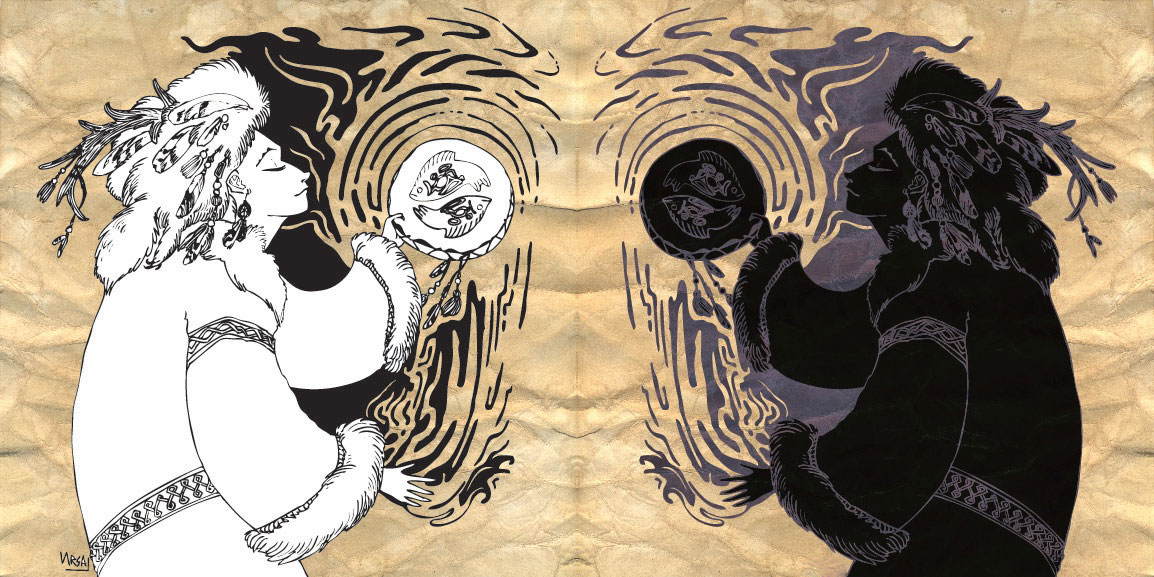
The Tambourines of Upper and 
Lower world by Obman-Veschestv
Many scholars define Gnosticism in a Christian context and other theologians predate it to include pre-Christian religious beliefs and spiritual practices. 

The debate changed radically with the discovery of the Nag Hammadi libraryThe Nag Hammadi library is a collection of Gnostic texts discovered near the Upper Egyptian town of Nag Hammadi in 1945; this discovery led to a revision of older assumptions. To date, no pre-Christian gnostic texts have been found, and gnosticism as a unique belief system is considered to be a 2nd century (A.D.) development.

The Nag Hummadi reveals a broad range of beliefs, including:
  • Their Role: They alone truly understood Jesus' message and all other thoughts within Christianity misinterpreted Christ's mission.
  • Gnosis: Knowledge had a redeeming and liberating function that helped an individual to break free from the bondage of the world.
  • Deity: Supreme God of Truth; remote from human affairs and created finite beings called Aeons. He/she created an inferior Creator-God [the demiurge] through one of his Aeons named Sophia (a virgin).
  • Duality of spirit and body: The spirit is of divine origin (good) and the body is earthly (evil).
  • Salvation: A person can attain salvation by learning the secret knowledge of their spiritual essence. They can escape from the prison of their bodies at death and reunite their soul with the supreme being.
  • Evil: The world is seen as being evil from the time of its origin, because it was created by an inferior god. The concept of 'original sin' is not accepted. 
  • Snake: Some Gnostic sects honor the snake and consider the viper to be a liberator who brought knowledge to Adam and Eve by convincing them to eat from the tree and become fully human.
  • Christ: The role of Jesus in Gnostic belief is heavily debated, although the majority of Gnostics look upon Jesus Christ as a revealer and liberator, rather than a savior or judge.
  •  The Universe: Is divided into three kingdoms... 1) Earthly Cosmos [center of the universe] surrounded by air and seven heavenly spheres (moon and planets). Within the spheres live demonic entities called Archons. Beyond this lies Paradise which contains the "Tree of Li]e", "Tree of Knowledge of Good and Evil", and the flaming sword of Genesis 3:24;  2) Intermediate Kingdom is composed of an inner blue circle of darkness and an outer yellow ring of light. Within these rings is a sphere which is the realm of Sophia. 3) Kingdom of God consists of two spheres: an outer sphere of the Supreme Being and, the inner ring of the Son (the demiurge).
Little is known about the antediluvian Gnostic practices as most ancient texts were destroyed during campaigns to suppress the movement. Although some of the ancient documents survived, there is little information included to extend upon how the group actually functioned.            


Painted by Gnostic
Saint William Blake in 1809
.
Some religious historians believe the Gnostics were mainly solitary practitioners and others were members of mainline Christian congregations. Theologians prescribe that most Gnostic texts were written by women and claim Mary Magdalene played an important role in many Gnostic gospels.

The Gnostics beginnings are etched in secrecy, but the modern day Gnostics hold fast to the idea that they have secret knowledge about the Supreme Being (God) that the general population of the world is unaware of. They are very tolerant of different faith groups within and outside of Gnosticism and have a lack of discrimination against women. The belief that salvation is achieved through relational knowledge that is obtained through experiential knowledge. 

Gnostic beliefs are currently experiencing a rebirth throughout the world, which was mainly due to the discovery of the ancient Gnostic library at Nag Hammadi in Egypt in the 1940s and finding the Gnostic Gospel of Judas at El Minya, Egypt in the 1970s. Today, the estimated total for the Gnostics is 20 million worldwide.

"He [Jesus] said, "Let him who seeks continue seeking until he finds. When he finds, he will become troubled. When he becomes troubled, he will become amazed, and he will rule over the All." Jesus concluded, "He who seeks will find; he who knocks will be let in." ~ Gospel of Judas 1:11-12


Monday, September 14, 2015

Rosh Hashanah, The Jewish New Year

The following article was written by Tracey R. Rich, author of the website, Judaism 101.

Rosh Hashanah Rosh Hashanah (in Hebrew)

Level: Basic
Significance: New Year
Observances: Sounding the shofar (ram's horn trumpet)
Length: 2 Days (Some: 1 Day)
Customs: Dipping apples in honey; Casting off "sins" into a river
Greeting: L'shanah tovah! (For a good year!)
...In the seventh month, on the first of the month, there shall be a sabbath for you, a remembrance with shofar blasts, a holy convocation. -Leviticus 16:24
Rosh Hashanah occurs on the first and second days of Tishri. In Hebrew, Rosh Hashanah means, literally, "head of the year" or "first of the year." Rosh Hashanah is commonly known as the Jewish New Year. This name is somewhat deceptive, because there is little similarity between Rosh Hashanah, one of the holiest days of the year, and the American midnight drinking bash and daytime football game.

There is, however, one important similarity between the Jewish New Year and the American one: Many Americans use the New Year as a time to plan a better life, making "resolutions." Likewise, the Jewish New Year is a time to begin introspection, looking back at the mistakes of the past year and planning the changes to make in the new year.  More on this concept at Days of Awe.

The name "Rosh Hashanah" is not used in the Bible to discuss this holiday. The Bible refers to the holiday as Yom Ha-Zikkaron (the day of remembrance) or Yom Teruah (the day of the sounding of the shofar). The holiday is instituted in Leviticus 23:24-25.
Shofar: Click to hear it blow!
The shofar is a ram's horn which is blown somewhat like a trumpet. One of the most important observances of this holiday is hearing the sounding of the shofar in the synagogue. A total of 100 notes are sounded each day. There are four different types of shofar notes: tekiah, a 3 second sustained note; shevarim, three 1-second notes rising in tone, teruah, a series of short, staccato notes extending over a period of about 3 seconds; and tekiah gedolah (literally, "big tekiah"), the final blast in a set, which lasts (I think) 10 seconds minimum. Click the shofar above to hear an approximation of the sound of Tekiah Shevarim-Teruah Tekiah. The Bible gives no specific reason for this practice. One that has been suggested is that the shofar's sound is a call to repentance. The shofar is not blown if the holiday falls on Shabbat.

No work is permitted on Rosh Hashanah. Much of the day is spent in synagogue, where the regular daily liturgy is somewhat expanded. In fact, there is a special prayerbook called the machzor used for Rosh Hashanah andYom Kippur because of the extensive liturgical changes for these holidays.

Another popular observance during this holiday is eating apples dipped in honey, a symbol of our wish for a sweet new year. This was the second Jewish religious practice I was ever exposed to (the first one: lighting Chanukkah candles), and I highly recommend it. It's yummy. We also dip bread in honey (instead of the usual practice of sprinkling salt on it) at this time of year for the same reason.

Another popular practice of the holiday is Tashlikh ("casting off"). We walk to flowing water, such as a creek or river, on the afternoon of the first day and empty our pockets into the river, symbolically casting off our sins. Small pieces of bread are commonly put in the pocket to cast off. This practice is not discussed in the Bible, but is a long-standing custom. Tashlikh is normally observed on the afternoon of the first day, before afternoon services. When the first day occurs on Shabbat, many synagogues observe Tashlikh on Sunday afternoon, to avoid carrying (the bread) on Shabbat.

Religious services for the holiday focus on the concept of G-d's sovereignty. 

The common greeting at this time is L'shanah tovah ("for a good year"). This is a shortening of "L'shanah tovah tikatev v'taihatem" (or to women, "L'shanah tovah tikatevi v'taihatemi"), which means "May you be inscribed and sealed for a good year." More on that concept at Days of Awe.

You may notice that the Bible speaks of Rosh Hashanah as occurring on the first day of the seventh month. The first month of the Jewish calendar is Nissan, occurring in March and April. Why, then, does the Jewish "new year" occur in Tishri, the seventh month?

Judaism has several different "new years," a concept which may seem strange at first, but think of it this way: the American "new year" starts in January, but the new "school year" starts in September, and many businesses have "fiscal years" that start at various times of the year. In Judaism, Nissan 1 is the new year for the purpose of counting the reign of kings and months on the calendar, Elul 1 (in August) is the new year for the tithing of animals, Shevat 15 (in February) is the new year for trees (determining when first fruits can be eaten, etc.), and Tishri 1 (Rosh Hashanah) is the new year for years (when we increase the year number. Sabbatical and Jubilee years begin at this time).

See Extra Day of Jewish Holidays for an explanation of why this holiday is celebrated for two days instead of the one specified in the Bible.

List of Dates


Rosh Hashanah will occur on the following days of the secular calendar:
  • Jewish Year 5776: sunset September 13, 2015-nightfall September 15, 2015
  • Jewish Year 5777: sunset October 2, 2016 - nightfall October 4, 2016
  • Jewish Year 5778: sunset September 20, 2017-nightfall September 22, 2017
  • Jewish Year 5779: sunset September 9, 2018 - nightfall September 11, 2018
  • Jewish Year 5780: sunset September 29, 2019 - nightfall October 1, 2019
For additional holiday dates, see Links to Jewish Calendars.


Saturday, September 5, 2015

The Prophet Hosea

Hosea was one of the minor prophets of ancient Israel, who was commonly accepted [among the scholars] as being born in the Northern Kingdom; his predictions soared in the 8th century B.C.  Among the many biblical scholars and theologians, he is called the "Prophet of Divine Love". Chronologically, Hosea came after the Prophet Amos and was a contemporary with the Prophet Isaiah. 

While Isaiah was endlessly prophesying at Jerusalem (in the Southern Kingdom), Hosea was baring faithful testimony to a corrupt Israel (in the Northern Kingdom). The Prophet Jeremiah would later become to Judah what Hosea had become to Israel. The message of this prophet held a warning and condemned the people for their idolatry and sins. 

According to the Abrahamic religions, Hosea was the son of Beeri [who was also considered a prophet in Judaism]. He is considered one of the 12 prophets of the Tanakh, one of the Minor Prophets in the Christian Bible and an honorable prophet in the Qur'an.

The Jewish Talmud (Pesachim 87a) claims that Hosea was the greatest prophet of his generation and the only messenger (of his own time) who left any type of written documentation. His prophesying span over 60 years and delivered his message of destruction mainly to the Northern Kingdom of ancient Israel. He was known as one of the "prophets of doom", but underneath his dismal message also held a promise of restoration. 

In Christian tradition, Hosea was represented comparing the relations of Israel to God with that of a wife to her husband and the defection of the Israelites with a wife's adultery. The ancient prophet used his own experience as a symbolic representation of God and Israel: God the husband; Israel the wife. According to the Book of Hosea, the prophet married a prostitute named Gomer, the daughter of Diblaim (maternal lineage), at the command of the God (Hosea 1:2). While she left him to "go with other men" (likewise, Israel left their God to go with false idols), Hosea always searched for Gomer and brought her back home (likewise, God would not abandon Israel and brought them back even though they had foresaken Him).

According to Islamic literature, only some of the Hebrew prophets are acknowledged in the Qur'an, but makes it abundantly clear that many others were sent that are not mentioned. Many Muslim scholars agree that Hosea was one of the true Hebrew prophets of ancient Israel. Such classical theologians as Ibn Ishaq and modern scholars as Reza Aslan hold fast to this belief. The Book of Hosea has also been used in Quranic interpretation by Abdullah Yusuf Ali, especially in reference to the Quranic verses which speak of the "backsliding of Israel".

Image result for hoseaWhile little is known about the life or social status of Hosea, it is recorded in his prophetic book where the wars were referenced, which led to the capture of the kingdom by the Assyrians (ca. 730-720 BC). 

It is not certain if he had also experienced the destruction of Samaria, which was foreseen in Hosea 14:1, but many theologians and scholars deem that he was there during the warring conflict. 

The Book of Hosea was a severe warning to the Northern Kingdom against the growing idolatry being practiced there; this ancient book was a dramatic call to repentance.

Today, the Prophet Hosea is still widely known to the world and many of the Abrahamic religions have festive observances in his honor. Hosea's tomb is purported to be located in the Jewish cemetery of Safed, which is believed to be the final resting place of this antediluvian prophet.