Saturday, August 17, 2019

Religions and Beliefs

"Religion can be explained as a set of beliefs concerning the cause, nature, and purpose of the universe, especially when considered as the creation of a superhuman agency or agencies, usually involving devotional and ritual observances, and often containing a moral code governing the conduct of human affairs." ~ BBC: Religions and Beliefs


Featured Religions and Beliefs:
  • Atheism

    Atheists are people who believe that god or gods are man-made constructs.
  • Baha'i

    One of the youngest of the world's major religions.
  • Buddhism

    A way of living based on the teachings of Siddhartha Gautama.

  • Candomblé

    A religion based on African beliefs, originating in Brazil.
  • Christianity

    The world's biggest faith, based on the teaching of Jesus Christ.
  • Hinduism

    A group of faiths rooted in the religious ideas of India.

  • Islam

    Revealed in its final form by the Prophet Muhammad.
  • Jainism

    An ancient philosophy and ethical teaching that originated in India.
  • Jehovah's Witnesses

    A Christian-based evangelistic religious movement.

  • Judaism

    Based around the Jewish people's covenant relationship with God.

  • Mormonism

    The Church of Jesus Christ of Latter-day Saints.
  • Paganism

    Contemporary religions usually based on reverence for nature.
  • Rastafari

    A young religion founded in Jamaica in the 1930s.
  • Santeria

    Afro-Caribbean syncretic religion originating in Cuba.
  • Shinto

    Japanese folk tradition and ritual with no founder or single sacred scripture.

  • Sikhism

    The religion founded by Guru Nanak in India in the 15th Century CE.
  • Spiritualism

    Spiritualists believe in communication with the spirits of people who have died.

  • Taoism

    An ancient tradition of philosophy and belief rooted in Chinese worldview.
  • Unitarianism

    An open-minded and individualistic approach to religion.
  • Zoroastrianism

    One of the oldest monotheistic faiths, founded by the Prophet Zoroaster.


Friday, August 9, 2019

The Apocrypha

According to most scholars, Apocrypha literature is mostly written works of unknown authorship, as well as doubtful origin; other educators claim some of the written literature has been declared authentic and the authorship is known, such as the Books of Maccabees. While a few of these ancient writings are of doubtful authenticity, some are widely circulated as being true.

The Apocrypha, which means, "hidden books" is a collection of 14 Jewish texts written somewhere around the 5th to 1st centuries B.C. These hidden books were included in the Greek translation of the Hebrew Bible (Septuagint) and in the early Christian Bible, such as Latin Vulgate, until the Reformation of the 16th century A.D.

When referring to biblical apocrypha, one is referring to a set of texts in the Latin Vulgate and the Septuagint, but not contained within the Hebrew Bible (Tanakh). The Catholic Church accepted these books [formally] in conjunction with the Holy Bible around the mid-16th century A.D. However, in 1534 Martin Luther (founder of the Protestant Reformation) published apocrypha literature as a separate intertestamental section, which was not included as Scripture in the Holy Bible. Amid much controversy of the day, it was the first time apocrypha literature had been published as a separate biblical composition. This caused much contention for the early Christian Church fathers; today, the Apocrypha is still an inclusive part of the Holy Bible for Catholics, Anglicans and Lutherans. Even unto this modern 21st century, these apocryphal texts continue to evoke disagreements about biblical canonicity. The following excerpt comes from Wikipedia.com:

"The term "Apocrypha" commonly appears in Christian religious contexts concerning disagreements about biblical canonicity. Apocryphal writings are a class of documents rejected by some as being either pseudepigraphical or unworthy to be properly called Scripture, though, as with other writings, they may sometimes be referenced for support, such as the lost Book of Jasher. While writings that are now accepted by Christians as Scripture were recognized as being such by various believers early on, the establishment of a largely settled uniform canon was a process of centuries, and what the term "canon" (as well as "apocrypha") precisely meant also saw development. The canonical process took place with believers recognizing writings as being inspired by God from known or accepted origins, subsequently being followed by official affirmation of what had become largely established through the study and debate of the writings. The Catholic Church provided its first dogmatic definition of its entire canon in 1546, which put a stop to doubts and disagreements about the status of the Apocrypha. The leader of the Protestant Reformation, Martin Luther, like the Catholic Church father Jerome (and certain others), favored the Masoretic canon for the Old Testament, excluding apocryphal books in his non-binding canon as unworthy to be properly called Scripture, but included most of them in a separate section, as per Jerome. Luther did not include the deuterocanonical books in his Old Testament, terming them "Apocrypha, that are books which are not considered equal to the Holy Scriptures, but are useful and good to read."
The King James Bible, which followed the ideologies of the Geneva Bible of 1560, was first published in 1611 and included the Apocrypha, though separately to denote the literature as not equal to Scripture, as noted by Jerome in the Vulgate, which he gave the name "The Apocrypha". However, the deuterocanonical books were officially removed from the King James Bible with the advent of the Revised Standard Version Bible in 1885. The English Bible Societies, whom had been in an "Apocrypha controversy" since the early 1800s, flooded the bible-buying market with a more Protestant Bible during 1885 and successfully had the deuterocanonical texts eliminated.

The King James Version of 1611 included the following apocryphal books:

1 Esdras (Vulgate 3 Esdras) - This is the Greek version of, and in some parts a reconstruction of the canonical Book of Ezra. It was written about 100 B.C. Some of the subject matter added is from the book of Nehemiah.

2 Esdras (Vulgate 4 Esdras) - This book is an apocalypse, especially chapters 3-14. It is composite in origin, dating from 65 B.C. to 120 A.D. The value of the book lies in the fact that it focuses heavily on the period of Jewish thought surrounding the fall of Jerusalem in 70 A.D. The views it expresses on eschatology are closely allied to the teachings of the New Testament.

Tobit - The Book of Tobit, a work of fiction, was very popular among Jews and early Christians. It is a story of romance and legend from the Jewish Dispersion in Egypt. It was written in the 3rd century B.C., and was based upon two well-known Egyptian stories. The purpose of this book was to teach useful lessons, and at the same time correct some of the then-current superstitions. It features prominently the angel Raphael.

Judith ("Judeth" in Geneva Bible) - The Book of Judith relates a story of victory won by the chosen people over its enemies, thanks to the intervention of a woman. It is a legendary tale of a Jewish widow reminiscent of 'Joan of Ark' who succeeds in outwitting and finally slaying a great Assyrian general, thus bringing deliverance to her oppressed people. It was written in Palestine during the latter half of the 2nd century B.C., probably by a Pharisee

Additions of Esther (Vulgate Esther 10:4 – 16:24) - This work, written about 100 B.C., consists of a number of additions to the Biblical book of Esther. The additions were added for detail and to make up for some of the spiritual deficiencies of the canonical book. The added verses greatly enhance the apocalyptic nature of the story and bring enormous symbolic understanding to it, dramatically enhancing its relationship to God. It is replete with dragons, and images easily reminiscent of the most important tenants and personages involved in the last-day warfare between Satan and Christ. The symbolism it brings to the Book of Esther is powerful prophecy.

Wisdom of Solomon - In many respects this is one of the most valuable books of the entire Apocrypha. It was written by a Jew of the Dispersion about 65 B.C. It is similar to the Wisdom Books of the Old Testament. It was written especially to combat the materialistic tendencies of the canonical book of Ecclesiastes. Filled with stunning prophecy and replete with the powerful and spiritual essence of God, this book is also sometimes referred to as the 'Wisdom of Solomon'.

Ecclesiasticus (also known as Sirach) - This book, written about 180 B.C., contains proverbs and practical observations of life two centuries before the birth of Christ. The work closely resembles the Wisdom Literature of the Old Testament. It represents one of the most valuable records of early Rabbinical thought. It was translated into Greek in 132 B.C. by a grandson of the author (Jesus ben Sira)

Baruch and the Epistle of Jeremy ("Jeremiah" in Geneva Bible) (all part of Vulgate Baruch) - The greater part of this book was written in the 1st century A.D. under the assumed name of Baruch, the private secretary of Jeremiah. The 6th chapter is known as the Epistle of Jeremiah. Both books contain a series of exhortations, encouragements and severe denunciations.

Song of the Three Holy Children (Vulgate Daniel 3:24–90) - This addition to the Book of Daniel was written about 100 B.C. and was found inserted in his book, in the third chapter, right after the 23rd verse.

Story of Susanna (Vulgate Daniel 13) - This is another 1st century B.C. addition to the book of Daniel. It is generally found prefixed to the book. The purpose of the story is to magnify Daniel's powers and the judgment.

Bel and the Dragon (Vulgate Daniel 14) - Written about 100 B.C., this story reveals Daniel's wisdom in exposing the falsehood of idolatry and those who promote it. The book also reveals the existence in Babylon of a dragon-god. Information about this idol is available from no other source, but it is particularly relevant in light of dragon prophecies relative to the last days, scattered throughout the scriptures.

Prayer of Manasses (Daniel) - This work dates from the first century B.C. It was intended to be used in connection with the story of Manasseh's Babylonian captivity (2 Chron. 33). Parts of the Prayer have found their way into Protestant liturgy.

1 Maccabees - First Maccabees, written by a Jew in Palestine during the latter part of the 2nd century B.C., is perhaps the best historical source on the period from 175 to 135 B.C. Well written, it reveals deep insight into the root causes of the Maccabean rebellion and details the rebellion itself down to the death of Simon in 135 B.C. This book is essential to both Christians and Jews. It gives detailed information relative to Antiochus Epiphanes and his desecration of the Jerusalem Temple, an action which Jesus said would be repeated at the time of the end. The book also contains a wealth of details relative to the Jewish feast of Hannukah (which celebrates the re-dedication of the Temple Antiochus debased). That information is available from no other source, Jewish or otherwise, and without it there would be no Hannukah celebration.

2 Maccabees - Unlike the first Book of the Maccabees, this work is a combination of history and fiction. It seems to be less useful than the first. It is an abridgment of a far more extensive work in existence at the time of its writing in the latter part of the 2nd century B.C, It presents information about the period leading up to the rebellion of the Maccabees under Mattathias in Modein and follows it down to 161 B.C.

Today, the Catholic Church believes the Apocrypha are not only important deuteronanonical books, but are the "lost books of the Bible", while the Protestants heartily disagree with such a summation. The only question left is ... Who's ? Right.


For Related Reading, please visit:


Sunday, July 21, 2019

The Devil's Bible

The Devil's Bible, also referred to as the Codex Gigas, is an ancient book with quite a history. The following description comes from Wikipedia.com:
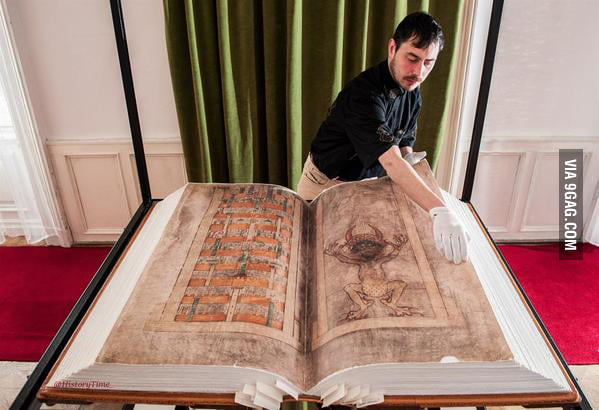
Image result for devil's bibleThe Codex Gigas (English:Giant Book) is the largest extant medieval illuminated manuscript in the world, at a length of 92 cm (36 in). 
It is also known as the Devil's Bible because of a very unusual full-page portrait of the devil, and the legend surrounding its creation. It was created in the early 13th century in the Benedictine monastery of Podlažice in Bohemia, which is a region in the modern-day Czech Republic. 
It contains the complete Vulgate Bible as well as other popular works, all written in Latin. Between the Old and New Testaments are a selection of other popular medieval reference works: Josephus's Antiquities of the Jews and De bello iudaico, Isidore of Seville's encyclopedia Etymologiae, the chronicle of Cosmas of Prague, and medical works; these are an early version of the Ars medicinae compilation of treatises, and two books by Constantine the African. 
Eventually finding its way to the imperial library of Rudolf II in Prague, the entire collection was taken as spoils of war by the Swedish in 1648 during the Thirty Years' War, and the manuscript is now preserved at the National Library of Sweden in Stockholm, where it is on display for the general public. Very large illuminated bibles were a typical feature of Romanesque monastic book production, but even within this group the page-size of the Codex Gigas is exceptional.

**************************************************************************

According to Bookriot..com, the Codex Gigas are summed up in the following article by Erika Harlitz-Kern  (07-15-15)

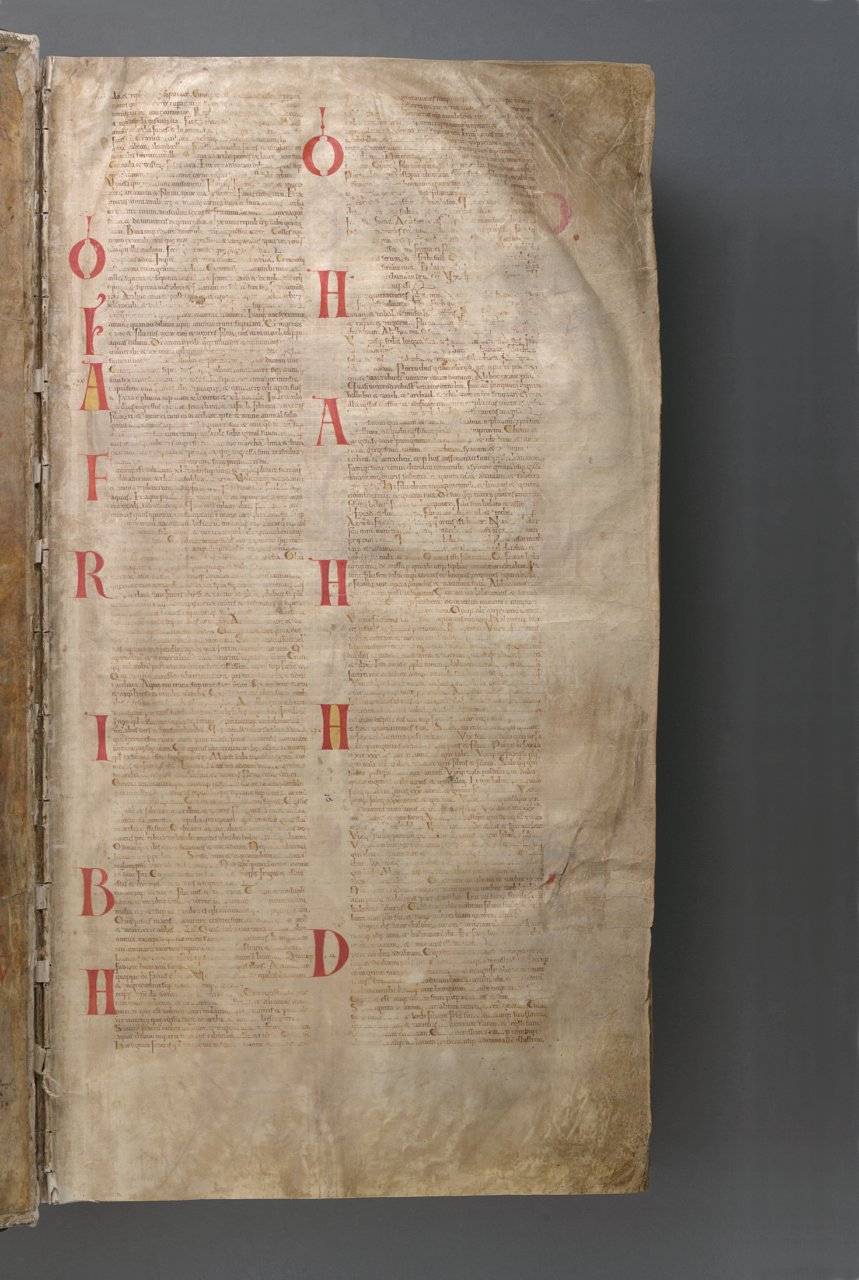
National Library of Sweden, Codex gigas, or The Devil's Bible, Book of Genesis, 2 r.
National Library of Sweden, Codex Gigas, 
or The Devil’s Bible, Book of Genesis, 2 r.

10 Things You Should Know About The Devil’s Bible (Or Codex Gigas)
by Erika Harlitz-Kern  


In July 1648, during the final clashes of the Thirty Years’ War, the Swedish army looted the city of Prague. Among the treasures they stole and brought with them when they returned home was a book called Codex Gigas.

Not only is Codex Gigas famous for being the largest medieval book in the world, but because of its contents, it is also known as The Devil’s Bible.


10 things you should know about the Codex Gigas, or The Devil’s Bible

1) The Devil’s Bible is 36 inches tall, 20 inches wide, and 8.7 inches thick.

2) The Devil’s Bible contains 310 pages made from vellum from 160 donkeys. Originally, The Devil’s Bible contained 320 pages, but at some point in time the last ten pages were cut out and removed from the book.

3) The Devil’s Bible weighs 165 lbs.

4) The Devil’s Bible was meant to be a work of history. That’s why it contains the Christian Bible in its entirety, The Jewish War and Jewish Antiquities by Flavius Josephus (37–100 C.E.), an encyclopedia by St. Isidor of Seville (560–636), and The Chronicle of Bohemia written by a Bohemian monk named Cosmas (1045–1125). In addition to these texts, there are a number of shorter texts included as well, e.g. on medical practices, penitence, and exorcism.

5) The identity of the scribe who created The Devil’s Bible is unknown. Scholars believe that the book is the creation of one person, most likely a monk living in Bohemia (today a part of the Czech Republic) during the first half of the thirteenth century.

6) Based on the amount of text and the details of the illuminations, it has been estimated that it took as long as thirty years to finish the book. In other words, the anonymous scribe seems to have dedicated the most part of his life to creating The Devil’s Bible.

7) In 1594, The Devil’s Bible was brought to Prague from the Broumov monastery, where it had been kept since the year 1420. King Rudolph II (1576–1612) asked to borrow The Devil’s Bible. He promised the monks that when he was finished with the book, he would return it. Which he of course never did.

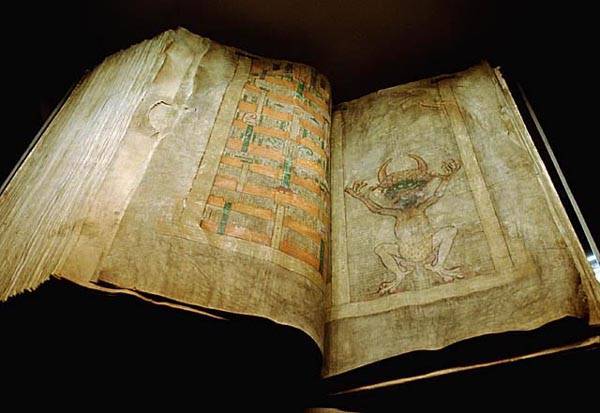
8) The Devil’s Bible has been given its name because of a full-size portrait of the Devil. Portraits of the Devil were common during the Middle Ages but this particular portrait is unique. Here, the Devil is portrayed alone on the page. The image is very big—nineteen inches tall. The Devil is crouching and facing forward. He is naked apart from an ermine loincloth. Ermine is worn as a sign of royalty. It is believed that the Devil wears ermine in this image to demonstrate that he is the Prince of Darkness.

9) There are several myths surrounding the creation of The Devil’s Bible, and they all involve the Devil. One of the most famous myths is that the scribe traded his soul to the Prince of Darkness so that he could complete the book in one night.
Codex gigas, or The Devil's Bible. The Heavenly City (289 v.) and the Devil (290 r).
Codex Gigas, or The Devil’s Bible. 
The Heavenly City (289 v.) and the Devil (290 r).

10) On the opposite page of the portrait of the Devil is an image of the Heavenly City. This has been interpreted as the Heavenly Jerusalem mentioned in the Book of Revelation. It was common in the Middle Ages to leave book spreads on display to convey a message to those who saw it. It is believed that the message intended here is to show the rewards of a God-fearing life on one page and the horrors of a sinful life on the other.


If you’d like to read more about The Devil’s Bible, please visit the book’s official home page at the National Library in Stockholm, Sweden.

Related Articles

https://en.wikipedia.org/wiki/Codex_Gigas


Tuesday, July 9, 2019

End Times Update

The following article was obtained through End Times News

WARNING: An innumerable host of evil angels are spreading over the earth. They are not only crowding government institutions, but also the churches. They are doing Satan's work, and soon they will perform great 'signs and wonders' to deceive the whole world. The policies of the Papal 'Beast' of Rome are being pushed and the whole world is soon to be deceived into giving their allegiance to the fallen churches and the Vatican, rather than our Creator God. Our ONLY safety is to anchor our lives upon the Word of God. Please submit your life to Jesus Christ today!

When we seek and learn the truth and then live according to it, the enemy's deceptions become useless, because we then come under the Spirit and power of God, which Satan CANNOT penetrate. This is why it is so important to seek and learn the truth in these end times we live in. The news is full of prophecy fulfilling images today. All the Biblical signs of the end have been fulfilled like never before in history, and we are living during the last "hours". Just take a look at the prophecy fulfilling news events below:

"Human civilisation as we know it may have already entered its last decades, a worrying new report examining the likely future of our planet's habitability warns. The increasingly disastrous impacts of the climate crisis, coupled with inaction to tackle it are sending our planet down a bleak path towards an increasingly chaotic world which could overwhelm societies around the globe, the report's authors contend."

Satan knows that Jesus is coming back soon. He knows that judgments from God and the 7 last plagues are to fall soon. So what does he do? Convince the world that the world will end due to 'climage change' if everyone doesn't UNITE to combat it and 'save the planet.' So what will the world think when the plagues start falling? They will be deceived into thinking that climate change has caused them and Satan will deceive the world into believing that God's remnant people, who will NOT unite with the world are the ones to blame!

Revelation 12:17 ...'And the dragon was wroth with the woman, and went to make war with the remnant of her seed, which keep the commandments of God, and have the testimony of Jesus Christ.'


"Despite some new tensions, 'practically the whole of Christianity is in a process of advancing beyond the controversies and competition of the past, toward greater understanding, trust and solidarity,' said Bishop Brian Farrell, secretary of the Pontifical Council for Promoting Christian Unity."

It is so sad to see how God's people have turned away from the Lord and are embracing that 'mother of harlots' in this ecumenical movement. And all for the sake of what? 'Peace and safety!' But what did the Lord say would happen to those who seek 'peace and safety' instead of TRUTH? 'Sudden destruction' (1 Thess.5:3). Notice the bishop says that Christians are now 'advancing beyond the past controversies' and are now embracing unity. Oh how deluded the professed Christian world is today (2 Thess.2:11). The Protestant reformation was a movement of TRUTH from God. We must NOT forget the past but EMBRACE it.

Jeremiah 6:16-19 ...'Thus saith the Lord, stand ye in the ways, and see, and ask for the old paths, where is the good way, and walk therein, and ye shall find rest for your souls. But they said, we will not walk therein. Also I set watchmen over you, saying, hearken to the sound of the trumpet. But they said, We will not hearken. Therefore hear, ye nations, and know, O congregation, what is among them. Hear, O earth: behold, I will bring evil upon this people.'

"After a long and severe conflict, the faithful few decided to dissolve all union with the apostate church if she still refused to free herself from falsehood and idolatry. They saw that separation was an absolute necessity if they would obey the Word of God. They dared not tolerate errors fatal to their own souls ... If unity could be secured only by the compromise of truth and righteousness, then let there be difference, and even war. Well would it be for the church and the world if the principles that actuated those steadfast souls were revived in the hearts of God's professed people. There is an alarming indifference in regard to the doctrines which are the pillars of the Christian faith. The opinion is gaining ground, that, after all, these are not of vital importance. This degeneracy is strengthening the hands of the agents of Satan, so that false theories and fatal delusions which the faithful in ages past imperiled their lives to resist and expose, are now regarded with favor by thousands who claim to be followers of Christ." (Great Controversy, p.45)

HEED THE WARNING - Come OUT OF HER My People!


"Dr. Smadja's daring plan calls for an international day of rest (about 53 days per year) plus approximately 15 'holidays' where cumulatively there would be a cessation of all productive activity for approximately 70 days, or about 20percent of the year. These days of 'non-activity' would help achieve the shared goal outlined in the Paris Climate Conference (COP21) of a 20 percent reduction of pollution globally by 2050, with the aim of keeping global warming below 2 degreesC ... This frantic race to go faster and faster makes us forget essential things, such as loving ourselves, others and also our earth ... the result is a global disaster, whose ecological impact is more and more obvious. A Sabbath for ourselves, our industry and our environment is a corrective to these failures." (see also here)

Now what day do you think they would choose to 'shut down' each week? Sunday! We were saying this would happen, just before the pope's climate encyclical came out. I mean, what better way to 'help the planet' than to have a law that makes businesses shut down one day a week. Ok, this is just someone suggesting it, but the Sunday law plan is now moving in darkness, concealed behind this climate agenda, and the leaders are concealing their true purpose. But God's people can see right through their plans, because everything is exposed when you are walking in the light of God.

The Sunday law is coming friends. The systems are being put in place, as you can see from the news item below, ready for the enforcement of the Sunday law. But should we wait for this to happen to get ready? NO! God forbid! We must BE ready now. If we keep putting off getting ready, then the Lord WILL pass us by and give our crown to someone else! The reason why things have not wrapped up by now, is because God's people have slumbered and slept. But the shaking is taking place now. The Spirit of the Lord is falling. People all over the world are waking up and the final events are soon to take place just before the Lord returns. Time to BE ready friends!

Revelation 3:11 ...'Behold, I come quickly: hold that fast which thou hast, that no man take thy crown.'

And PLEASE do not rely upon your church leaders to keep you informed. As they have joined hands with Babylon and will lead you down the wide road to destruction! We must stop following the churches, and follow Jesus Christ alone (Revelation 14:1-5)


"Donald Trump's nomination of Brett Kavanaugh to the Supreme Court is a gift to evangelical Christians ... Simply put, the Supreme Court is the reason that many Evangelicals voted for Trump ... Evangelical leader Franklin Graham (Billy Graham's son) posted to his Facebook page a month before the 2016 election: 'The most important issue of this election is the Supreme Court' ... In an interview on NPR, another evangelical American, Karen Swallow Prior of Liberty University, concurred with Graham as she explained how easy it was for Christian conservatives to become Trump's bedfellows in order to make long-term gains on the Supreme Court."

Revelation 13 tells us that the second beast (America), would make an image to the first beast (the Papacy), and what is the Papacy? It is a uniting of church and state, with the church directing the affairs of the state. And that is what we see going on in America today. The image of the beast is already set up in America, and all it needs now is POWER to 'spead and cause' the world to take the mark of the Papal beast - the Sunday law in honour of their false trinity god. And that is why the Evangelicals are trying to get their people, whether they be Catholic or Protestant, into the hot seat in the Supreme Court. And it matters not whether they are Catholic or Protestant, because they have all united into the same team of "fallen Babylon".

The signs are all around for us to see that we are in the very end times. So it is time to BE READY in Jesus Christ. We must surrender ALL to Him now, so that He can live His life in us and make us ready for heaven.

Tuesday, June 18, 2019

The Tower of Babel (Gen 11:1-9)

The following article was obtained through BibleOdyssey.org and written by Jan Christian Gertz

Together with Solomon’s temple, the tower of Babel may be the best-known building in the Hebrew Bible. The notion of a tower reaching toward heaven is deeply inscribed in our cultural memory. As a result, readers often overlook the fact that Gen 11:1-9 reports little about the actual tower. For example, the story only implies that the workers stopped building the tower. The tower’s destruction, though often read into the story, is never stated. Instead of being the central interest of the story, the tower functions as a symbolic motif.

The people who built the tower of Babel were driven by fundamental human concerns. They preferred settlement to the uncertainties of dispersion, uniformity to diversity, fame and power to obscurity and weakness. But in the account in Gen 11:1-9, God denies their preferences. At the center of the story is humanity’s transition from speaking one language and living in one location to speaking several languages and living in multiple locations across the world.

What is God’s problem with the tower? 

The standard answer is that the project of building a tower reaching the heavens is a symbol of humanity’s arrogant pursuit of fame and power—ideas closely linked in the ancient Near East. It is true that God expresses some concern about safeguarding the line between the human and divine spheres, perhaps even suggesting that the people pose some kind of threat to the divine realm (Gen 11:6, Job 42:2). The tower, then, is a symbol of humanity’s ability and propensity to cross boundaries and of God’s endeavor to check such behavior.

The tower itself, however, is a minor motif—something mentioned twice and only in passing (see Gen 11:4-5). The narrative’s conclusion focuses on the real issue at hand: God’s dissolution of humanity’s linguistic unity, an act that results in dispersion and that reflects the historical experience of the Israelites in the exilic and postexilic periods. The story ends with an etiology (an origin story) connecting the name of the city with the confusion (balal) of languages and identifying the city as the origin point for the dispersion of humanity (Gen 11:9).

How and when was the tower of Babel story written? 
Scholars often assume that the story of the tower of Babel was stitched together from different sources or that it underwent stages of literary development. As evidence, they point to subtle tensions, apparent repetitions, and the seemingly large number of motifs. Since none of the individual elements are superfluous, however, such reconstructions are hardly convincing. Literary and historical analysis may suggest that a poem mocking Babel was the core tradition of the story.

The story of the tower of Babel concludes the biblical primeval narrative (Gen 1-11), whose origin is often explained by assuming a combination of two previously independent sources. Here, our story is generally attributed to the earlier source. But as the story meshes well with the genealogies of the second, later source, this argument is questionable. Additionally, the Babel story seems to have in view the stories about Abraham and Sarah, both of whom are from Mesopotamia (see Gen 11:31). All this would seem to suggest that Gen 11:1-9 was composed after the strands of the primeval history and the ancestral narrative were combined, which likely happened fairly late (sixth century B.C.E.). Even so, the age of a story whose author we do not know remains difficult to determine. Gen 11:1-9 is a myth set in primeval times, but this setting indicates neither that the text was written at the same time the “events” occurred nor that it is later.

Here, the tower can help us. Because the story mentions Babel and is also set in the land of Shinar (Gen 11:2), scholars argue that the text’s author was thinking of the ziggurat Etemenanki, which is located in ancient Babylon. The imagery of a building reaching the heavens supports this suggestion (Gen 11:4). If this is correct, then Gen 11:3 provides further evidence for the time of writing: the oldest ziggurat was originally built with mud bricks. Only at the latest building stage, in the seventh century B.C.E., did it receive a sheathing of fired bricks. It is also possible that the notion of an “unfinished” tower is connected with the extensive damage done by the Persian king Xerxes (518–465 B.C.E.) to religious buildings in Babylon. All things considered, the tower of Babel story is likely a postexilic addition to the primeval history.


<<<<<<<<<<<<<<<<***>>>>>>>>>>>>>>>>

The tower of Babel, probably a postexilic addition to the primeval history, is a symbol of the human ability and propensity to cross boundaries and of God’s endeavor to halt such behavior.

Did you know…? 

The story of the tower of Babel describes the diversity of languages and people.

The tower of Babel is only mentioned in Gen 11:4-5.

Some scholars dispute the identification of the tower mentioned in Gen 11:1-9 with the ziggurat Etemenanki because the Hebrew word migdal can describe every form of tower and the expression “city and tower” could also refer to the city and its acropolis. However, as the story is located in Babylon, the identification with Etemenanki is reasonable.

The use of fired bricks and bitumen for mortar was unknown in ancient Israel and introduces local Babylonian building techniques and color into the story.
The literary and archaeological evidence suggests that the postexilic period is the most plausible setting for an author to write such a story.

Wednesday, June 5, 2019

How OLD Are the Religions?

The following article was posted by Reed Hall on Beliefnet.com

In a previous series of blog entries, I addressed a common basic question: How MANY religions are there?

In my immediately preceding blog entries, I addressed a follow-up question: How BIG are the religions?

In this blog entry, I’d like to round out this preliminary overview of the global religious landscape by addressing another follow-up question: How OLD are the religions?
 

For the major world religions, the simple answer is: pretty old. Most of them are 2000+ years old.


This bar graph presents the relative ages (in years) of each of the major world faiths. Hinduism is the oldest, with roots stretching back some 4000 years, or more; Sikhism is the youngest, being only about 500 years old.

As the chart indicates, among the very oldest religions are Hinduism, Judaism, and (possibly) Zoroastrianism. The roots of Hinduism stretch back at least to India’s Vedic era, and perhaps even further back, into pre-Vedic times (2000 BC, or earlier). The roots of Judaism stretch back to the time of the patriarch Abraham, traditionally dated at around 1800 BC. The precise age of Zoroastrianism, the religion of ancient Persia, remains a matter of some controversy; conflicting dates suggested for the era of its founding prophet Zoroaster range from the 18th to the 6th centuries BC.

A number of major religions seem to have all gotten their start, in different places around the globe, at roughly the same time: the 6th century BC. Jainism, Buddhism, Confucianism, and possibly Zoroastrianism (if one favors a later rather than an earlier date for Zoroaster) were each born in that religiously creative century. The Tao Te Ching, the foundational text of Taoism, is also traditionally attributed to a 6th-century-BC sage known as Lao Tzu, but more recently scholars have suggested a somewhat later date for its composition.

Christianity, of course, is right at about 2000 years old, having gotten started with the life and teachings of Jesus of Nazareth (and his apostles, such as Paul) during the 1st century AD. Indeed, our Western (Gregorian, Christian) calendar revolves around the presumed date of the birth of Christ as the axis point which divides all of time and history into two eras, referred to as B.C. (“Before Christ”) and A.D. (Anno Domini, Latin for “In the Year of the Lord”).

As religions go, then, Christianity (at only 2000 years of age) is one of the younger ones. And Islam is even younger still (by about 600 years). Although Muslims point out that the Arabic term islam merely means “submission” to the will of God, and further holds that Adam, Noah, Abraham, and Moses were among the first such “submitters,” Islam as a distinctive religious movement did not appear on the scene until the prophet Muhammad established it in Arabia in the 7th century AD, making Islam in this sense some 1400 years old.

The precise origin of Shinto, the indigenous traditional religion of Japan, is a bit hazy to date with precision; many place its origins at somewhere roughly around perhaps the 8th century AD (or at least that is when written records pertaining to Shinto beliefs and practices first appeared in Japan).

Sikhism, the youngest of the world’s major faiths, was founded in India by Guru Nanak right around 1500 AD.

So, that’s it, at least as far as the major religions are concerned. But what about some of the other, perhaps smaller but nevertheless well-known religions — religions such as Baha’i, Christian Science, Mormonism, Rastafarianism, Scientology, Wicca, or the Unification Church? How old are they?

For them, the simple answer is: not very old. All of those aforementioned faiths are not only far smaller than the major faiths, but also far younger, each of them having been born as recently as the 19th or 20th centuries.

Baha’i was founded by Baha’u’llah in Persia in the mid-to-late 1800s. Christian Science was founded in Boston by Mary Baker Eddy in the late 1800s. Mormonism was founded by Joseph Smith in western New York in the early 1800s. Rastafarianism was founded in Jamaica around 1930. Scientology was founded by L. Ron Hubbard in New Jersey in 1953. Wicca is a modern revival or reconstruction of ancient European forms of indigenous paganism, whose varying traditions began to emerge in Britain in the early to mid-1900s. And the Unification Church was founded in South Korea by Sun Myung Moon in 1954.

Most of today’s well-known “alternative” religions are of far more recent vintage than the larger, longer-established faiths — which count their own ages in terms of many centuries, even millennia, rather than in mere decades (or at most a couple of centuries).
However, it is perhaps also wise to remember that even the largest and longest-enduring major religions of today must have also started out at one time as small, young “minority religions” themselves, during their own early formative eras.