Friday, May 5, 2017

The Illuminati – Founders of a New World Order (Part 2)

The following article was obtained from Erenow.com [Free Online Library]. 

THE ILLUMINATI – FOUNDERS OF A NEW WORLD ORDER?

images
Yale University's Skull and Bones
Society Symbol
The symbol of Yale University’s Skull and Bones Society is pictured [on the right]. The society was formed in 1832 and its members have numbered several American presidents, the list of whom is said to include George W. Bush and his father, George Bush Senior.  

In many ways this methodology mirrors the current-day practices of cults when recruiting new members; the gradual initiation of intended victims by group members who have been specially trained for such a task. However, once the candidate had become a fully fledged member of the Illuminati they would have had very little in common with their modern-day counterparts, for under the tutelage of an instructor their first task was to learn that ‘silence and secrecy are the very soul of the order.’7 To this end, each member of the Illuminati was given a new name – indeed the only name by which he would be known to others within the group (thus Weishaupt was known as Spartacus, Knigge as Philo etc.) – while even place names were given codenames (for instance Bavaria was Achaia, Munich was Athens, Vienna was Rome, Austria was Egypt and so on). Having digested all of this information, the novitiate would then be required to learn the statutes of the society, the most vital being that a knowledge of mankind was the most important tenet, and to acquire it the new member was commissioned to observe the world at all times and note down all these observations. The novitiate also had to present his superiors with a written account of his life, noting down details such as his place of birth, his enemies, his friends, his likes and dislikes, secret writings and all manner of personal information. These revelations were then assessed with a view to either accepting or rejecting the candidate. If accepted, the novitiate was then required to undergo an initiation ceremony.  

At dead of night he was led into a small, dimly lit room where he was questioned as to his readiness to devote himself to the order. According to several sources a solemn oath then had to be taken at sword point, which include swearing to eternal silence and complete obedience to the order on pain of death. The novice was then afforded the title of ‘Minerval’. It was at this point, or so Payson states, that the Illuminati and Freemasonry converged. That said, apart from telling us that Minervals enter a lodge (a term commonly used by Freemasons), Payson fails to furnish us with any further evidence of a connection.  

Minervals usually met in groups under the tutelage of a more illuminated superior. During these gatherings they were encouraged to discuss illuminism in great detail, including its laws and those acts which were acceptable or not acceptable within the order. For instance, under certain circumstances suicide was sanctioned. The same was also the case for theft and murder, both of which could be practiced for the good of the group. As always, during these discussions the novitiates or Minervals would be watched carefully by their superiors who were constantly judging their suitability to progress onto the next rung of the Illuminati ladder.  

After the position of Minerval came that of the Illuminatus Minor. At this point it was the instructor’s duty to remove any trace of political and religious prejudice the novitiate might harbor. In addition, the novitiate was also required to study the Illuminati’s secret arts – such as the art of mind control and of concealing one’s true feelings from others. Having passed this stage in their training the Illuminatus Minor now proceeds to the title of Illuminatus Major, or Scotch Novice. Once again Payson was at pains to point out just how close the process through which the novitiates progressed came to brainwashing. ‘It is impossible,’ he wrote, ‘[ …] to give a full view of the slow, artful, and insidious process by which the mind is powerfully, though insensibly, drawn from the possession of its former principles, and fired with a fanciful idea of soon attaining the regions of sublime wisdom.’8  

At this stage the Scotch Novice, with guidance from his new counselor, was required to acquaint himself with all of mankind’s many miseries, miseries which the Illuminati blamed on the pressure citizens of every nation had to endure from both church and state. Once the novitiate had completed this term of study he then moved on to the title of Scotch Knight, the last stage before he reached a state of full illuminism. This stage differed radically in tone from those that went before because, instead of being confined to dark chambers and secrecy, a Scotch Knight was privileged to enter a new lodge whose splendor was second to none. As well as studying further rules and regulations, a Scotch Knight was also tasked with converting every opportunity that came his way to the advantage of the Illuminati.  

Having passed these tests it was now time for the novitiate to become acquainted with the Illuminati’s ‘lesser mysteries’, revelations that required him to take on the title of ‘Priest’ or ‘Edopt.’ In this role he was taught that there was no religion, and no government on earth which answered to the needs of mankind, but instead the only effective means by which to remedy the situation was through those societies privileged enough to know the secret of Jesus.  

On this occasion, it is safe to say that both the Illuminati’s and the Freemasons’ creeds united to the extent that the secret of Jesus was revealed to be the reinstatement of mankind to his original liberty and equality. In Freemasonry, one of the symbols employed is that of a rough-hewn stone representing the primitive nature of man, savage but ultimately free. The split stone represents the fallen nature of humanity, divided by state and religion. (In Dan Brown’s Angels and Demons, his protagonist Robert Langdon claims that the Order of the Freemasons was used as a means of shielding the Illuminati from the inevitable fall-out from the Catholic Church – not a wholly ludicrous theory given both the political and religious climate of eighteenth-century Europe.)  

The Edopt was also entitled to don a white tunic with a broad scarlet belt, with scarlet ribbons tied to one sleeve. After the position of Edopt was achieved, the novitiate was allowed to move on to the role of Regent, a position that required him to be led to his lodge dressed as a slave tied with chains, a condition meant to represent the miserable position of mankind bowed down by society and government. A voice from within the lodge then denies him entrance, declaring that only freemen may enter, after which the novitiate’s guide replies that the Edopt’s desire is to be free; that he has reached illumination; that he flies from all tyrants and seeks refuge only among freemen.  
By 1784, both church and state saw to it that Weishaupt’s activities were significantly restricted. Payson (basing his evidence on Barruél and Robison’s findings) declared this turn of events was brought about by the discovery of dangerous publications – several of which were traced back to the lodge Theodore of which Weishaupt was, of course, a member. The Elector of Bavaria instructed the lodge to curtail their activities. When he was ignored, he had no option but to order a judicial inquiry, only to discover that several other Masonic lodges were also associated with a group called the Illuminati. Four professors were arrested: Utschneider, Cosandey, Renner, and Grunberger, all of whom later gave testimony to the evil goings-on within their respective groups – activities that ranged from illicit sexual practices to suicide. It was at this point that Weishaupt was sacked from his job at the university and banished from Bavaria. Various documents are then said to have come to light illustrating the truly pernicious nature of the Illuminati society. Barruél, in his book on Jacobinism, claims that the following extract is a direct quotation from one of Weishaupt’s private letters:  

It is very proper to make your inferiors believe, without telling them the real state of the case, that all other secret societies, particularly that of Free Masonry, are secretly directed by us. Or else, and it is really the fact in some states, that potent monarchs are governed by our order. When any thing remarkable or important comes to pass, hint that it originated with our order. Should any person by his merit acquire a great reputation, let it be generally understood that he is one of us.9  

Despite these fighting words however, once banished there was little Weishaupt could do to keep the Illuminati going. At this point the entire society appears to have faded gently from view.10 That is, until recently, when a handful of contemporary researchers have claimed that the Bavarian Illuminati is up and running again, still aiming to establish a New World Order. Their evidence appears to lie with the emergence of several organizations as varied as the Yale Skull and Bones Society and the Bilderberg Group.  

The former is an elite club that includes some of the most powerful men of the twentieth century including several American presidents. Established in 1832, not long after the abolition of the Bavarian Illuminati, it is said that the Skull and Bones was none other than a new-world version of the type of societies so rife in Germany during the mid-nineteenth century. No wonder then, that outsiders claim this group to be a hotbed of Illuminati plottings and conspiracies. Several critics continue to demand the club’s termination, much as detractors did back in the eighteenth century. One such is Ron Rosenbaum, a columnist for the New York Observer.‘I think,’ says Rosenbaum, ‘there is a deep and legitimate distrust in America for power and privilege that are cloaked in secrecy. It’s not supposed to be the way we do things. We’re supposed to do things out in the open in America. And so that any society or institution that hints that there is something hidden is, I think, a legitimate subject for investigation.’11  

Another good reason for investigating the club is that several American presidents, including the present incumbent of the White House, George W. Bush, as well as his father George Bush Senior, and his grandfather, are alleged to have belonged to this group and have been said to have invited other Skull and Bones members to join them in government.  

But the Skull and Bones is not the only secretive organization potentially at work in the upper echelons of government. The Bilderberg Group, an elite coterie of power brokers, bankers, economists and world leaders who meet in secret to discuss world affairs was formed shortly after the end of World War II. In 1954, the Bilderberg’s agenda was to promote transatlantic cooperation so that future wars could be averted. Meeting in secret, usually in Holland, where the group held its first meeting at the Bilderberg Hotel, not a word of what is discussed ever reaches the general public. Is it any wonder that conspiracy theorists have linked this organization with shady goings-on, not to mention the establishment of a New World Order second only to that espoused by the Illuminati? Both the Oklahoma City bomber, Timothy McVeigh, and international terrorist Osama Bin Laden, are said to have believed in the theory ‘that Bilderberg pulls the strings with which national governments dance.’12 In response to this assumption, the former Chancellor of the Exchequer in Britain, Denis Healey, who was one of the founding members of Bilderberg, vehemently denies the group exerts any sinister influence on world affairs. ‘There’s absolutely nothing in it,’ he said. ‘We never sought to reach a consensus on the big issues at Bilderberg. It’s simply a place for discussion.’  

Similarly, a group calling itself the Trilateral Commission, formed in 1973 by private citizens from Japan, Europe and North America, insist that their group’s sole function is not to act as a screen shielding the evil machinations of the Illuminati, but as a think-tank established to foster greater cooperation amongst the democratic, industrialized countries of the world. The European Union has also been accused of being involved in Illuminati-managed decisions, as has the UN and the Council on Foreign Relations. This latter group, which was founded in 1921, is yet another independent, non-partisan organization for scholars dedicated to promoting a better understanding of the world and the foreign policies adopted by the United States and other governments. That is what the CFR professes to be. On the other hand, conspiracy theorists are more inclined to believe that it is the promotional wing of the ruling elite in America who use its members (all of whom are influential politicians, academics or economists) to further the cause of the New World Order and surreptitiously transplant its doctrines into mainstream American life. The conspiracy theorists’ websites use quotes by any number of influential persons to support their ideas. The following, for instance, was written on February 23, 1945 by President Roosevelt: ‘The real truth of the matter is, as you and I know, that a financial element in the large centers has owned the government ever since the days of Andrew Jackson.’ Or how about this from Felix Frankfurter, Justice of the Supreme Court in America (1939–62): ‘The real rulers in Washington are invisible and exercise power from behind the scenes.’ Neither quote is a shattering exposé of anything even remotely underhand, yet time and again what these people say is presented to us as concrete evidence that a secret society is at work, attempting to dominate the world. Be it the EU, the Commonwealth Institute or any other multi-national gathering – whether political or economic, conspiracy theorists continue to insist that the Illuminati (amongst others) are involved. They also point to acts of terrorism such as 9/11, assassinations such as John F. Kennedy’s and all manner of other world-shattering events as having been orchestrated by the Illuminati.  

David Icke, a British ex-footballer turned author, states in an article which appears on a website called appropriately enough, www.propagandamatrix.com, that ‘It was clear that something of enormous magnitude was being orchestrated that would so devastate the collective human mind with fear, horror, and insecurity, that “solutions” could be offered that would advance the agenda in a colossal leap almost overnight. This is what we saw in America on the ritually-significant eleventh day of the ninth month – 911 is the number for emergencies in the United States. Ritual and esoteric codes are at the heart of everything the Illuminati undertakes.’  

So does such a society really exist and if it does, is it really attempting, as Robert Langdon would have us believe, to control world freedom? The idea of a secret organization attempting to rule the world seems a deep-seated one in the psyche of modern-day man. After all, this is the premise, give or take a few plotlines, behind all of the James Bond movies, not to mention thousands of other books and films that would have us believe in such hidden agendas.  

There is scant evidence, however, to back up such speculation but, given the freedom of speech we have in most democratic countries, conspiracy theorists will always be able to point at men of power and influence and accuse them of pursuing a hidden agenda. Perhaps this is evidence in itself that mankind has a deep-rooted need for conspiracy theories; we want to blame the problems of the world on a faceless organization more than any thing else; we want there to exist a sinister secret organization, the eradication of which would solve all our problems overnight. The Illuminati fits the bill and, even if it no longer exists as a covert group, it will live on in the minds of many as a convenient scapegoat for all the world’s ills.


Wednesday, May 3, 2017

The Illuminati – Founders of a New World Order (Part 1)

The following article was obtained from Erenow.com [Free Online Library]. 

THE ILLUMINATI – FOUNDERS OF A NEW WORLD ORDER?
"As Weishaupt lived under the tyranny of a despot and priests, he knew that caution was necessary even in spreading information, and the principles of pure morality. This has given an air of mystery to his views, was the foundation of his banishment […] If Weishaupt had written here, where no secrecy is necessary in our endeavors to render men wise and virtuous, he would not have thought of any secret machinery for that purpose." ~ Thomas Jefferson
Ever since Dan Brown wrote his bestselling novel, Angels and Demons, the Illuminati has been the subject of intense speculation among both the general public and the media alike. In his novel, Brown presents an intriguing scenario, one in which a highly secretive society that has been presumed extinct for several centuries establishes itself once again in order to continue its bloody feud against the Catholic church. But how much of the Brown plotline is based on fact? Did such a group ever exist and if so is it still functioning today?  

When attempting to study the nature and activities of secret societies, it quickly becomes very difficult (occasionally well-nigh impossible) to separate fact from fiction, reality from centuries-old fabrication, the truth from downright lies. The case of the Illuminati is no exception and it is, in fact, even more difficult to distill the truth from all of the available information about this group owing to the huge public interest in new world orders, global conspiracy theories and shadowy organizations who supposedly control world affairs. Over the centuries, several groups have laid claim to the name Illuminati, boasting their possession of Gnostic texts or of other even more arcane information not otherwise available to the general public. The first known record of the name Illuminati comes in the second century AD when a self-styled prophet by the name of Montanus, who had previously belonged to the cult of Cybele, converted to Christianity. He then set up a group in direct opposition to the institutionalized church. Alongside the prophetesses, Prisca (or Priscilla) and Maxilla, Montanus’s most famous convert to the cause was the Catholic apologist Tertullian. But it is the fourth-century historian, Eusebius, who best illustrates Montanus’s extraordinary gifts, describing how converts underwent all manner of religious experiences including ‘speaking in tongues’ and receiving apocalyptic visions. 

Their opposition and their recent heresy which has separated them from the Church arose on the following account […] a recent convert, Montanus by name, through his unquenchable desire for leadership, gave the adversary opportunity against him. And he became beside himself […] in a sort of frenzy and ecstasy, he raved and began to babble and utter strange things, prophesying in a manner contrary to the custom of the Church handed down by tradition from the beginning. 

Aside from these reveries however, what lay at the heart of Montanus’s teachings was a type of ‘end-of-the-world’ scenario so beloved of almost all the sects studied in this book. To help his followers come to terms with his apocalyptic vision, Montanus laid down a strict moral code for them to follow, one that would purify the Christian soul and deter disciples from coveting material goods. This form of illuminism flourished for several centuries, particularly in Asia Minor, before gradually diminishing until, in the ninth century, it died out altogether.  

Nothing was then heard of the Illuminati in any shape or form until, in fifteenth-and sixteenth-century Spain, a group calling themselves the Alumbrado (which roughly translates as ‘Illuminati’) appeared. The Alumbrado claimed to be in direct communion with the Holy Spirit and stated that all outward forms of religious adherence, such as the observance of the liturgy, were unnecessary. One of their earliest leaders, who wholeheartedly embraced these teachings, was a laborer’s daughter from Salamanca known as La Beata de Piedrahita. She declared that she held long conversations with both Jesus and the Virgin Mary, claims that quite naturally brought her to the attention of the Inquisition. Miraculously, she escaped death at the hands of her interogators, although others weren’t quite as lucky. In Toledo, adherents to the Alumbrado were subjected to severe beatings and imprisonment while the Inquisition served no less than three separate edicts against the group, issued in 1568, 1574 and 1623.  

It was also in 1623 that a movement known as the Illuminés was established in France (some say having traveled up from Seville in Spain). Quite rapidly this movement attained a strong following in the Picardy region although very little documentation remains as to the nature of the group, its beliefs or practices. What is generally agreed upon is that Pierce Guérin, the curé of Saint-Georges de Roye, who founded his own group called the Gurinets, joined the Illuminés in 1634.  

Over a century later, in 1772, yet another group called the Illuminés came to light in the south of France, but while little is known about the Picardy sect, even less is known about this second organization. Finally, we arrive at perhaps the best known of all the Illuminati-style societies, which started in eighteenth-century Bavaria.   

images
Adam Weishaupt
Adam Weishaupt was born on 6 February 1748 in Ingolstadt and as a young boy was educated by Jesuit priests who instilled in him not only discretion, but also respect for the hierarchic obedience of the Society of Jesus (or Jesuits). Yet despite his early allegiance to the order, his appointment as Professor of Natural and Canon Law at the University of Ingolstadt in 1775 angered his teachers for not only did he grow to espouse seriously liberal, cosmopolitan views, but he also ‘condemned bigotry and superstitious Priests.’ 

Not everyone was against him however, for soon Weishaupt had earned a good reputation amongst both students and professors alike and even those at neighboring universities were impressed by his teachings. Perhaps this support afforded Weishaupt confidence, and no doubt this in turn led to the suggestion that he should become the leader of a more influential group.  

On 1 May 1776, with the help of Baron Adolph von Knigge, Weishaupt formed the ‘Order of Perfectibilists’, which later became known as the Illuminati. Interestingly, some historians have since claimed that this founding date marks the origin of the Communist May Day observance, although there is little evidence to support the theory. What is certain is that in 1777, Weishaupt was invited to join a Freemasonry Lodge, the Theodor zum guten Rath (Lodge Theodor), in Munich. He accepted the invitation even though most of his energies were still devoted to the Illuminati, whose doctrine was a curious mixture of Islamic mysticism, Jesuit mental discipline and some of Freemasonry’s own teachings, many of which also cherished the idea of ‘illumination’. Nonetheless, Weishaupt’s group was a law unto itself with its own agenda and initiatives. Its declared mission was an adherence to a strict code of morality in order to create a society of men strong enough to oppose the forces of evil.    

Adam Weishaupt was Professor of Natural and Canon Law at the University of Ingolstadt in 1775, but was sacked from his post nine years later after forming a group called the Order of Perfectibilists, later known as the Illuminati.  

Yet, despite being completely separate from the Freemasons, an apocryphal story has grown up around the conception of the Illuminati, a story that relates how a courier by the name of Lanz, who had recently joined the Illuminati, was struck down by a bolt of lightning whilst carrying a bundle of Weishaupt’s most important papers. Lanz died, but when his body was discovered by the authorities, so too were Weishaupt’s documents which were said to reveal a direct link between his group and that of Freemasonry. Perhaps this is why, in Dan Brown’s novel, a basic premise of the story is that in the sixteenth century the Illuminati (who Robert Langdon believes had already established themselves in Italy), having been banished from Rome, were taken in by the Bavarian Freemasons after which they set about using the latter as a front for their activities, effectively forming a secret society within a secret society. They then set their sights on the United States, once again using the Freemasons as a front in order to attain a foothold on American soil. ‘The Illuminati,’ says Langdon, ‘took advantage of the infiltration and helped found banks, universities, and industry to finance their ultimate quest [ …] The creation of a single unified world state – a kind of secular New World Order.’3  

This is a wonderful idea, and one that illustrates how clever Brown is when it comes to weaving good yarns, but there is little evidence to support his plotline and as for the story of Lanz, there is also little doubt in most historians’ minds that the anecdote was an invention by anti-Masonic writers and Jesuit groups opposed to Weishaupt and his new order. There was, after all, little in Weishaupt’s teachings that mainstream religion could warm to. Take for example this early nineteenth-century analysis of Weishaupt’s methods and underlying agenda:  

His scheme appears to be calculated, not so much for uniting persons of similar sentiments in one society, as for seducing those of opposite inclinations, and by a most artful and detestable process, gradually obliterating from their minds every moral and religious sentiment. It is in this view principally that this plan of seduction calls for the attention of mankind, as it develops the secret, insidious policy by which the agents of faction and infidelity lead on their disciples, still concealing their real designs, until the mind is involved in a maze of error, or entangled in snares from which there is no retreat.’   

By 1780, the Illuminati had grown in strength, with its co-founder, Knigge, recording how the group had enrolled approximately two thousand members throughout Europe. Weishaupt was delighted. His mission of ‘illuminating’ his disciples’ minds through reasoned argument was working and seemed to complement the oncoming Enlightenment when radical free thinkers such as Voltaire and Jean Jacques Rousseau were at work espousing, amongst other theories, the concept that religion should be ‘reasonable’ and consequently result in the highest moral behavior of its adherents.  

But this was Bavaria in the mid-eighteenth century – a highly conservative, inward-looking state dominated by the Roman Catholic church who did not take kindly to Weishaupt’s type of radical rationalism, nor his arguments that nations and religions should be swept away alongside such institutionalized ideas as property and marriage. As a result, the Illuminati was labeled seditious and in 1784 the Bavarian government banned the Society. Weishaupt subsequently lost his position at Ingolstadt University and fled Bavaria to sanctuary in Gotha.  

Despite the apparent collapse of the Illuminati, the flood of anti-Illuminati literature written by those opposed to the group’s beliefs means that, ironically, we know more about the group today than we would ever otherwise have done. Two books in particular stand out: Proofs of a Conspiracy Against All the Religions and Governments of Europe and which was published in Ireland in 1797, written by John Robison, a professor at Edinburgh University, and a work by Abbé Augustin Barruel, Memoirs Illustrating the History of Jacobinism (also published in 1797), a four-volume tome that contains several vivid conspiracy theories involving not only the Illuminati but also the Freemasons, the Knights Templar and the Rosicrucians. Each of these sects, according to the author, were aiming to overthrow not only religion but also all political institutions and governments. 

Of the four volumes of Barruél’s book, the first two were dedicated to exposing the campaign against Christianity by French and European philosophers such as Voltaire, Diderot and Rousseau. The third volume concerns the Illuminati – in particular, how Weishaupt recruited several French, German and other European Freemasonry leaders to join his new society, thus gathering together all the different factions under the Illuminati’s overall control. In the fourth volume Barruél accuses the Illuminati of being the true cause behind the French Revolution (1789), an episode from which, he claims, France never truly recovered.  

Both Barruel’s book and that of Robison had a tremendous effect when they were first published and even after several decades their accusations were being read by eminent statesmen. For example, George Washington in America was said to have drawn the conclusion that every government was in danger from Illuminists trying to overthrow them by bringing revolutionary Jacobinism into play. Nor was Washington alone in his fears. Other prominent Americans (indeed, nearly everyone except Washington’s own Secretary of State, Thomas Jefferson) feared the Illuminists and added to Barruel’s and Robison’s theories by producing books of their own. One of these was Seth Payson who wrote Proof of the Illuminati, which was first published in 1802. Among numerous accusations to be found in its pages is the printing of a letter which was supposed to have been sent by Weishaupt (under the pseudonym ‘Spartacus’) to Hertel Canon of Munich (under the pseudonym ‘Marius’) giving details of how he has made his sister-in-law pregnant. ‘We have already made several attempts to destroy the child,’ wrote Spartacus, ‘[ … ] Could I depend on Celse’s secrecy (Professor Buder at Munich), he could be of great service to me; he had promised me his aid three years ago. Mention it to him if you think it proper.’5  

Whether the letter is real or not, the obvious conclusion to be drawn from its inclusion in Payson’s book is that every attempt was being made by the religious establishment to blacken Weishaupt’s reputation. Not that the abortion claim was the worst of the mud being slung in his direction, for Payson also accuses Weishaupt of brainwashing his devotees and of seducing them so that they would act out his every wish.  

Nevertheless, books such as those by Robison, Barruel and Payson do give us – even if only a fraction of what they write is true – a fascinating insight into Weishaupt’s secret order. Robison is a pains to point out that, although Weishaupt himself preferred to remain a shadowy figure within the society, other members of his order were more prominent so that they could actively recruit new members. ‘These are the Minervals,’ states Robison. ‘They are the only visible members of the Illuminati and in order for a candidate to be admitted to the group, he has to make himself known to a Minerval who in turn reports the request to the council. After this, a certain amount of time passes during which the candidate is secretly observed. If he is deemed unfit, nothing more is made of his request; if on the other hand he is successful, he receives an invitation to attend a secret conference where he is admitted as a Novitiate.’  

‘But,’ wrote Payson in true conspiratorial style, ‘the Insinuators are the principal agents for propagating the order. These are invisible spies, seeking whom they may devour, who enter on their tablets, with which they are always to be furnished, the names of such as they judge would be useful to the order, with the reasons for or against their admission.’6  

By employing such emotive language, it is little wonder that the Illuminati’s reputation was one to be feared. But the abuse didn’t stop there for Payson goes on to explain how the Insinuators, once they have chosen a target, return to ‘seduce’ these unwilling victims until, having been brainwashed, they become a pupil of the Illuminati.  

Click here to continue reading "The Illuminati - Founders of a New World Order"


Monday, April 17, 2017

As In The Days of Noah

The following article comes from the Billy Graham Evangelistic Association website:

                 Image result for days of noah in 21 century

As In the Days of Noah
By Chuck Smith   

As we watch the downward spiral of our society today, we realize that a powder keg is ready to explode. Something has got to change.

We look at the deteriorating moral values in our nation–the divorce rate, abortion, pornography, drug addiction and child abuse. We witness what has transpired in the homosexual community. We are shocked at the violent crimes, the drive-by shootings and the terrorism that plagues our world. What is the world coming to? Is the end near?

What will be the signs of Jesus’ coming and the end of the world? This was the very same question Jesus’ disciples asked. Jesus’ answer to them and to us is found in Matthew 24:37-39: "As the days of Noah were, so shall also the coming of the Son of Man be. For as in the days that were before the flood they were eating and drinking, marrying and giving in marriage, until the day that [Noah] entered into the ark, and knew not until the flood came, and took them all away; so shall also the coming of the Son of Man be."

Genesis 6:5 tells us what was going on in the days of Noah. “God saw that the wickedness of man was great in the earth, and that every imagination of the thoughts of his heart was only evil continually.” As we look at our world today, we see the parallel–the movie industry corrupting our values, television defiling our homes, children’s video games teaching violence–all these are polluting people’s minds until the thoughts and the imagination of man’s heart is continually evil.

We read in Genesis 6:11 that “the earth also was corrupt before God, and the earth was filled with violence.” Pick up the newspaper and you will see the hostility that fills the earth. Our nation’s morality has sunk to the place where Ruth Graham once said, “If God doesn’t judge America, He will need to apologize to Sodom and Gomorrah!”

I would say that the world right now is very much like it was in the days of Noah. Jesus pointed out that in Noah’s day, the people were totally oblivious to the coming judgment of God. They were eating and drinking, marrying and giving in marriage. It was pretty much business as usual. There was no awareness that the judgment of God was about to fall upon them. They did not realize anything was wrong until Noah went into the ark and the rain began to fall.

People today do not realize how ripe the world is for judgment. God is trying to shake us from our lethargy and wake us up. We see a worldwide financial crisis, disasters, earthquakes, hurricanes, fires, floods, famines and the AIDS epidemic. But try to suggest to a worldly person that these indicate the beginning of sorrows and God’s judgment, and they will laugh at you. The world may acknowledge their belief in the existence of God, but they live as though God does not exist. There is a total lack of fear of a holy and righteous God.

The Prophet Isaiah said, “Woe unto them who call evil good, and good evil” (Isaiah 5:20). Speaking of the future woes that are coming upon the earth, the angel proclaims in Revelation 8:13, “Woe, woe, woe, to the inhabiters of the earth by reason of the other voices of the trumpet of the three angels, which are yet to sound!” A day of reckoning is coming.

We see prophecies rapidly fulfilled before our very eyes. I believe the current economic crisis–and it’s not just a crisis here in America but a worldwide crisis–is going to force a joining together of the nations, a one-world union as prophesied in the Book of Revelation. It’s going to be moving in that direction. And as we look at the situation in Israel, we see their concern about the need to defend themselves against the possibility of a nuclear attack from other nations. Who and what can save us? Increased knowledge can’t save us. The government can’t save us. Neither can science nor Greenpeace save our planet.

So what does America need today? Rather than the homosexual community coming out of the closet, we need godly parents who will go into the closet and pray for their children, for their families, for the school system and the community. We need a spiritual revival to sweep our land. I believe more could be accomplished for good if we gathered together for times of prayer. Without a spiritual awakening, let’s face it, our nation is through. We need to realize that the only hope is to pray and to teach morality from a biblical base; that the Bible is the only true basis for morality.

We need men and women in our Congress and Senate who love God and fear Him. We need God’s people to humble themselves and pray, and seek God’s face and turn from their wicked ways. You see–we’re either part of the problem or we’re a solution to the problem!

The only hope for the future is the coming again of Jesus Christ. Only Jesus can save us. This is what Jesus is talking about in Matthew 24, the day of the Lord’s coming, the day of the establishing of the Kingdom of God. He said, “Immediately after the tribulation of those days … they shall see the Son of man coming in the clouds of heaven with power and great glory” (Matthew 24:29-30).

This will be the day when, according to the Book of Revelation, “God shall wipe away all tears from their eyes; and there shall be no more death, neither sorrow, nor crying, neither shall there be any more pain: for the former things are passed away” (Revelation 21:4). The day when “He [that is, Jesus] shall judge among the nations. … nation shall not lift up sword against nation, neither shall they learn war any more” (Isaiah 2:4).

As we face the conditions of the world today, we see the same conditions that existed in the days of Noah. We realize that judgment is not far off. So let us pray that God will draw our hearts unto the things of the Spirit and free us from the bondage of corruption that holds the world in its grip. And let us pray–as God’s people–to have a real heart and concern for our families and for our nation–for a spiritual revival in our land. As we see the deteriorating condition of the world around us, it should be a wake-up call for us to live godly, righteous, holy lives, placing our minds, hearts and priorities on eternal values.

May the Lord be with you and bless you. May the Lord’s hand be upon you to guide you. May His Spirit inspire you to a greater commitment to Jesus than you’ve ever had before, as we look forward to that glorious day of the Lord and the establishment of His Kingdom on the earth.


Sunday, April 2, 2017

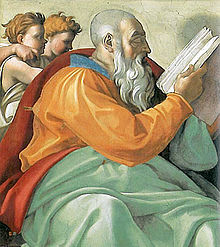
The Prophet Zechariah

Zechariah - foretold the destruction of Phoenicia and Damascus and the Jews passing a test of courage and perseverance. He predicted the glory that shall come upon Jerusalem after rebuilding the [Second] Temple, as well as prophesying that all people will embrace the Jewish faith (Today, Christianity and Islam share many of the same core beliefs as Judaism). Zechariah is possibly a revered prophet in the Islamic Qur'an.

Zechariah was considered a prophet in the Hebrew Bible/Old Testament and traditionally is considered the author of the Book of Zechariah. He is the eleventh of the Twelve Minor Prophets. This particular prophet was from the Kingdom of Judah, and, like the prophet Ezekiel, was probably of priestly extraction (also known as the Kohen). 

According to Ezra 5:1 and Ezra 6:14, the father of the prophet Zechariah was Iddo, however according to Zechariah 1:1, Berechiah was the father of this ancient prophet, and Iddo was his grandfather. According to The Interpreter's Bible,
This discrepancy is best explained on the supposition that the words 'the son of Berechiah' did not form part of the original text of 1:1 - had they done so, it is very improbable that they would have been omitted in the Ezra passages - but that they are an insertion on the part of someone who identified the prophet Zechariah with Zechariah the son of Jeberechiah, who is mentioned in Isaiah 8:2, Berechiah in Zech. 1:1 being a corruption of Jeberechiah.
And yet a third possibility is Jehoiada [the priest] was his father:
"Then the Spirit of God came on Zechariah, son of Jehoiada the priest. He stood before the people and said," ~ 2 Chronicles 24:20
There is not any documentation about Zechariah’s life other than what may be inferred from the holy book. It has been speculated that Iddo was the head of a priestly family who returned with Zerubbabel (Nehemiah 12:4), and that Zechariah may himself have been a priest as well as a prophet. This is supported by Zechariah's interest in the Temple and the priesthood, and from Iddo's preaching in the Books of Chronicles.

Regardless of his mysterious beginnings, shortly after the Babylonia exile and King Cyrus allowing the Jews to return to Jerusalem, Zechariah began his prophetic ministry. He encouraged a spiritual renewal, imploring the people to turn from their evil ways and embrace the righteousness of God.

He was also instrumental in motivating them to rebuild the sacred Second Temple by revealing to them God's future plan for Israel. His instruction was met when the reconstruction of the [Second] Holy Temple was completed five years later in Jerusalem. 

He also foretold the destruction of Phoenicia and Damascus with precision. 
"The burden of the word of the Lord in the land of Hadrach, and Damascus shall be the rest thereof: when the eyes of man, as of all the tribes of Israel, shall be toward the Lord." ~ Zechariah 9:1
According to some Jewish rabbis, Hadrach was a place near Damascus. The prophecy is thought to relate to Alexander the Great conquering Syria, Damascus and all of King Darius’ treasure, which was laid up there and delivered into Alexander's hands. Christian scholars attest that Zechariah was foretelling the restoration of the land of Israel and the future appearance of Jesus Christ into Jerusalem in Chapers 9-14.

There is also a possibility of martyrdom where Zechariah is concerned. In the Gospel of Matthew, Jesus is quoted as stating that Zechariah, son of Barachiah, was killed between the altar and the temple:
"That upon you may come all the righteous blood shed upon the earth, from the blood of righteous Abel unto the blood of Zacharias son of Barachias, whom ye slew between the temple and the altar." ~ Matthew 23:35
Image result for Targum LamentationsAlthough there is an indication in the Targum of Lamentations (Aramaic Bible) that "Zechariah, son of Iddo" was killed in the Temple, many scholars generally understand this as a reference to the death of a much earlier figure, Zechariah ben Jehoiada. As Abel was the first prophetic figure killed in the Hebrew scriptures, and Zechariah ben Jehoiada was the last figure killed in those scriptures, which conclude with 1 and 2 Chronicles, they represent the full historical scope of prophetic martyrdom. But whether this is the same Zechariah is still a debate among the theologians.

In Islam, the Qur'an mentions only 25 prophets by name, including a different Zechariah, the father of John the Baptist. Muslims believe that many prophets were sent to mankind to spread the message of God, including many not mentioned in the Qur'an. Therefore, although this particular Zechariah is not mentioned by name in the Qur'an, some scholars, including Abdullah Yusuf Ali have suggested that Qur'anic verses mentioning the martyrdom of prophets and righteous men are a reference to the slaying of [among others] Zechariah, son of Berechiah.

Zechariah is the ancient prophet who famously quoted, in reference to the End Times, the following words of God:
"Behold, I will make Jerusalem a cup of trembling unto all the people round about, when they shall be in the siege both against Judah and against Jerusalem. And in that day will I make Jerusalem a burdensome stone for all people: all that burden themselves with it shall be cut in pieces, though all the people of the earth be gathered together against it." ~ Zechariah 12:2-3

Tuesday, March 21, 2017

The Definition of Prophecy

Definition Per Dictionary.com:

Image result for prophecy
1. the foretelling or prediction of what is to come.

2. something that is declared by a prophet, especially a divinely inspired prediction, instruction, or exhortation.

3. a divinely inspired utterance or revelation: oracular prophecies.

4. the action, function, or faculty of a prophet.

----------------------------------------------------------------------------------------------------

What Is Prophecy?

A prophecy is a message inspired by God, a divine revelation. The Bible says that prophets “spoke from God as they were moved by the holy spirit.” (2 Peter 1:20, 21) So a prophet is one who receives God’s message and transmits it to others.— Acts 3:18.

How did prophets receive information from God?

God used several methods to transmit his thoughts to his prophets:

1. Writing. God used this method in at least one case by directly supplying to Moses the Ten Commandments in written form.— Exodus 31:18.

2. Oral communication through angels. For example, God used an angel to instruct Moses about the message he was to deliver to Pharaoh of Egypt. (Exodus 3:2-4, 10) When precise wording was crucial, God directed angels to dictate his message, as he did when he told Moses: “Write down these words, because in accordance with these words, I am making a covenant with you and with Israel.”— Exodus 34:27. *

3. Visions. These were sometimes given while the prophet was awake and fully conscious. (Isaiah 1:1; Habakkuk 1:1) Some were so vivid that the recipient participated in them. (Luke 9:28-36; Revelation 1:10-17) At other times, visions were conveyed while the recipient was in a trance. (Acts 10:10, 11; 22:17-21) God also transmitted his message by dreams while the prophet slept.— Daniel 7:1; Acts 16:9, 10.

4. Mental guidance. God guided the thoughts of his prophets to convey his message. This is the sense of the Bible’s statement: “All Scripture is inspired of God.” The phrase “inspired of God” can also be rendered “God-breathed.” (2 Timothy 3:16; The Emphasised Bible) God used his holy spirit, or active force, to “breathe” his ideas into the minds of his servants. The message was God’s, but the prophet selected the wording.— 2 Samuel 23:1, 2.

Does prophecy always involve foretelling the future?

No, Bible prophecy is not limited to foretelling the future. However, most messages from God relate to the future, even if only indirectly. For example, God’s prophets repeatedly warned the ancient Israelites about their evil ways. Those warnings described the future blessings if the people would heed the warning, as well as the future calamity if they refused. (Jeremiah 25:4-6) The actual outcome depended on the course that the Israelites chose to follow.— Deuteronomy 30:19, 20.

Examples of Bible prophecies not involving predictions

> On one occasion when the Israelites asked God for help, he sent a prophet to explain that because they had refused to obey God’s commands, He had not helped them.—Judges 6:6-10.

> When Jesus spoke to a Samaritan woman, he revealed things about her past that he could have known only by divine revelation. She recognized him as a prophet even though he had made no predictions about the future.— John 4:17-19.

> At Jesus’ trial, his enemies covered his face, hit him, and then said: “Prophesy! Who is it that struck you?” They were not calling for Jesus to foretell the future but for him to identify by divine power who had hit him.— Luke 22:63, 64.

----------------------------------------------------------------------------------------------------

According to CatholicEncyclopedia.com:  

As the term is used in mystical theology, it applies both to the prophecies of canonical Scripture and to private prophecies. Understood in its strict sense, it means the foreknowledge of future events, though it may sometimes apply to past events of which there is no memory, and to present hidden things which cannot be known by the natural light of reason. 

St. Paul, speaking of prophecy in 1 Corinthians 14, does not confine its meaning to predictions of future events, but includes under it Divine inspirations concerning what is secret, whether future or not. As, however, the manifestation of hidden present mysteries or past events comes under revelation, we have here to understand by prophecy what is in its strict and proper sense, namely the revelation of future events. 

Prophecy consists in knowledge and in the manifestation of what is known. The knowledge must be supernatural and infused by God because it concerns things beyond the natural power of created intelligence; and the knowledge must be manifested either by words or signs, because the gift of prophecy is given primarily for the good of others, and hence needs to be manifested. It is a Divine light by which God reveals things concerning the unknown future and by which these things are in some way represented to the mind of the prophet, whose duty it is to manifest them to others.

For further reading, please visit: New Advent: Prophecy

----------------------------------------------------------------------------------------------------

According to Judaism101.com:

Many people today think of a prophet as any person who sees the future. While the gift of prophecy certainly includes the ability to see the future, a prophet is far more than just a person with that ability. 

A prophet is basically a spokesman for G-d, a person chosen by G-d to speak to people on G-d's behalf and convey a message or teaching. Prophets were role models of holiness, scholarship and closeness to G-d. They set the standards for the entire community.

The Talmud teaches that there were hundreds of thousands of prophets: twice as many as the number of people who left Egypt, which was 600,000. But most of the prophets conveyed messages that were intended solely for their own generation and were not reported in scripture. Scripture identifies only 55 prophets of Israel.  

A prophet is not necessarily a man. Scripture records the stories of seven female prophets, listed below, and the Talmud reports that Sarah's prophetic ability was superior to Abraham's.  

A prophet is not necessarily a Jew. The Talmud reports that there were prophets among the gentiles (most notably Balaam, whose story is told in Numbers 22), although they were not as elevated as the prophets of Israel (as the story of Balaam demonstrates). And some of the prophets, such as Jonah, were sent on missions to speak to the gentiles.

For further reading, please visit: Prophets and Prophecy

-------------------------------------------------------------------------------------------------

According to Wikipedia.com, Islamic prophecy is defined as:

Muslims believe that the Qur'an predicted many events years before they happened and that such prophecies are proof of the divine origin of the Qur'an. The Qur'an itself states "For every prophecy is a term, and you will come to know (it)." [Quran 6:67] Muslims also recognize the validity of some prophecies in other sacred texts like in the Bible; however, they believe that, unlike the Qur'an, some parts of the Bible have been corrupted over the years, and as a result, not all of the prophecies and verses in the Bible are accurate.

Prophets in Islam include "messengers", bringers of a divine revelation via an angel and "prophets", lawbringers that Muslims believe were sent by God to every people, bringing God's message in a language they can understand. Belief in Islamic prophets is one of the six articles of the Islamic faith, and specifically mentioned in the Quran.

Muslims believe the first prophet was also the first human being, Adam (Adem). Many of the revelations delivered by the 48 prophets in Judaism and many prophets of Christianity are mentioned as such in the Quran but usually in altered form and with different names. For example, the Jewish Elisha is called Alyasa, Job is Ayyub, Jesus is Isa, etc. The Torah given to Moses (Musa) is called Tawrat, the Psalms given to David (Dawud) is the Zabur, the Gospel given to Jesus is Injil). Notwithstanding, none of the seven Jewish Prophetesses are mentioned in the Quran as prophets.

Unique to Islam is Muhammad (Muhammad ibn ʿAbdullāh), who Muslims believe is the "Seal of the Prophets" (Khatam an-Nabiyyin, i.e. the last prophet); and the Quran, revealed to Muhammad without witnesses and that he himself did not write down, which Muslims believe is unique among divine revelations as the only correct one protected by Allah ("God") from distortion or corruption, destined to remain in its true form until the Last Day.

In Muslim belief, every prophet in Islam preached the same main Islamic beliefs, the Oneness of God, worshipping of that one God, avoidance of idolatry and sin, and the belief in the Islamic Day of Resurrection or the Day of Judgement and life after death. Each came to preach Islam at different times in history and some told of the coming of the final Islamic prophet and messenger of God, who would be named "Ahmed" commonly known as Muhammad. Each Islamic prophet directed a message to a different group of people, and thus would preach Islam in accordance with the times.