Sunday, April 24, 2016

How Billy Graham became an American icon

The following article was written by Molly Worthen, a freelance writer and contributor for CNN's Belief Blog.

How Billy Graham became an American icon
Opinion by Molly Worthen, special to CNN

(CNN) - Under ordinary circumstances, Donald Trump and Rupert Murdoch are probably not in the habit of attending the birthday parties of elderly Christian preachers in the North Carolina mountains.

But they were both among the hundreds of well-wishers at the party on Thursday marking Billy Graham’s 95th birthday.

Graham spent his career leading revivals around the globe, following a long tradition of evangelists who have traveled far and wide to urge sinners to accept Christ. But his birthday guest list shows that he is no ordinary preacher. He is a cultural icon, the most famous face of traditional Protestant Christianity.

“We need Billy Graham's message to be heard, I think, today more than ever," former vice-presidential candidate Sarah Palin told the crowd.

What, exactly, is that message—and what accounts for its mass appeal? Now that Billy is 95, I wonder: is there anyone who can fill his shoes?

Graham rose to success in the God-fearing years of the early Cold War. In 1949, the year of Graham’s first big revival in Los Angeles, President Harry Truman told Americans that “the basic source of our strength as a nation is spiritual. ... Religious faith and religious work must be our reliance as we strive to fulfill our destiny in the world.”

Five years later, Congress added the words “under God” to the Pledge of Allegiance. By the end of the decade, 65% of Americans belonged to a religious institution, and 90% told pollsters they believed in God and the power of prayer: they were ready to hearken to Graham’s call.

Tall, handsome, “like Gabriel in a gabardine suit” according to Time magazine, Graham appealed to Americans’ hunger for spiritual direction.

His sermons contained just the right mix of patriotism and reproof. He urged Americans to stand strong against “godless communism” but also criticized American hubris.

“We have an idea that we Americans are God's chosen people, that God loves us more than any other people, and that we are God's blessed,” he told an audience in Charlotte, North Carolina in 1958. “I tell you that God doesn't love us any more than He does the Russians.”

Graham urged his listeners to acknowledge their sins and embrace Christ; to quit making excuses and go to church. But he abandoned the strict fundamentalism of his youth for a less doctrinaire theology.

His crusades mobilized hundreds of volunteers from local churches—not just evangelical churches, but liberal Protestant and Roman Catholic parishes as well.

Graham had plenty of theological quarrels with these collaborators.

He accepted the assistance of New York Catholics during his crusade there in 1957, but three years later he helped organize Protestant ministers to oppose John F. Kennedy’s presidential campaign.

However, when it came to evangelism, he was a broad-minded pragmatist - outraging hard-line fundamentalists, who demanded strict separation from other Christians.

He replied to his critics: “The one badge of Christian discipleship is not orthodoxy but love. Christians are not limited to any church. The only question is: are you committed to Christ?"

One member of Graham’s circle coined the term “neo-evangelical” to describe this attitude. They were all conservative evangelicals who had left fundamentalism to lead a revival of both the soul and the mind. They formed the National Association of Evangelicals to unite conservative Protestants. In 1956 they founded the magazine Christianity Today, an “evangelical, theologically oriented” alternative to liberal periodicals, Graham wrote.

Secular journalists quoted Graham as a capable spokesman for the evangelical point of view. Graham’s visits to the White House gave the impression that he was a Protestant pope, possessing Christian wisdom and a valuable imprimatur. Graham seemed to represent an American evangelical consensus.

But from the beginning, this consensus was more apparent than real.

Far more conservative Protestants stayed out of the National Association of Evangelicals than joined up. They thought of themselves as Baptists or Mennonites first, and “evangelical” second, if at all.

Some evangelicals rejected the idea that Christians must experience the radical “born-again experience” at the heart of Graham’s crusades: they believed that conversion is sometimes slow and incremental. Others objected to the conservative politics of Graham and his colleagues.

I have spent the past few years researching the stories of these different evangelical communities, ranging from pacifist Mennonites to tongues-speaking Pentecostals. I found that even if they disagreed with Billy Graham, they had no choice but to take him seriously.

They often defined their own beliefs against his ministry. Graham and other neo-evangelicals helped other Christians understand themselves more clearly. As a result, the fissures and tensions that have always divided the evangelical world are deeper than ever.

Billy Graham has no successor.

In today’s age of fragmented evangelicalism and social media-savvy churches, there is no individual who can represent American evangelicalism to the world. Every believer has his own favorite Christian blog, her own like-minded Twitter network. And evangelicalism’s golden age seems to be ending. The biggest denominations, booming during the height of Graham’s career, are now stagnating or losing members.   

Graham’s career ranged well beyond American shores, and conservative Protestantism is flourishing in the Global South. Some evangelists there command crowds that rival or exceed Graham’s biggest crusades. For more than 50 years, the German evangelist Reinhard Bonnke has preached throughout Africa to audiences that range in the hundreds of thousands.

But evangelists making their careers in non-Western societies face different challenges than Graham did. They are trying to reach people who worry not about the threat of secular liberalism, but the fate of their unbaptized ancestors or witchcraft in their villages. In the Global South, the label “evangelical” implies similarities to American religion that don’t exist.

Billy Graham may be an icon of an era that has passed, a Christian coalition that was never as harmonious as it seemed.

His own message, however, remains the same. In his message on Thursday —perhaps his final sermon — he warned that “our country is in great need of a spiritual awakening.”

[Molly Worthen is an assistant professor of history at the University of North Carolina at Chapel Hill and the author of "Apostles of Reason: The Crisis of Authority in American Evangelicalism."]


Thursday, April 14, 2016

Who's ? Right on YouTube


Who's ? Right has recently began creating documentary videos [on various subjects] on their YouTube Channel and would like to invite the readers of the Who's ? Right Blog to view these interesting docu-vids, which approaches each subject from different perspectives.

In keeping with the format of the Who's ? Right Blog, the various YouTube videos will include recorded programs that mainly cover the topics of Religions & the End Times, with an emphasis being placed upon the prophecies of the Biblical Prophets in the some of the docu-vids. 

Please feel free to subscribe to the Who's ? Right Channel on YouTube to keep up-to-date on future documentaries.

The following docu-vids are some of the videos that have already been created, produced and published on YouTube:

Nostradamus: The Man and His Prophecies

The following documentary takes a look at the life & prophecies of the famous  renowned prophet of the 16th century A.D.

Strange Heavenly Signs Occurring Around Israel and Jerusalem

Since 2011, strange and unexplained events have been occurring around Israel, and Jerusalem in particular. From 2011-2015, the phenomenal occurrences were few and far between; since 2016 the activity of the unknown has definitely increased. The following video examines and features some of these odd incidences occurring.

Seven Churches of Revelation

The following documentary takes a look at the Seven Churches [of Revelation] and their meaning in the Book of Revelation.

 
Dividing Israel

The following documentary draws a parallel between biblical prophecy and current events surrounding Israel and the UN Peace Conference [held in Paris] which occurred on Jan. 15, 2017.

Countdown to Armageddon

The following documentary takes a look at the biblical prophecies of the ancient prophets and how they correlate with "End Times" events in our modern world. 

Comparisons of World Religions 

The following video compares the various religions around the world in the
21st century.

Jesus' Disciples - What Happened to Them?

The following video examines the fates of Jesus' Twelve (12) Disciples.


Sunday, April 3, 2016

Joel C. Rosenberg: Biblical Prophecy and Russia

Russia's New Alliance: Biblical Prophecy Coming to Life?
10-04-2015 CBN News

Many Christians believe Russia plays a major role in biblical prophecy about the end times.

CBN News spoke by phone with best-selling author Joel Rosenberg about Russia's big move into the Middle East and what it might mean for Israel.

Rosenberg refers to the book of Ezekiel and prophecies that involve an alliance of Russia, Syria, and Iran all aligned against Israel.

He told CBN News that for the first time in 2,500 years that scenario is a reality. He is quick, however, to downplay whether biblical prophecy is in fact being fulfilled with these recent developments.

He also blamed the Obama administration for leaving a huge vacuum in the Middle East, which has allowed Russia to move in.

Rosenberg had much more to say about the future of Israel and how Christians can stand up for the Jewish state. Click play to listen to the entire interview.


Russia's New Alliance: Biblical Prophecy Coming to Life? (Joel Rosenberg)


~*~*~*~*~*~*~*~*~*~*~*~*~*~*~*~*~*~*~

Where Are We on the End Times Timetable?
01-01-2016 CBN News
JERUSALEM, Israel -- The recent Russian moves in Syria have many Christians asking, "Where are we in God's End Times timetable?"

CBN Middle East Bureau Chief Chris Mitchell discussed the issue with author and Middle East expert Joel Rosenberg in Jerusalem this week. 

Click play to hear what Rosenberg told us about the book of Ezekiel, how world leaders are reacting to events in light of the Bible, and how Christians should be looking at seeming apocalyptic scenarios.

*Originally published Nov. 6, 2015.


Where Are We on the End Times Timetable? (Joel Rosenberg)


~*~*~*~*~*~*~*~*~*~*~*~*~*~*~*~*~*~*~*~

Where Are We on the End Times Timetable?
01-05-2016  Jessilyn Justice (Charisma News)

Joel C. Rosenberg talks about Russia's military action in Syria. (CBN)

The presence of Russia in Syria reverberates end-times prophecies, says author Joel C. Rosenberg, and much of that lays at the feet of the Americans. 

"We are watching a catastrophic capitulation by the American government in the Middle East," Rosenberg says. "It was bedrock U.S. foreign policy for six, seven decades to keep the Russians out of the Middle East. Yet President Obama and his administration have surrendered—surrendered. We have withdrawn, we have surrendered, we have ceded the playing field to Vladimir Putin, who is a czar rising." 

Putin's military freedom "just a few miles north of Israel" has devastating consequences for the region. Rosenberg draws parallels between Russia's military action and the foretold war of Gog and Magog in Ezekiel.


Is Russia Fulfilling Prophecy in Syria? (Joel Rosenberg)


~*~*~*~*~*~*~*~*~*~*~*~*~*~*~*~*~*~*~*~

Joel C. Rosenberg's Blog - With Russian & Iranian forces now engaged in combat in Syria, people are asking, “What is the War of Gog & Magog?” Here’s the answer.


Saturday, March 26, 2016

Religions Around the World


 Image result for 2016 world religions
According to BBC, religion can be defined as:   
"Religion can be explained as a set of beliefs concerning the cause, nature, and purpose of the universe, especially when considered as the creation of a superhuman agency or agencies, usually involving devotional and ritual observances, and often containing a moral code governing the conduct of human affairs."   

There are twelve (12) classical world religions—those religions most often included in history of world religion surveys and studied in world religions classes are: Baha'i, Buddhism, Christianity, Confucianism, Hinduism, Islam, Jainism, Judaism, Shinto, Sikhism, Taoism, and Zoroastrianism.

While these twelve (12) religions are depicted worldwide, the top five (5) religions most commonly known are: Buddhism, Christianity, Hinduism, Islam and Judaism. Although Hinduism is touted the world's oldest religion, there are others that have been around a long time as well, such as: Judaism, Taoism, Buddhism, and Jainism. A few older style religions are Zorastrianism, Confucianism, and Pantheism.

The following video shows the spread of Buddhism, Christianity, Hinduism, Islam, and Judaism over time: 


The Monotheistic Religions (Christianity, Islam, Judaism)
(from Wikipedia.com)

Monotheism has been defined as the belief in the existence of one god or in the oneness of God. The Oxford Dictionary of the Christian Church gives a more restricted definition: "belief in one personal and transcendent God", as opposed to polytheism and pantheism. Also known as the Abrahamic religions, which traces its origins to Abraham, are monotheistic faiths of Middle Eastern origin. The chronological order of founding are Judaism (late 2nd millennium B.C.), Christianity (1st century A.D.) and Islam (7th century A.D.). While all adherents of the Abrahamic religions consider themselves to be monotheists, Judaism considers Christianity to be polytheistic, recognizing only Islam as monotheistic. Islam likewise does not recognize Christianity as monotheistic.

The Polytheistic Religions (Buddhism, Hinduism)
(from Wikipedia.com)

Polytheism is the worship of or belief in multiple deities usually assembled into a pantheon of gods and goddesses, along with their own religions and rituals. In most religions which accept polytheism, the different gods and goddesses are representations of forces of nature or ancestral principles, and can be viewed either as autonomous or as aspects or emanations of a creator (God). Polytheism was the typical form of religion during the Bronze Age and Iron Age, up to the Axial Age and the development of Abrahamic religions which enforced strict monotheism. Important polytheistic religions practiced today include Chinese traditional religion, Buddhism, Hinduism, Japanese Shinto, and the neopagan context.


Various Religious Programs Around the World

A BBC (British Broadcasting Corp.) TV religious series called "Around the World in 80 Faiths" can be viewed on You Tube. Peter Owen-Jones, an Anglican priest from Suffolk in the UK, travels to six continents and experiences the widest possible range of religious beliefs and practices. See: http://www.youtube.com/

The Shalom Show on TV is a public affairs television program that focuses on Israel and Jewish life subject matter with cultural, educational, and entertainment programming of interest to the American Jewish community. The show features magazine-style specials and in-depth interviews with Israeli and American leaders in politics, business, technology, medicine, education, culture, and entertainment.

Understanding Islam is a weekly educational show that broadcasts on Dubai One TV, a channel of Dubai Media Incorporated, and the broadcast covers the Middle East, Europe and Africa. Each Friday, the show highlights some of the tenets of Islam, and it aims at explaining the foundations of the Muslims faith by exploring it from different angles, from the simplest fundamentals to the most complex questions of how faith applies to everyday lives. Understanding Islam is prepared and presented by Dr. Mohammed Alkobaisi

Currents is a daily Catholic news magazine television show on New Evangelization Television (NET), broadcast five (5) days a week from its studios in Brooklyn (USA). The program examines current events through the perspective of Catholicism.

The Buddhist Channel (BC) is a global news platform that provides current events, featured articles and reviews pertaining to Buddhism.

Hinduismtoday.com is an educational website that includes magazine articles, editorials, and Hindu news.

Beliefnet.com discusses topics from all religions re: inspiration, spirituality, faith, news etc.

BBC-Religion: Islam is a guide to Islam, including history, beliefs, holy days around the world and various messages of faith.

Being Hindu is basically a guide to the Hindu beliefs and was produced by Summerhill Television for Vision TV. The show is based in Canada.

Christian.com is a free social network dedicated to the entire Christian world. 

Patheos.com provides balanced views of religion and spirituality.

Islamreligion.com is a network that provides the beliefs, practices and current events of Islam.

For further TV listings, please visit: http://wwitv.com/religious_tv/

---------------------------------------------------------------------------------------------------------------
---------------------------------------------------------------------------------------------------------------

For further information regarding "religion", please visit:

Religions of the World
The Definition of Religion
Comparison of World Religions
Timeline of Major & Other Religions


Friday, March 18, 2016

The Biography of Jesus Christ

The following article was written by the Biography.com Editors and depicts a wonderful story of the man called Jesus Christ.

"Jesus" by Leonardo da Vinci
Biblical Figure (c. 6–c. 30)

Jesus is a religious leader whose life and teachings are recorded in the Bible’s New Testament. He is a central figure in Christianity and is emulated as the incarnation of God by many Christians all over the world.

Synopsis

Jesus Christ was born circa 6 B.C. in Bethlehem. Little is known about his early life, but his life and his ministry are recorded in the New Testament, more a theological document than a biography. According to Christians, Jesus is considered the incarnation of God and his teachings are followed as an example for living a more spiritual life. Christians believe he died for the sins of all people and rose from the dead.

Background and Early Life

Most of Jesus's life is told through the four Gospels of the New Testament Bible, known as the Canonical gospels, written by Matthew, Mark, Luke and John. These are not biographies in the modern sense but accounts with allegorical intent. They are written to engender faith in Jesus as the Messiah and the incarnation of God, who came to teach, suffer and die for people’s sins.

Jesus was born circa 6 B.C. in Bethlehem. His mother, Mary, was a virgin who was betrothed to Joseph, a carpenter. Christians believe Jesus was born through Immaculate Conception. His lineage can be traced back to the house of David. According to the Gospel of Matthew (2:1), Jesus was born during the reign of Herod the Great, who upon hearing of his birth felt threatened and tried to kill Jesus by ordering all of Bethlehem’s male children under age two to be killed. But Joseph was warned by an angel and took Mary and the child to Egypt until Herod’s death, where upon he brought the family back and settled in the town of Nazareth, in Galilee.

Image result for jesus 12 years old temple
 “Jesus in the Temple of Jerusalem”
by Heinrich Hofmann (painted c/1901-14)
There is very little written about Jesus's early life. The Gospel of Luke (2:41-52) recounts that a 12-year-old Jesus had accompanied his parents on a pilgrimage to Jerusalem and became separated. He was found several days later in a temple, discussing affairs with some of Jerusalem’s elders. Throughout the New Testament, there are trace references of Jesus working as a carpenter while a young adult. It is believed that he began his ministry at age 30 when he was baptized by John the Baptist, who upon seeing Jesus, declared him the Son of God.

After baptism, Jesus went into the Judean desert to fast and meditate for 40 days and nights. The Temptation of Christ is chronicled in the Gospels of Matthew, Mark and Luke (known as the Synoptic Gospels). The Devil appeared and tempted Jesus three times, once to turn stone to bread, once to cast himself off a mountain where angels would save him, and once to offer him all the kingdoms of the world. All three times, Jesus rejected the Devil's temptation and sent him off.

Jesus's Ministry

Jesus returned to Galilee and made trips to neighboring villages. During this time, several people became his disciples. One of these was Mary Magdalene, who is first mentioned the Gospel of Luke (16:9) and later in all four gospels at the crucifixion. Though not mentioned in the context of the "12 disciples," she is considered to have been involved in Jesus's ministry from the beginning to his death and after. According to the gospels of Mark and John, Jesus appeared to Magdalene first after his resurrection.

‘My Soul Is Joyful...’
The Crosiers photo
According to the Gospel of John (2:1-11), as Jesus was beginning his ministry, he and his disciples traveled with his mother, Mary, to a wedding at Cana in Galilee. The wedding host had run out of wine and Jesus's mother came to him for help. At first, Jesus refused to intervene, but then he relented and asked a servant to bring him large jars filled with water. He turned the water into a wine of higher quality than any served during the wedding. John's gospel depicts the event as the first sign of Jesus's glory and his disciples' belief in him.

After the wedding, Jesus, his mother Mary and his disciples traveled to Jerusalem for Passover. At the temple, they saw moneychangers and merchants selling wares. In a rare display of anger, Jesus overturned the tables and, with a whip made of cords, drove them out, declaring that his Father’s house is not a house for merchants.

The Synoptic Gospels chronicle Jesus as he traveled through Judea and Galilee, using parables and miracles to explain how the prophecies were being fulfilled and that the kingdom of God was near. As word spread of Jesus's teaching and healing the sick and diseased, more people began to follow him. At one point, Jesus came to a level area and was joined by a great number of people. There, at the Sermon on the Mount, he presented several discourses, known as the Beatitudes, which encapsulate many of the spiritual teachings of love, humility and compassion.

As Jesus continued preaching about the kingdom of God, the crowds grew larger and began to proclaim him as the son of David and as the Messiah. The Pharisees heard of this and publicly challenged Jesus, accusing him of having the power of Satan. He defended his actions with a parable, then questioned their logic and told them such thinking denied the power of God, which only further hardened their resolve to work against him.

Near the city of Caesarea Philippi, Jesus talked with his disciples. According to the gospels of Matthew (16:13), Mark (8:27) and Luke (9:18), he asked, "Who do you say that I am?" The question confused them, and only Peter responded, saying, "You are the Christ, the Son of the living God." Jesus blessed Peter, accepting the titles of "Christ" and the "Son of God," and declared the proclamation was a divine revelation from God. Jesus then proclaimed Peter to be the leader of the church. Jesus then warned his disciples of the Pharisees’ conspiracy against him and of his fate to suffer and be killed, only to rise from the dead on the third day.

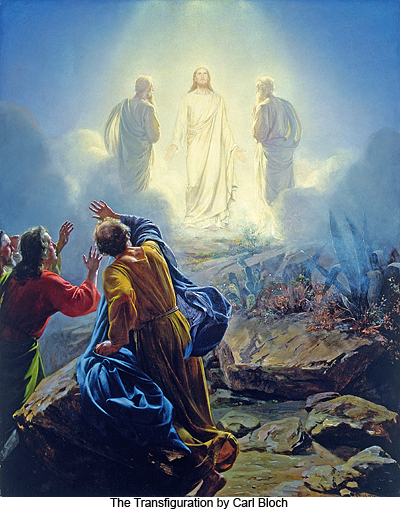
 Festival Held In Commemoration Of The Transfiguration Jesus
"Transfiguration"
by Carl Bloch
Less than a week later, Jesus took three of his disciples to a high mountain where they could pray alone. According to the Synoptic Gospels, Jesus's face began shining like the sun and his entire body glowed with a white light. Then, the prophets Elijah and Moses appeared, and Jesus talked to them. A bright cloud emerged around them, and a voice said, "This is my beloved Son, with whom I am well pleased; listen to him." This event, known as the Transfiguration, is a pivotal moment in Christian theology. It supports the identity of Jesus as the Christ, the Son of the living God.

Jesus arrived in Jerusalem, the week before the holiday of Passover, riding on a donkey. Great numbers of people took palm branches and greeted him at the city's entry. They praised him as the Son of David and as the Son of God. The priests and Pharisees, fearful of the growing public adulation, felt he must be stopped.

All four Gospels describe Jesus's final week in Jerusalem. During this time, Jesus raised Lazarus from the dead, confronted moneychangers and merchants in the temple, and debated with the high priests who questioned Jesus's authority. He told his disciples about the coming days and that Jerusalem's temple would be destroyed. Meanwhile, the chief priests and elders met with high priest Caiaphas, and set plans in motion to arrest Jesus. One of the disciples, Judas, met with the chief priests and told them how he would deliver Jesus to them. They agreed to pay him 30 pieces of silver.

The Last Supper

"The Last Supper" by Andrea Solari (ca. 1520)
Jesus and his 12 disciples met for the Passover meal, and he gave them his final words of faith. He also foretold of his betrayal by one of the disciples and privately let Judas know it was he. Jesus told Peter that before a rooster crowed the next morning, he would have denied knowing Jesus three times. At the end of the meal, Jesus instituted the Eucharist, which in the Christian religion, signifies the covenant between God and humans.
After the Last Supper, Jesus and his disciples went to the Garden of Gethsemane to pray. Jesus asked God if this cup (his suffering and death) might pass by him. He implored a group of his disciples to pray with him, but they kept falling asleep. Then the time had come. Soldiers and officials appeared, and Judas was with them. He gave Jesus a kiss on the cheek to identify him and the soldiers arrested Jesus. One disciple tried to resist the arrest, brandished his sword and cut the ear off one of the soldiers. But Jesus admonished him and healed the soldier's wound.

After his arrest, many of the disciples went into hiding. Jesus was taken to the high priest and interrogated. He was hit and spat upon for not responding. Meanwhile, Peter had followed Jesus to the high priests' court. As he hid in the shadows, three house servants asked if he was one of Jesus' disciples and each time he denied it. After each denial, a rooster crowed. Then Jesus was led out of the house and looked directly at Peter. Peter remembered how Jesus had told him he would deny him and he wept bitterly. Judas, who was watching from a distance, became distraught by his betrayal of Jesus and attempted to return the 30 pieces of silver. The priests told him his guilt was his own. He threw the coins into the temple and later hanged himself.

The Crucifixion

Unknown Artist
The next day, Jesus was taken to the high court where he was mocked, beaten and condemned for claiming to be the Son of God. He was brought before Pontius Pilate, the Roman governor of Judea. The priests accused Jesus of claiming to be the king of the Jews and asked that he be condemned to death. At first Pilate tried to pass Jesus off to King Herod, but he was brought back, and Pilate told the Jewish priests he could find no fault with Jesus. The priests reminded him that anyone who claimed to be a king speaks against Caesar. Pilate publicly washed his hands of responsibility, yet ordered the crucifixion in response to the demands of the crowd. The Roman soldiers whipped and beat Jesus, placed a crown of thorns on his head and then led him off to Mount Calvary.

Jesus was crucified with two thieves, one at his left and the other at his right. Above his head was the charge against him, "King of the Jews." At his feet were his mother, Mary, and Mary Magdalene. The Gospels describe various events that occurred during the last three hours of his life, including the taunting by the soldiers and the crowd, Jesus's agony and outbursts, and his final words. While Jesus was on the cross, the sky darkened, and immediately upon his death, an earthquake erupted, tearing the temple's curtain from top to bottom. A soldier confirmed his death by sticking a spear into his side, which produced only water. He was taken down from the cross and buried in a nearby tomb.

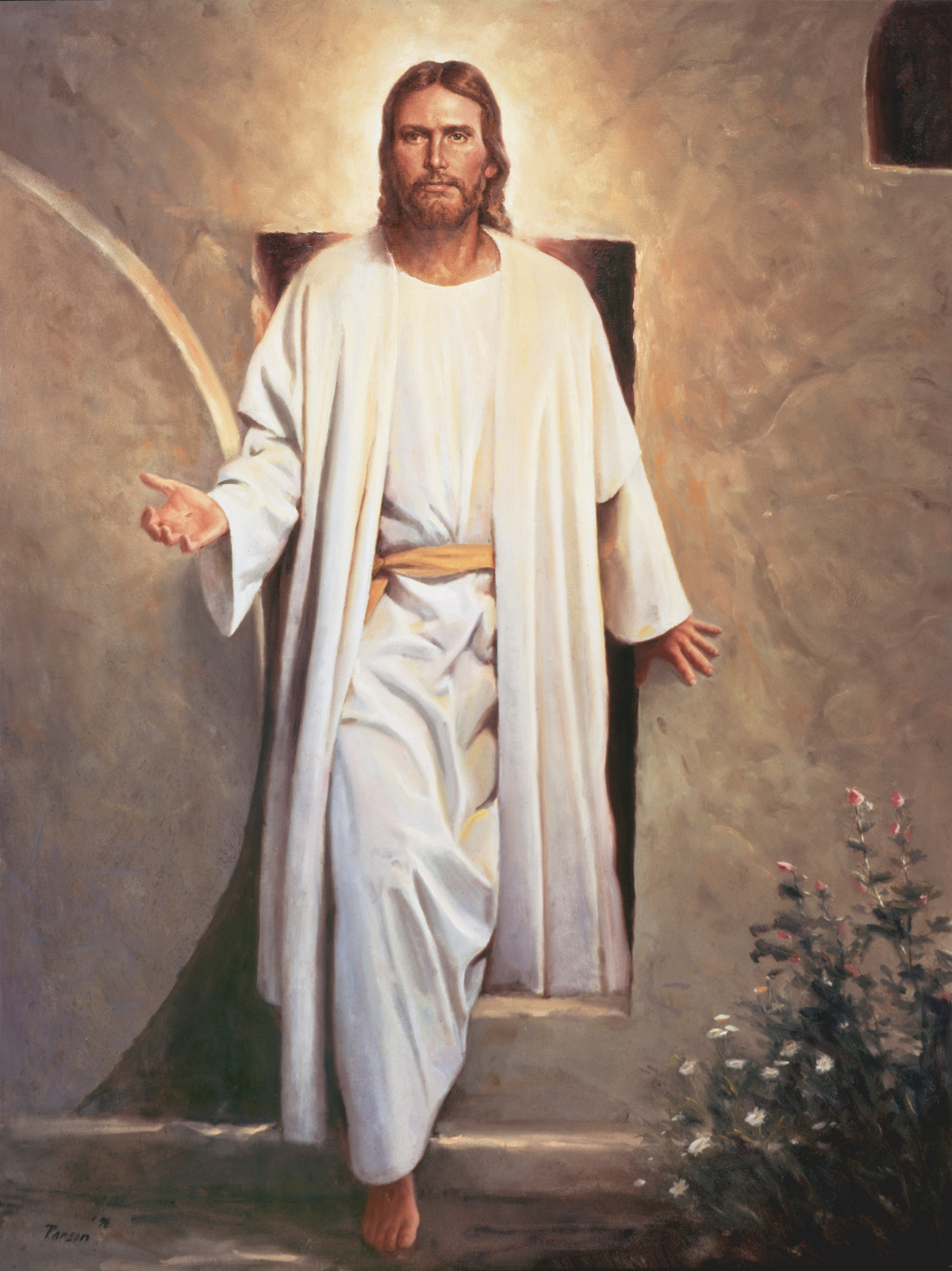
Risen from the Dead

"He is Risen" by Del Parson
Three days after his death, Jesus's tomb was found empty. He had risen from the dead and appeared first to Mary Magdalene and then to his mother Mary. They both informed the disciples, who were in hiding, and later, Jesus appeared to them and told them not to be afraid. During this brief time, he beseeched his disciples to go into the world and preach the gospel to all humanity.

After 40 days, Jesus led his disciples to Mount Olivet, east of Jerusalem. Jesus spoke his final words to them, saying that they would receive the power of the Holy Spirit, before he was taken upward on a cloud and ascended into heaven.


Quote

“Put your sword back into its place; for those who live by the sword, die by the sword." [Matthew 26:52] - Jesus Christ