Saturday, December 6, 2014

Religion of Confucianism

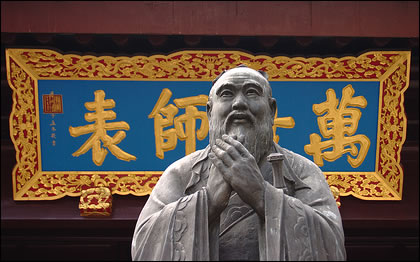
Kong Qiu (Confucius)
Traditionally, Confucianism was founded by Kong Qiu, a Chinese teacher, editor, politician, and philosopher during the Spring and Autumn period of Chinese history. 

Kong Qui was born c/552 B.C. in the state of Lu and died sometime in 479 B.C., leaving behind the percepts of Confucianism to his followers and students. The Latinized name "Confucius" (based on the honorific title Kong Fuzi, meaning "Master Kong") was introduced by Jesuit missionaries in China in the 16th century A.D.     

Confucius was instrumental in shaping Chinese social relationships and moral thought, as well as advising political figures [such as Duke Jing of Qi]. When the Duke asked the wise sage about proper administration in government that could bring about social harmony, Confucius replied simply, "There is government, when the prince is prince, and the minister is minister; when the father is father, and the son is son." (Analects 12.11) Another famous quote from the Confucius writings states the following about government: "To govern by virtue, let us compare it to the North Star: it stays in its place, while the myriad stars wait upon it." (Analects 2.1) Confucius was not only a wise sage, but a well renowned diplomat even unto our modern times. 

Many modern scholars and theologians agree that Confucianism is not classified as a religion, since the teachings of this ancient thinker contain no mention of deities or the afterlife. Confucianism could better be defined as an abstract creed. The philosophical ethics of Confucius' teachings are described as humanistic and can be practiced by all the members of society. Confucianism is characterized by the promotion of virtues, which is encompassed by the Five Constants: 

  • Rén (仁, humaneness);
  • Yì (義, righteousness or justice);
  • Lǐ (禮, proper rite);
  • Zhì (智, knowledge);
  • Xìn (信, integrity).

The Five Classics are five pre-Qin Chinese books that make up a part of the Confucian canon. Some scholars believe that Confucius was the author and editor of the Five Classics, while other theologians expand upon a theory of the texts being re-collected and edited writings of prior works by Confucius. Either way, during the Western Han dynasty Confucianism was adopted as its official ideology and became a part of the state-sponsored curriculum. It was during this epochal era that the texts first began to be considered as a set collection of five classic texts and was named accordingly. The Five Classics are:
Title (English)Title (Chinese)Brief Description
詩經
A collection of 305 poems divided into 160 folk songs, 105 festal songs sung at court ceremonies, and 40 hymns and eulogies sung at sacrifices to gods and ancestral spirits of the royal house.
尚書
A collection of documents and speeches alleged to have been written by rulers and officials of the early Zhou period and before. It is possibly the oldest Chinese narrative, and may date from the 6th century BC. It includes examples of early Chinese prose.
禮記
Describes ancient rites, social forms and court ceremonies. The version studied today is a re-worked version compiled by scholars in the third century BC rather than the original text, which is said to have been edited by Confucius himself.
(Book of Changes)
易經
The book contains a divination system comparable to Western geomancy or the West African Ifá system. In Western cultures and modern East Asia, it is still widely used for this purpose.
春秋
A historical record of the State of Lu, Confucius's native state, 722–481 BC.
Note: The Classic of Music is sometimes considered as the sixth classic but was lost in the Burning of the Books.

The Four Books are another set of Chinese classic texts considered canonical and illustrates the core value and belief system in Confucianism. They were carefully selected by Zhu Xi in the Song dynasty to serve as an introduction to Confucian thought; during the Ming and Qing dynasties the ancient texts made the official curriculum for the civil service examinations. The Four Books are:
Title (English)Title (Chinese)Brief Description
大學
Originally one chapter in the Book of Rites. It consists of a short main text attributed to Confucius and nine commentary chapters by Zeng Zi, one of Confucius's disciples. Its importance is illustrated by Zeng Zi's foreword that this is the gateway of learning.
It is significant because it expresses many themes of Chinese philosophy and political thinking, and has therefore been extremely influential both in classical and modern Chinese thought. Government, self cultivation and investigation of things are linked.
中庸
Another chapter in Book of Rites, attributed to Confucius' grandson Zisi. The purpose of this small, 33-chapter book is to demonstrate the usefulness of a golden way to gain perfect virtue. It focuses on the Way (道) that is prescribed by a heavenly mandate not only to the ruler but to everyone. To follow these heavenly instructions by learning and teaching will automatically result in a Confucian virtue. Because Heaven has laid down what is the way to perfect virtue, it is not that difficult to follow the steps of the holy rulers of old if one only knows what is the right way.
論語
A compilation of speeches by Confucius and his disciples, as well as the discussions they held. Since Confucius's time, the Analects has heavily influenced the philosophy and moral values of China and later other East Asian countries as well. The Imperial examinations, started in the Jin dynasty and eventually abolished with the founding of the Republic of China, emphasized Confucian studies and expected candidates to quote and apply the words of Confucius in their essays.
孟子
A collection of conversations of the scholar Mencius with kings of his time. In contrast to the sayings of Confucius, which are short and self-contained, the Mencius consists of long dialogues with extensive prose.
The Four Books were written before 300 B.C. and believed to have been authored and/or edited by Confucius.
From the time of the Han dynasty, scholars believed Confucius "fixed" the versions of his ancient text's original writings which became commonly known as the Classics. In the 21st century, many Chinese theologians still hold to this tradition. 
While Confucius was not particularly renowned during his lifetime, and even considered himself a failure, his incredible works of literature created one of China's most renowned religious philosophies. Even without deities and a vision of salvation, Confucianism plays much the same role as religion does in other cultural contexts.
Confucius stated that "heaven and the afterlife were beyond human capacity to understand, and one should therefore concentrate instead on doing the right thing in life." According to the earliest records, his students indicated that Confucius did not provide many moral precepts; rather he taught an attitude of respect towards fellow humans, especially towards parents, teachers and elders. This ancient sage also encouraged his followers to learn from others and honor their cultural norms. 
In modern China, as well as other areas in Asia, the social ethics and moral teachings of Confucius are blended with the Taoist communion with nature and the Buddhist concepts of the afterlife, which constitute Chinese Traditional Religion [a set of complementary and ecumenical religions]. Today, it is estimated that there are over 6.3 million adherents of Confucianism worldwide.

Thursday, November 27, 2014

Thanksgiving Day Blessings

(From Wikipedia.com)
Thanksgiving Day is a national holiday celebrated primarily in the United States and Canada as a day of giving thanks for the blessing of the harvest and of the preceding year. Several other places around the world observe similar celebrations. It is celebrated on the fourth Thursday of November in the United States and on the second Monday of October in Canada. Thanksgiving has its historical roots in religious and cultural traditions, and has long been celebrated in a secular manner as well.

History

Prayers of thanks and special thanksgiving ceremonies are common among almost all religions after harvests and at other times. The Thanksgiving holiday's history in North America is rooted in English traditions dating from the Protestant Reformation. It also has aspects of a harvest festival, even though the harvest in New England occurs well before the late-November date on which the modern Thanksgiving holiday is celebrated.

In the English tradition, days of thanksgiving and special thanksgiving religious services became important during the English Reformation in the reign of Henry VIII and in reaction to the large number of religious holidays on the Catholic calendar. Before 1536 there were 95 Church holidays, plus 52 Sundays, when people were required to attend church and forego work and sometimes pay for expensive celebrations. The 1536 reforms reduced the number of Church holidays to 27, but some Puritans wished to completely eliminate all Church holidays, including Christmas and Easter. The holidays were to be replaced by specially called Days of Fasting or Days of Thanksgiving, in response to events that the Puritans viewed as acts of special providence. Unexpected disasters or threats of judgement from on high called for Days of Fasting. Special blessings, viewed as coming from God, called for Days of Thanksgiving. For example, Days of Fasting were called on account of drought in 1611, floods in 1613, and plagues in 1604 and 1622. Days of Thanksgiving were called following the victory over the Spanish Armada in 1588 and following the deliverance of Queen Anne in 1705. An unusual annual Day of Thanksgiving began in 1606 following the failure of the Gunpowder Plot in 1605 and developed into Guy Fawkes Day.

In Canada


While some researchers state that "there is no compelling narrative of the origins of the Canadian Thanksgiving day", the first Canadian Thanksgiving is often traced back to 1578 and the explorer Martin Frobisher. Frobisher, who had been trying to find a northern passage to the Pacific Ocean, held his Thanksgiving celebration not for harvest but in thanks for surviving the long journey from England through the perils of storms and icebergs. On his third and final voyage to the far north, Frobisher held a formal ceremony in Frobisher Bay in Baffin Island (present-day Nunavut) to give thanks to God and in a service ministered by the preacherRobert Wolfall they celebrated Communion. The origins of Canadian Thanksgiving are also sometimes traced to the French settlers who came to New France with explorer Samuel de Champlain in the early 17th century, who celebrated their successful harvests. The French settlers in the area typically had feasts at the end of the harvest season and continued throughout the winter season, even sharing food with the indigenous peoples of the area. As settlers arrived in Canada from New England, late autumn Thanksgiving celebrations became common. New immigrants into the country, such as the Irish, Scottish and Germans, also added their own traditions to the harvest celebrations. Most of the U.S. aspects of Thanksgiving (such as the turkey), were incorporated when United Empire Loyalists began to flee from the United States during the American Revolution and settled in Canada. Thanksgiving is now a statutory holiday in most jurisdictions of Canada, with the exception of the Atlantic provinces of Prince Edward Island, Newfoundland and Labrador, New Brunswick and Nova Scotia.   

In the United States

Main article: Thanksgiving (United States)


Jennie Augusta Brownscombe, The First Thanksgiving at Plymouth, 1914, 
Pilgrim Hall Museum, Plymouth, Massachusetts
In the United States, the modern Thanksgiving holiday tradition is commonly, but not universally, traced to a poorly documented 1621 celebration at Plymouth in present-day Massachusetts. The 1621 Plymouth feast and thanksgiving was prompted by a good harvest. 

Pilgrims and Puritans who began emigrating from England in the 1620s and 1630s carried the tradition of Days of Fasting and Days of Thanksgiving with them toNew England. Several days of Thanksgiving were held in early New England history that have been identified as the "First Thanksgiving", including Pilgrim holidays in Plymouth in 1621 and 1623, and a Puritan holiday in Boston in 1631. According to historian Jeremy Bangs, director of the Leiden American Pilgrim Museum, the Pilgrims may have been influenced by watching the annual services of Thanksgiving for the relief of the siege of Leiden in 1574, while they were staying in Leiden. In later years, religious thanksgiving services were declared by civil leaders such as Governor Bradford, who planned a thanksgiving celebration and fast in 1623. The practice of holding an annual harvest festival did not become a regular affair in New England until the late 1660s.

Thanksgiving proclamations were made mostly by church leaders in New England up until 1682, and then by both state and church leaders until after the American Revolution. During the revolutionary period, political influences affected the issuance of Thanksgiving proclamations. Various proclamations were made by royal governors, John Hancock, General George Washington, and the Continental Congress, each giving thanks to God for events favorable to their causes. As President of the United States, George Washington proclaimed the first nation-wide thanksgiving celebration in America marking November 26, 1789, "as a day of public thanksgiving and prayer to be observed by acknowledging with grateful hearts the many and signal favours of Almighty God".

In modern times the President of the United States, in addition to issuing a proclamation, will "pardon" a turkey, which spares the bird's life and ensures that it will spend the duration of its life roaming freely on farmland.

Observance

Canada
Main article: Thanksgiving (Canada)

Pumpkin pie is commonly served on and around Thanksgiving in North America. 


Thanksgiving (French: l'Action de grâce), occurring on the second Monday in October, is an annual Canadian holiday to give thanks at the close of the harvest season. Although the original act of Parliament referencesGod and the holiday is celebrated in churches, the holiday is mostly celebrated in a secular manner. Thanksgiving is a statutory holiday in all provinces in Canada, except for New Brunswick and Nova Scotia. While businesses may remain open in these provinces, the holiday is nonetheless recognized and celebrated regardless of its status.

Grenada


In the West Indian island of Grenada, there is a national holiday known as Thanksgiving Day which is celebrated on October 25. Even though it bears the same name, and is celebrated at roughly the same time as the American and Canadian versions of Thanksgiving, this holiday is unrelated to either of those celebrations. Instead the holiday marks the anniversary of the U.S.-led invasion of the island in 1983, in response to thedeposition and execution of Grenadian Prime Minister Maurice Bishop.

Liberia


In the West African country of Liberia, which began in 1820 with the colonization of freed black slaves (Americo-Liberians) from the United States, Thanksgiving is celebrated on the first Thursday of November.

The Netherlands


Many of the Pilgrims who migrated to the Plymouth Plantation had resided in the city of Leiden from 1609–1620, many of whom had recorded their births, marriages and deaths at the Pieterskerk. To commemorate this, a non-denominational Thanksgiving Day service is held each year on the morning of the American Thanksgiving Day in the Pieterskerk, a Gothic church in Leiden, to commemorate the hospitality the Pilgrims received in Leiden on their way to the New World.

Norfolk Island


In the Australian external territory of Norfolk Island, Thanksgiving is celebrated on the last Wednesday of November, similar to the pre-World War II American observance on the last Thursday of the month. This means the Norfolk Island observance is the day before or six days after the United States' observance. The holiday was brought to the island by visiting American whaling ships.

United States

Main article: Thanksgiving (United States)

Thanksgiving, currently celebrated on the fourth Thursday in November by federal legislation in 1941, has been an annual tradition in the United States by presidential proclamation since 1863 and by state legislation since the Founding Fathers of the United States. Historically, Thanksgiving has traditionally been a celebration of the blessings of the (agricultural) year, including the harvest.

Similar holidays

See also: List of harvest festivals


Germany

A food decoration for Erntedankfest, a Christian Thanksgiving harvest festival celebrated in Germany. The Harvest Thanksgiving Festival, Erntedankfest, is an early October, German Christian festival. The festival has a significant religious component to it, but also, like its North American counterpart, includes large harvest dinners (consisting mostly of autumn crops) and parades. The Bavarian beer festival Oktoberfest generally takes place within the vicinity of Erntedankfest.

Japan

Main article: Labor Thanksgiving Day

Labor Thanksgiving Day (勤労感謝の日 Kinrō Kansha no Hi?) is a national holiday in Japan. It takes place annually on November 23. The law establishing the holiday, which was adopted during the American occupation after World War II, cites it as an occasion for commemorating labor and production and giving one another thanks. It has roots in an ancient harvest ceremony (Niiname-sai (新嘗祭?)) celebrating hard work.