The Ark of the Covenant is one of the greatest unsolved mysteries of antiquity. The story of the sacred ark is familiar to many, yet the enigmatic subject is seldom discussed or dissected by the modern theologians of religious studies.
What Is The Ark of the Covenant? (from Wikipedia.com)

According to the Book of Exodus, Yahweh (God) came to Moses during his 40-day stay upon Mount Sinai and instructed him to build a sacred 'box' made of shittim wood to house the divine Tablets of Stone, which were the Ten Commandments (Exodus 19:20; 24:18). The prophet of Yahweh was given the pattern and furnishings required of the Ark; Moses employed Bezalel and Oholiab to construct the divine chest and built it according to the Creator's detailed and specific instructions (Exodus 31). The Ark was placed in a special tent known as the Tabernacle, when it was not being carried across the wilderness during the 40 year Hebrew exodus. A description of the Ark can be found in the following chapters of Exodus: 25, 26, 27.
What Was The Purpose of the Ark?
As mentioned above, God instructed Moses to build a sacred box to store the divine Tablets of Stone, that were written by the hand of Yahweh himself, for safe keeping. The Hebrew priests became the vanguard of the Ark, starting with Aaron (brother of Moses) and the first high priest of the Israelite nation. When the Israelites, led by Joshua who was leading the exodus toward the Promised Land, arrived at the banks of the River Jordan, the Ark was carried in the lead preceding the people. During the crossing, the river grew dry as soon as the feet of the priests carrying the Ark touched its waters, and remained so until the priests—with the Ark—left the river after the people had passed over. As a memorial for this great miracle, twelve stones (representing the twelve tribes of Israel) were taken from the River Jordan at the place where the priests had stood (Joshua 3 and 4).
As mentioned above, God instructed Moses to build a sacred box to store the divine Tablets of Stone, that were written by the hand of Yahweh himself, for safe keeping. The Hebrew priests became the vanguard of the Ark, starting with Aaron (brother of Moses) and the first high priest of the Israelite nation. When the Israelites, led by Joshua who was leading the exodus toward the Promised Land, arrived at the banks of the River Jordan, the Ark was carried in the lead preceding the people. During the crossing, the river grew dry as soon as the feet of the priests carrying the Ark touched its waters, and remained so until the priests—with the Ark—left the river after the people had passed over. As a memorial for this great miracle, twelve stones (representing the twelve tribes of Israel) were taken from the River Jordan at the place where the priests had stood (Joshua 3 and 4).
According to the narrative of the Battle of Jericho, the Ark was carried around the city once a day for seven (7) days, preceded by the armed men and seven (7) priests sounding seven (7) trumpets of rams' horns (Joshua 6:4-15). On the seventh day, the priests sounding the trumpets of rams' horns before the Ark marched around the city seven (7) times and, with a great shout, Jericho's wall fell down and the Israelites took the city (Joshua 6:16-20).
After the defeat at Ai, Joshua lamented before the Ark (Joshua 7:6-9). When Joshua read the Law to the people between Mount Gerizim and Mount Ebal, they stood on each side of the Ark.
In retrospect, the main purpose of the Ark of the Covenant was to not only protect the Israelites, but for the Israelites to give the respect due to their Great Creator.
Where Was The Ark Located?
 After a short stay in Gilgal, the Ark was moved to Shiloh by Joshua, not long after the settlement of the Israelites in Canaan, during Samuel's apprenticeship (1 Sam. 3:3). The Ark remained in the Tabernacle at Shiloh until the time of Eli, between 300 and 400 years (Jeremiah 7:12), when it was carried into the field of battle. The Ark was taken by the Philistines (1 Samuel 4:3-11) who subsequently sent it back after retaining it for seven (7) months (1 Sam. 5:7, 8) because of the unfortunate events said to have transpired. For further information about the capture of the Ark by the Philistines, please visit Philistine captivity of the Ark.
The Philistines, on the advice of their diviners, returned the Ark to the Israelites, accompanying its return with an offering consisting of golden images of the tumors and mice [wherewith they had been afflicted]. The Ark was set in the field of Joshua the Beth-shemesh (1 Samuel 6:1-15). Out of curiosity the men of Beth-shemesh gazed at the Ark; and as a punishment, seventy of them were smitten by the Lord (1 Samuel 6:19). The Bethshemites sent to Kirjath-jearim to have the Ark removed (1 Samuel 6:21); and it was taken to the house of Abinadab, whose son, Eleazar, was sanctified to keep watch over it. Kirjath-jearim remained the abode of the Ark of the Covenant for twenty years. Under Saul, the Ark was with the army before he first met the Philistines, but the king was too impatient to consult it before engaging in battle... hence the capture of the Ark by the Philistines. In 1 Chronicles 13:3 it is stated that the people did consult the Ark in the days of Saul.
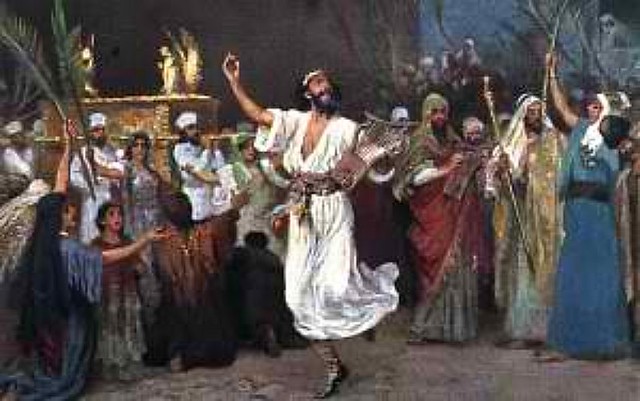 During the early reign of King David, he removed the Ark from Kirjath-jearim, but abandoned it before entering Zion. Uzzah, one of the drivers of the cart whereon the Ark was carried, put out his hand to steady the Ark, and was smitten by God for touching it. David, in fear, carried the Ark aside into the house of the Obed-edom the Gittite and there it stayed three (3) months (2 Samuel 6:1-11; 1 Chronicles 13:1-13). When King David learned that God had blessed Obed-edom, he had the Ark brought to Zion by the Levites. The Levites were appointed to minister before the Ark (1 Chronicles 16:4). David's plan of building a temple for the Ark was halted at the advice of God (2 Sam. 7:1-17; 1 Chron. 17:1-15; 28:2, 3). The Ark was with the army during the siege of Rabbah (2 Sam. 11:11); and, when David fled from Jerusalem at the time of Absalom's conspiracy, the Ark was carried along with him until he ordered Zadok the priest to return it to Jerusalem (2 Sam. 15:24-29). For further information about the return of the Ark to King David's possession, please visit: Ark of the Covenant in Zion
King Solomon worshipped before the Ark after his dream in which God promised him wisdom (1 Kings 3:15). During the construction of Solomon's Temple, a special inner room, named Kodesh Hakodashim (Holy of Holies), was prepared to receive and house the Ark (1 Kings 6:19). When the Temple was dedicated, the Ark was placed in the inner holy room (1 Kings 8:6-9) and there it remained for over the next three hundred years. It is written, when the priests emerged from the holy place after placing the Ark there, the Temple was filled with a cloud, "for the glory of the Lord had filled the house of the Lord" (1 Kings 8:10-11; 2 Chron. 5:13, 14)
What Happened to the Ark?
In 586 BC, the Babylonians destroyed Jerusalem and Solomon's Temple. However, there is no record of what became of the Ark in the Books of Kings and Chronicles. But, the 3rd Book of Ezra (1 Esdras) suggests that the Babylonians:
"...took all the holy vessels of the Lord, both great and small, and the ark of God, and the king's treasures, and carried them away into Babylon." (1 Esdras 1:54)
In Rabbinic Literature, the final disposition of the Ark is disputed. Some Rabbis hold that it must have been carried off to Babylon, while others claim that it must have been hidden lest it be carried off into Babylon and never brought back. According to the Jewish book of Second Maccabees and the Greek text in the Septuagint, at the beginning of chapter 2:
The records show that it was the prophet Jeremiah who, .... prompted by a divine message ... gave orders that the Tent of Meeting and the ark should go with him. Then he went away to the mountain from the top of which Moses saw God's promised land. When he reached the mountain, Jeremiah found a cave-dwelling; he carried the tent, the ark, and the incense-altar into it, then blocked up the entrance. Some of his companions came to mark out the way, but were unable to find it. When Jeremiah learned of this, he reprimanded them. 'The place shall remain unknown', he said, 'until God finally gathers his people together and shows mercy to them. The Lord will bring these things to light again, and the glory of the Lord will appear with the cloud, as it was seen both in the time of Moses and when Solomon prayed that the shrine might be worthily consecrated.' (II Maccabees 2:4-8.)
Note: The "mountain from the top of which Moses saw God's promised land" would be Mount Nebo, located in what is now Jordan.
In the New Testament of the Christian Bible, the Ark is mentioned in Hebrews 9:4 and Revelation 11:19 and states that the Ark contained "the golden pot that had manna, and Aaron's rod that budded, and the tablets of the covenant." (Hebrews); and, says the prophet saw God's temple in heaven opened, "and the ark of his covenant was seen within his temple." (Revelation). But it does not enlighten the reader about what actually happened to the Ark.
In Sura 2:248, of the Islamic Qur'an, the Children of Israel, at the time of Samuel and Saul, were given back the Tabut E Sakina (the casket of Shekhinah) which contained remnants of the household of Musa (Moses) and Harun (Aaron) carried by angels which confirmed peace and reassurance for them from their Lord. The Qur'an states:
"And (further) their Prophet said to them: "A Sign of his authority is that there shall come to you the Ark of the Covenant, with (an assurance) therein of security (Sakina) from your Lord, and the relics left by the family of Moses and the family of Aaron, carried by angels. In this is a symbol for you if ye indeed have faith."
The Islamic scholar Al Baidawi mentioned that the sakina could be Tawrat, the Books of Moses. According to Al-Jalalan, the relics in the Ark were the fragments of the two tablets, rods, robes, shoes, mitres of Moses and the vase of manna. According to most Muslim scholars, the Ark of the Covenant has a deep religious basis in Islam, and Islam gives it special significance. A Shia sect of Muslims believe that it will be found by Mahdi near the Qiyamah (end of times) from Lake Tiberias.
For further information about the Islamic history of the Ark, please visit Qisas Al-Anbiya (The Stories of the Prophets).
Current Theoretical Locations of the Ark...

The Lemba people of South Africa and Zimbabwe have claimed that their ancestors carried the Ark south, calling it the ngoma lungundu ("voice of God"), eventually hiding it in a deep cave in the Dumghe mountains, their spiritual home. On 14 April 2008, in a UK Channel 4 documentary, Tudor Parfitt, taking a literalistic approach to the Biblical story, described the research and theories of his claim. He says that the object described by the Lemba have several attributes similar to the Ark. It was of similar size, was carried on poles by priests, was not allowed to touch the ground, was revered as a voice of their God, and was a weapon of great power used to sweep enemies aside.
In his book, The Lost Ark of the Covenant (2008), Parfitt also suggests that the Ark was taken to Arabia following the events depicted in the Second Book of Maccabees, and cites Arabic sources which maintain it was brought in distant times to Yemen.
 French author Louis Charpentier insisted that the Ark was taken to Chartres Cathedral by the Knights Templar. In 2003, author Graham Phillips hypothetically claimed that the Ark was taken to Mount Sinai in the Valley of Edom by the Maccabees. Phillips concluded it remained there until the 1180s, when Ralph de Sudeley, the leader of the Templars found the Maccabean treasure at Jebel al-Madhbah, returned home to his estate at Herdewyke in Warwickshire, England and taking the treasure with him
Several modern authors of recent times have theorised that the Ark was taken from Jerusalem to the village of Rennes-le-Château in Southern France. Karen Ralls has cited Freemason Patrick Byrne, who believes the Ark was moved from Rennes-le-Château at the outbreak of World War I to America
The Ark of the Covenant was said to have been kept in the Basilica of St. John Lateran, surviving the pillages of Rome by Genseric and Alaric I but lost when the basilica burned.
~ ~ ~ ~ ~ ~ ~ ~ ~ ~ ~ ~
In the Book of Jeremiah, it is referenced by the prophet Jeremiah, who [speaking in the days of King Josiah] prophesied a future time, possibly the end of days, when the Ark will no longer be talked about or be made again:
"And it shall be that when you multiply and become fruitful in the land, in those days - the word of the LORD - they will no longer say, 'The Ark of the Covenant of the LORD' and it will not come to mind; they will not mention it, and will not recall it, and it will not be used any more." - Jeremiah 3:16
Rashi comments on this verse that "The entire people will be so imbued with the spirit of sanctity that God's Presence will rest upon them collectively, as if the congregation itself was the Ark of the Covenant."
Yet the question still remains... What really happened to the sacred Ark of the Covenant and where is it today?


