Sunday, November 11, 2012

Biblical Veterans of War

The Bible is filled with many "Veterans of War". From the beginning of time war has been a part of mankind's agenda in obliterating evil from this planet... with the majority of the battles being victorious where Israel is concerned. War is defined as "a conflict carried on by force of arms between nations and a period of armed hostility." To hear the variety of responses coming from various churches, mosques and synagogues, one would think that the Scriptures were either silent or irrevocably confused about the purpose of these holy wars. Perhaps the reason for this confusion comes from an attempt to distort a very difficult issue? Or perhaps one just does not comprehend the reason for such brutal events throughout mankind's history? Was mankind meant to understand? Or is mankind destined to continue consecrated combats in the name of the universal Creator? Who knows? And, Who's ? Right ...

A Biblical Definition of War:

The Israelites had to take possession of the Promised Land by conquest. They had to engage in a long and bloody war before the Canaanite tribes were finally defeated and subdued. Except in the case of Jericho and Ai, war did not become overly aggressive till after the death of Joshua. However, God employed the Israelites to sweep the Canaanites from the face of the earth to do away with the evil they inflicted. In the days of King Saul and King David the people of Israel engaged in many conflicts with the ancient nations that surrounded them [ie: Egypt, Assyria, Babylon]. From the first Israelite battle in the BC era to our present time, there have been few periods of peace for Israel and the Jews.

The life of the Christian is also described as 'warfare' and the Christian graces are represented as figurative pieces of armour [Eph. 6:11-17; Thess. 5:8; II Tim. 2:3, 4]. The Crusades were a series of religious expeditionary wars against Muslims blessed by Pope Urban II and the Catholic Church, with the stated goal of restoring Christian access to the holy places in and near Jerusalem. Even though Muslims and Jews fought together to hold back the first of many Christian takeovers, they were unsuccessful in keeping their land.   

In Islam, major battles arose between the Meccans and the Muslims. The Battle of Badr in 624 AD was one of the most important and well-known victory for the Muslims. It is recorded in the Qu'ran that Allah sent an "unseen army of angels" that helped the Muslims defeat the Meccans. This Muslim triumph over polytheists showed “demonstration of divine guidance and intervention on behalf of Muslims, even when outnumbered".

Biblical Heroes of War:
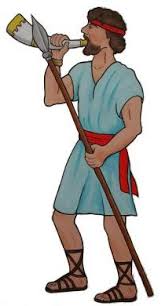
Joshua... is a figure in the Torah, being one of the spies for Israel (Num. 13–14) and in few passages as Moses' assistant. He is the central character in the Hebrew Bible's Book of Joshua. According to the books Exodus, Numbers and Joshua, he became the leader of the Israelite tribes after the death of Moses. He led the Israelite tribes in the conquest of Canaan, and allocated the land to the tribes afterwards. At the Jordan River, the waters parted, as they had for Moses at the Red Sea. The first battle after the crossing of the Jordan was the Battle of Jericho. Joshua led the destruction of Jericho, then moved on to Ai, a small neighboring city to the west. However, they were defeated with thirty-six Israelite deaths. The defeat was attributed to Achan taking an "accursed thing" from Jericho; and was followed by Achan and his family and animals being stoned to death to restore God's favor. Joshua then went to defeat Ai. The Israelites faced an alliance of Amorite kings from Jerusalem, Hebron, Jarmuth, Lachish, and Eglon. At Gibeon Joshua asked God to cause the sun and moon to stand still, so that he could finish the battle in daylight. This event is most notable because "there was no day like that before it or after it, that the LORD hearkened unto the voice of a man: for the LORD fought for Israel." (Joshua 10:14) God also fought for the Israelites in this battle, for he hurled huge hailstones from the sky which killed more Canaanites than those which the Israelites slaughtered. From there on, Joshua was able to lead the Israelites to several victories, securing much of the land of Canaan.

"Be strong and of good courage; do not be afraid, nor be dismayed, for the Lord your God is with you wherever you go." (Joshua 1:9)
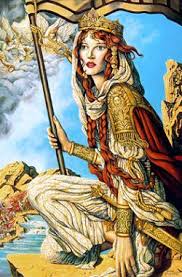
Deborah...was a prophetess of the God of the Israelites, the fourth Judge of pre-monarchic Israel, counselor, warrior, and the wife of Lapidoth according to the Book of Judges chapters 4 and 5. She was the only female judge mentioned in the Bible. Deborah led a successful counterattack against the forces of Jabin, king of Canaan, and his military commander Sisera. After being oppressed by Jabin in Hazor, for twenty years, Deborah prevailed upon Barak who was the head captain of the army at that time, to face the Assyrian General Sisera, the commander of Jabin's army, in battle. The victory to which the Bible refers is the victory of an Israelite force of ten thousand over Sisera's force of nine hundred iron chariots. (Judges 4:10) When Deborah saw the army, she said, according to Judges 4:14: "Up; for this is the day in which the LORD hath delivered Sisera into thine hand: is not the LORD gone out before thee? So Barak went down from Mount Tabor, and ten thousand men after him." As Deborah prophesied, the Lord gave the victory to the Israelites. Sisera fled the battle site seeking refuge in the tent of the woman Jael, who killed the enemy leader, Sisera. The biblical account of Deborah ends in Judges 5 and there was peace in the land for 40 years after the battle.

"On that day God subdued Jabin king of Canaan before the Israelites. And the hand of the Israelites pressed harder and harder against Jabin king of Canaan until they destroyed him." (Judges 4:23-24)
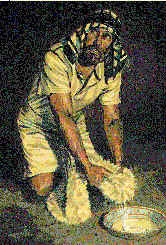
Gideon... which means "Mighty warrior" was a judge of the Hebrews and his story is recorded in chapters 6 to 8 in the Book of Judges in the Hebrew bible. He was reluctant of God's command to destroy his enemies, but did follow through and on God's instruction, Gideon destroyed the town's altar to the foreign god Baal and the symbol of the goddess Asherah beside it. He went on to send out messengers to gather together men from the tribes of Asher, Zebulun, and Naphtali, as well as his own tribe Manasseh in order to meet an armed force of the people of Midian and the Amalek that had crossed the Jordan River and were encamped in the Valley of Jezreel. However, God informed Gideon that the men he had gathered were too many – with so many men, there would be reason for the Israelites to claim the victory as their own instead of acknowledging that God had saved them. God first instructed Gideon to send home those men who were afraid. Gideon then allowed any man who wanted to leave, to leave; 22,000 men returned home and 10,000 remained. Yet the number was still too many, according to God. Finally with 300 men, Gideon claimed the victory over the Midianites "The Lord said to Gideon, "With the 300 men that lapped I will save you and give the into your hands. Let all the other men go, each to his own place." (Judges 7:7) Even though Gideon required signs from God before he did His will, he was a great hero of war. Now the Ephraimites asked Gideon, “Why have you treated us like this? Why didn’t you call us when you went to fight Midian? And they challenged him vigorously. But he answered them, “What have I accomplished compared to you? Aren’t the gleanings of Ephraim’s grapes better than the full grape harvest of Abiezer? God gave Oreb and Zeeb, the Midianite leaders, into your hands. What was I able to do compared to you?” At this, their resentment against him subsided. (Judges 8:1-3) 
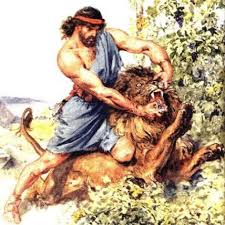
Samson... is the third-to-last of the Judges of the ancient Israelites mentioned in the Tanakh (the Hebrew Bible) and his story is related in the Book of Judges chapters 13 to 16. Samson was granted supernatural strength by God in order to combat his enemies and perform heroic feats such as wrestling a lion, slaying an entire army with only the jawbone of a donkey, and destroying a pagan temple. It was part of God's plan for Samson to fall in love with a Philistine woman [the Philistines were enemies to the Israelites]. At the wedding-feast, Samson proposes that he tell a riddle to his thirty groomsmen (all Philistines); if they can solve it, he will give them thirty pieces of fine linen and garments. The riddle, "Out of the eater, something to eat; out of the strong, something sweet", is a veiled account of his second encounter with the lion he had killed with his bare hands (at which only he was present). The Philistines are infuriated by the riddle. The thirty groomsmen tell Samson's new wife that they will burn her and her father's household if she does not discover the answer to the riddle and tell it to them. At the urgent and tearful imploring of his bride, Samson tells her the solution, and she tells it to the thirty groomsmen... "What is sweeter than honey? And what is stronger than a lion?"  Samson killed the whole lot after he found out they had pressured his wife for the answer and then murdered her. He later met and fell in love with a woman named Delilah [another Philistine] who also betrayed him and caused his death at the pagan temple. However, with the help of God, Samson was able to destroy the pagan temple before he died.

"Samson led Israel for twenty years in the days of the Philistines." Judges 16:20 
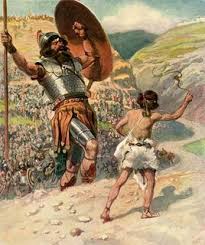
King David... the account of the battle between David and Goliath is written about  in 1 Samuel, chapter 17. Saul and the Israelites were contemplating a war with the Philistines at the Valley of Elah. Twice a day for 40 days, Goliath, the champion of the Philistines, comes out between the lines and challenges the Israelites to send out a champion of their own to decide the outcome in single combat, but Saul and all the Israelites were afraid. David, bringing food for his elder brothers, hears that Saul has promised to reward any man who defeats Goliath, and accepts the challenge. Saul reluctantly agrees and offers his armor, which David declines, taking only his sling and five stones from a brook. David and Goliath confront each other; Goliath with his armor and shield, David with his staff and sling. Goliath the Philistine cursed David by his gods, but David replies: "This day the LORD will deliver you into my hand, and I will strike you down; and I will give the dead bodies of the host of the Philistines this day to the birds of the air and to the wild beasts of the earth; that all the earth may know that there is a God in Israel, and that all this assembly may know that God saves not with sword and spear; for the battle is God’s, and he will give you into our hand." David hurls a stone from his sling with all his might and hits Goliath in the center of his forehead, Goliath falls on his face to the ground, and David cuts off his head. The Philistines flee and are pursued by the Israelites "as far as Gath and the gates of Ekron". David puts the armor of Goliath in his own tent and takes the head to Jerusalem, and Saul sends Abner to bring the boy [David] to him. The king asks whose son he is, and David answers, "I am the son of your servant Jesse the Bethlehemite." The purpose of the original story was to show David's identity as the true king of Israel.

"So David triumphed over the Philistine with a sling and a stone; without a sword in his hand he struck down the Philistine and killed him." (I Samuel 17:50)

The Maccabees...
in the biblical narrative of  I Maccabees, after Antiochus  (ruler of the Seleucid Empire from 175 BC until his death in 164 BC.) issued his decrees forbidding Jewish religious practice in the nation, a rural Jewish priest from Modiin, Mattathias [the Hasmonean], sparked the revolt against the ancient  Seleucid Empire by refusing to worship their Greek gods.  Mattathias killed a Hellenistic Jew who stepped forward to offer a sacrifice to an idol in Mattathias' place. He and his five sons fled to the wilderness of Judah. After Mattathias' death about one year later in 166 BC, his son, Judas Maccabee, led an army of Jewish dissidents to victory over the Seleucid dynasty in guerrilla warfare, which at first was directed against Hellenizing Jews, of whom there were many. The Maccabees destroyed pagan altars in the villages, circumcised boys and forced Jews into outlawry. The term Maccabees was used to describe the Jewish army and taken from the Hebrew word for "hammer". The revolt itself involved many battles, in which the Maccabean forces gained notoriety among the Seleucid army for their use of guerrilla tactics. After the victory, the Maccabees entered Jerusalem in triumph and ritually cleansed the Temple, reestablishing traditional Jewish worship there and installing Jonathan Maccabee as high priest. A large Seleucid army was sent to quash the revolt, but returned to Syria on the death of Antiochus IV. Its commander Lysias, preoccupied with internal Seleucid affairs, agreed to a political compromise that restored religious freedom. The Jewish festival of Hanukkah celebrates the re-dedication of the Temple following Judah Maccabee's victory over the Seleucids. According to Rabbinic tradition, the victorious Maccabees could only find a small jug of oil that had remained uncontaminated by virtue of a seal, and although it only contained enough oil to sustain the Menorah for one day, it miraculously lasted for eight days, by which time further oil could be procured.
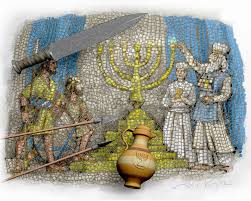
Mattathias calls upon people loyal to the traditions of Israel to oppose the invaders and the Jewish Hellenizers, and his three sons begin a military campaign against them. There is one complete loss of a thousand Jews (men, women and children) to Antiochus when the Jewish defenders refuse to fight on the Sabbath. The other Jews then reason that, when attacked, they must fight even on the holy day. In 165 BC the Temple is freed and reconsecrated, so that ritual sacrifices may begin again. The festival of Hanukkah is instituted by Judas Maccabeus and his brothers to celebrate this event (1 Macc. iv. 59).
~ * ~ * ~ * ~ * ~ * ~ * ~

"No king is saved by the size of his army; no warrior escapes by his great strength." (Psalm 33:16)


Sunday, November 4, 2012

A Few End-Time Promises

Revelation 21:1-8 & 24-27

(King James Version)
 
21 And I saw a new heaven and a new earth: for the first heaven and the first earth were passed away; and there was no more sea.
 
New Jerusalem
2 And I, John, saw the holy city, new Jerusalem, coming down from God out of heaven, prepared as a bride adorned for her husband.
 
3 And I heard a great voice out of heaven saying, Behold, the tabernacle of God is with men, and he will dwell with them, and they shall be his people, and God himself shall be with them, and be their God.
 
4 And God shall wipe away all tears from their eyes; and there shall be no more death, neither sorrow, nor crying, neither shall there be any more pain: for the former things are passed away.
 
5 And he that sat upon the throne said, Behold, I make all things new. And he said unto me, Write: for these words are true and faithful.
 
6 And he said unto me, It is done. I am Alpha and Omega, the beginning and the end. I will give unto him that is athirst of the fountain of the water of life freely.
 
7 He that overcometh shall inherit all things; and I will be his God, and he shall be my son.
 
Lake of Fire and Brimstone
8 But the fearful, and unbelieving, and the abominable, and murderers, and whoremongers, and sorcerers, and idolaters, and all liars, shall have their part in the lake which burneth with fire and brimstone: which is the second death.   
 
 
24 And the nations of them which are saved shall walk in the light of it: and the kings of the earth do bring their glory and honour into it.
 

25 And the gates of it shall not be shut at all by day: for there shall be no night there.
 
26 And they shall bring the glory and honour of the nations into it.
 
27 And there shall in no wise enter into it any thing that defileth, neither whatsoever worketh abomination, or maketh a lie: but they which are written in the Lamb's book of life.
 
 
Lamb's Book of Life


Wednesday, October 31, 2012

Halloween Hodgepodge


Happy Halloween Vintage
 
The history of Halloween is steeped rich in pagan customs, traditions and rituals. While the roots of this holiday can be dated back to the 5th century BC and Celtic legends, the seed of the holdiay was planted in Greek mythology through the portrayal of the goddesses invoking the Samhain.

 
The festival of Samhain is a celebration of the end of the harvest season in Gaelic culture and was a time used by the ancient pagans to take stock of supplies and prepare for the winter season. 
 
Brief History of Halloween:

The word itself, "Halloween," actually has its origins in the Catholic Church. It comes from a contracted corruption of All Hallows Eve. November 1, "All Hollows Day" (or "All Saints Day"), is a Catholic day of observance in honor of saints. But, in the 5th century BC, in Celtic Ireland, summer officially ended on October 31. The holiday was called Samhain (sow-en), the Celtic New year.

One story says that, on that day, the disembodied spirits of all those who had died throughout the preceding year would come back in search of living bodies to possess for the next year. It was believed to be their only hope for the afterlife. The Celts believed all laws of space and time were suspended during this time, allowing the spirit world to intermingle with the living.

Naturally, the still-living did not want to be possessed. So on the night of October 31, villagers would extinguish the fires in their homes, to make them cold and undesirable. They would then dress up in all manner of ghoulish outfits (similar to today's Halloween Costumes, and noisily parade around the neighborhood, being as destructive as possible in order to frighten away spirits looking for bodies to possess.

For more explanations and legends, please visit: http://wilstar.com/holidays

Halloween Superstitions:

Halloween superstitions are fairly modern concepts with a trace of ancient inferences. The following superstitions are mainly recognized during the Halloween holiday:
  • Black Cats - Often used as symbols of bad luck, black cats grace many Halloween decorations. The black cat's bad reputation dates back to the Dark Ages, when witch hunts were commonplace. Elderly, solitary women were often accused of witchcraft, and their pet cats were said to be their "familiars," or demonic animals that had been given to them by the devil.
  • Bats - Medieval folklore also described bats as witches' familiars, and seeing a bat on Halloween was considered to be quite an ominous sign. One myth was that if a bat was spotted flying around one's house three times, it meant that someone in that house would soon die. Another myth was that if a bat flew into your house on Halloween, it was a sign that your house was haunted because ghosts had let the bat in.
  • Witches - The stereotypical image of the haggard witch with a pointy black hat and warty nose stirring a magical potion in her cauldron actually stems from a pagan goddess known as "the crone," who was honored during Samhain. The crone was also known as "the old one" and the "Earth mother," who symbolized wisdom, change, and the turning of the seasons. Today, the kind, all-knowing old crone has morphed into the menacing, cackling witch.
  • Halloween Colors - The traditional Halloween colors of orange and black actually stem from the pagan celebration of autumn and the harvest, with orange symbolizing the colors of the crops and turning leaves, while black marks the "death" of summer and the changing season. Over time, green, purple and yellow have also been introduced into the color scheme of Halloween decorations.
  • Candy Corn - The candy most synonymous with Halloween, candy corn was invented in the late 1880s and began to be mass-produced in the early 1900s. The original process for making candy corn was cumbersome and time-consuming, as each color of syrup had to be heated up in large vats and carefully poured by hand into specially shaped molds. But the yellow, orange and white candy — meant to resemble a corn kernel — was a huge hit and remains a popular part of Halloween to this day.    

image photo : Halloween
 
 
For more information about Halloween Superstitions, please visit: http://www.livescience.com/16677-halloween-superstitions-traditions.html
 
Halloween Legends:
 
There are various legends associated with the holiday known as Halloween and many believe certain things can transpire if precautions are not taken. Here are just a few of those legends:
 
  • A burning a candle inside a jack-o-lantern on Halloween keeps evil spirits and demons at bay.
  • Gazing into a flame of a candle on Halloween night will enable you to peer into the future.    
  •  
  • Girls who carry a lamp to a spring of water on this night can see their future husband in the reflection.
  • If a candle suddenly goes out by itself on Halloween, as though by breath or wind, it is believed that a ghost has come to call.
For more information on Halloween legends, please visit http://www.theholidayspot.com.htm
 
~  ~  ~  ~  ~  ~  ~  ~  ~  ~  ~  ~  ~  ~  ~
 

 Today, Halloween is mainly recognized by Western Christians, but is celebrated worldwide by many non-Christians as well. From trick or treating to eerie adult activities, Halloween - which is relatively new to America, becoming popular in the early 1900's -  is commonly the most celebrated holiday, next to Christmas. This holiday, which received its beginnings from paganistic ideals, has been converted into a day filled with pranks, satisfying the sweet tooth and a fun-filled expectation of celebrating in disguise.
 
 
HAPPY HALLOWEEN!
 

Sunday, October 21, 2012

Religion of the Pagan

Paganism typically refers to religious traditions which are polytheistic or indigenous and dates back almost to beginning of historical mankind. The Christian perspective of Paganism historically encompasses all non–Abrahamic religions. The term pagan is a Christian adaptation of the "gentile" of Judaism, and as such has an inherent Abrahamic bias, and pejorative connotations among monotheists, comparable to heathen and infidel. Words such as kafir and mushrik are similarly used by Muslims.  

(The following excerpts below were taken from theurbanpagan.com)  

"Pagan" means different things to different people.


At its broadest, Pagan religion can be defined as any religion that is neither Christian, Jewish, nor Muslim, or even irreligious or hedonistic. (Dictionary.com). However, through common usage, the term has come to mean a practitioner of any earth-based or polytheistic religion. The less used (and marginally more accurate) term for this is "Neopaganism" or the "Neopagan Movement".  

"Pagan" is closely associated, and often used interchangeably, with "Wiccan". However, the two words do not have exactly the same meaning. Wicca is a slightly more specific term, and has been in the news and public eye a fair amount in the past several years. Wicca is a somewhat formalized system of religion that follows a Neopagan framework, but not all Pagans are Wiccan.  
 
I define Paganism as a religious or spiritual faith, primarily defined by respect for the Earth and the cycle of nature, with an understanding that mankind is an integral part of the natural order. A Pagan is someone who follows the beliefs of Paganism. These are fairy broad definitions. Each Pagan tradition varies in the way it treats these basic doctrines.  

Traditions are the various "churches" of Wicca and many other Pagan religions. Each Tradition has its own rituals, initiations and opinions about how things "should" be done.

Brief History of Modern Pagan Religion:  

The Wiccan religion was first openly practiced in England in the 1954 by Gerald Gardner. It was spread into the US in the 1960s by Raymond Buckland, founder of Seax-Wicca. Anyone interested in the details of the history of Wicca can read more about it here. Those who claim to be a Pagan, rather than strictly Wiccan, would not want to speak too strongly on this matter.

There are two major branches of Wicca: Traditional and Eclectic. Traditional Wicca is a Mystery Religion, meaning that the deeper meaning of rituals and certain practices are hidden from the outside world. Most of the Traditional Wicca groups include a decreed initiation system, perform rituals skyclad, and worship both God and Goddess. Eclectic Wicca is harder to define, since the beliefs and practices are always subject to interpretation and alteration. However, Eclectic Wicca is basically an all-purpose term applied to Neo-Wiccan traditions that generally do not fit into any specific category. Eclectic Wiccans generally follow a solitary path, but there are some covens that proclaim to be of this elusive group.

The biggest issue early Wiccans faced was a complete lack of knowledge of their faith by the general public. In the western world of the day, it was generally believed you where Christian, or you were wrong. Other faith generally didn't even enter into the equation. Even the Jewish faith was barely tolerated in most communities. The general public not only didn't know about faiths other than their own, they didn't want to know, and weren't given any reason to need to know.  

Today's Pagan faces a different challenge. Rather than the uniformed ignorance of years past, today there is a massive amount of false [and partly true] information about the Pagan Religion in the media. I'm not talking about slanted documentaries that can be found on educational TV, although those can be bad enough. I'm talking about what movies and popular television are "teaching" people about Paganism through movies like The Craft and Practical Magic, and through TV shows like Charmed and Buffy the Vampire Slayer. I often say the trying to learn Magic or Paganism from these stories is like trying to learn Catholicism from The Exorcist and John Carpenter's Vampires. The image of Magic, Wicca and Paganism presented by Hollywood is very different than the way it is in the real world.  

For more information about Paganism, please visit the following links: 

Sunday, October 14, 2012

Pre-Historic Mankind

While the scientists geologically proclaim the planet to be billions of years old, the timeline of mankind purports to be anywhere from 100,000 to 500,000 years old. According to pre-historic chronologies, the historical aspect of mankind reports about 6,000 years. It is a known fact that history can sometimes cause contradiction and confliction, such as the creation/evolution debate that has been going on for some time now, so actual facts are lacking when researching pre-historic mankind.
 
image photo : Stoneage Man
Stone-Age man
When researching the aspects of pre-history it is restricted to material processes, remains and artifacts rather than written records, which makes the findings of pre-history somewhat anonymous. In addition, human pre-history differs from history (the written form) because it deals with the activities of archaeological cultures instead of  nations or individuals. Pre-history is commonly divided into three  consecutive time periods - Stone Age, Bronze Age, and Iron Age - which are named for their respective predominant tool-making technologies. The terms are modern labels that are often subject to debate. It is interesting to note that marking the end of pre-history varies according to culture and region [ie: in Egypt it is generally accepted that pre-history ended around 3200 BC, whereas in New Guinea it is set much more recently at around 1900 AD]. 

However, the Bronze Age is reported to begin around the third millennium BC, after the creation of historical mankind [Adam and Eve] and the Iron Age is reported to begin after the Bronze era. These Ages of Man brought about the period characterized by the use of copper and its alloy bronze as the chief hard materials in the manufacturing of some implements and weapons. Besides the widespread use of bronze tools and weapons, this  period continued development of pictogramic  or ideogramic symbols and proto-writing.      

image photo : Cuneiform writing of the ancient Sumerians
Form of Cuneiform
Although the Iron Age (which was marked by the prevalent use of iron and steel)  generally followed the Bronze Age, in some cultures it is believed the Iron Age intruded directly on the Neolithic period, bypassing the Bronze Age completely. The controversy states that some cultures differed in their development of the first writing. According to archaeological evidence, certain cultures in Egypt (hieroglyphs), the Near East  (cuneiform)  and the Mediterranean (Linear B) had viable writing systems. The Bronze Age is the earliest period for which we have direct written accounts, since the invention of writing coincides with its early beginnings. Hence, the Historical period was ushered in.

STONE AGE
 
image photo : Neanderthal man face
Neanderthal Man
The Stone Age is divided into three periods: Paleolithic, Mesolithic and Neolithic. The Paleolithic is the earliest period of the Stone Age and begins with the first use of stone and bone tools. The earliest known human-like creature, Homo Erectus, appeared during the early part of the Paleolithic era about 500,000 to one million years ago. The next pre-historic man was called the Homo Sapiens originated some 200,000 years ago and it is believed that the modern language capacity was born during this time period. During the latter part of Paleolithic, the Neanderthal (who were reputed to live in caves and make cave drawings) and Cro-Magnon man (who made houses from animal skins, made cave drawings and used clay to make pots) made an appearance between 100,000 and 40,000 years ago. Both pre-historic humanoids were credited with the systematic burial of the dead, making music and creating art. They were known as a small nomadic race of hunter-gatherers whose society had an abundance of resources and food-storage techniques. 
 
The Mesolithic period (c/18,000-9,500 BC) began at the end of the Pleistocene epoch and was a time of primitive technology exploration. This time period was credited with the invention of flint tools, fishing tackle and objects made from wood (ie: bows and canoes). It was during this era that the transition from hunting and gathering food to growing crops transpired. Remains and artifacts from this time slot is few and far between and often limited to middens.
 
The Neolithic period (c/8,000-4,500 BC) was the last period of the Stone Age and saw development of primitive technology and social behavior. During this era of time villages, agriculture, and the earliest recorded incidents of warfare were introduced.  The use of farming animals and copper tools were also utilized. The Sumerians were said to be one of the earliest race of people during the last period of the Stone Age.

File:Matera01.jpg
The Sassi di Matera (meaning "stones of Matera") are prehistoric cave
dwellings in the Italian city of Matera, Basilicata
 
French archaelolgist Paul Tournal originally coined the term "ante-historique" in describing the finds he had made in the caves of southern France in 1830; the word "prehistoric" was later introduced into the English language in 1851 by Sir Daniel Wilson (Canadian archaeologist, ethnologist and author.). With the occurence of written materials, ideals on prehistoric mankind generally varies in cultures and classified within either the late Bronze Age or the early Iron Age.
 
 Many historians do not restrict themselves to evidence from written records; they rely on evidence found within natural and social sciences. In doing so, the destinction between the terms "history" and "pre-history" are sometimes blurred. While pre-history has many scenarios and theologies about the timeline of pre-historic mankind, most scholars agree that pre-history refers to the vast span of time since the beginning of the Universe and the  time preceding modern human existence and the invention of writing. 
 

Sunday, October 7, 2012

The Lukewarm Church

The following excerpt was taken from the blog:  "Bible Prophecy - Signposts of the Times"

http://signpostsofthetimes.blogspot.com/2012/03/12000-relate-to-osteens-pep-talk.html


12,000 relate to Osteen's pep talk

Prophecy Sign: The lukewarm Church of the last days

One of the major signs of the end will be the wishy washy lukewarm apostate form of Christianity which will be the hallmark of the last days. Case in point is the feel good seeker friendly prosperity gospel of such Christian leaders as Joel Osteen.

While we would never question anyone's faith who claims to be a follower of Jesus Christ, (that is the job of Christ himself when he judges us all), we will however make light of the unbiblical nature of their teachings.
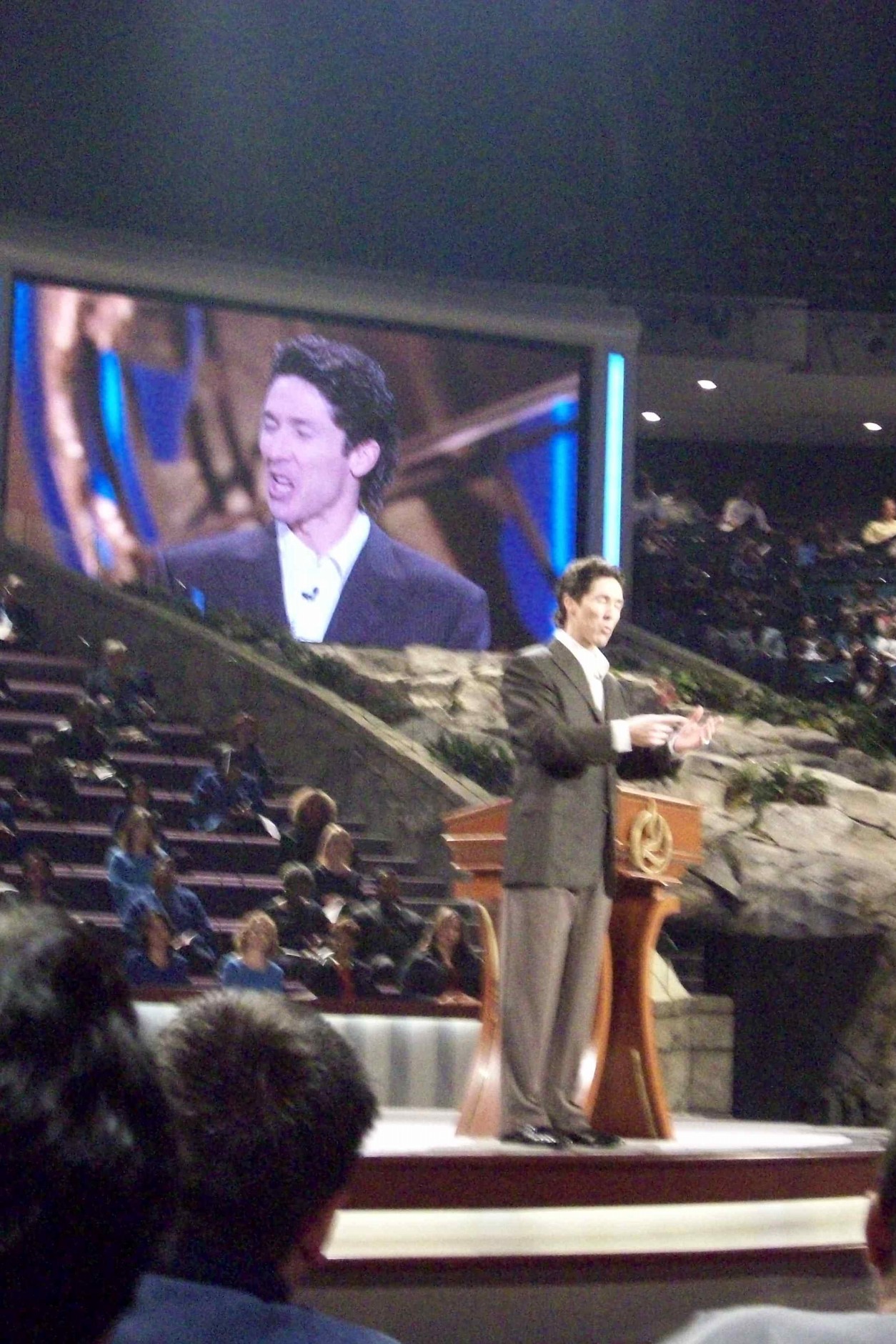
File:Joel Osteen at Lakewood Church.JPG
Olsteen at his Lakewood Church in Houston, TX


In Joel Osteen’s case, he preaches a prosperity theology that says that you can have it all when you subscribe to Osteen’s gospel message. However Jesus Christ warned that such teaching only produces a form of Christianity that is despicable to Christ himself. In the book of Revelation, the last day’s church of Laodicea was warned that due to its lukewarm state of riches and wealth, Jesus would spew out those Christians from his presence. Jesus knew that these prosperity material wealth seeking Christians were spiritually bankrupt and needed more than worldly wealth.

It would be interesting to know if Joel Osteen has ever given an altar call at any of his massively sold out motivational seminars, (notice we don't call them Christian evangelism meetings). Would Joel Osteen even know how to pray for a group of people seeking personal salvation?


To the angel of the church in Laodicea write: These are the words of the Amen, the faithful and true witness, the ruler of God’s creation. I know your deeds, that you are neither cold nor hot. I wish you were either one or the other! So, because you are lukewarm—neither hot nor cold—I am about to spit you out of my mouth. You say, ‘I am rich; I have acquired wealth and do not need a thing.’ But you do not realize that you are wretched, pitiful, poor, blind and naked. Revelation 3:14-17 NIV

From the article:

For more than two hours, Pastor Joel Osteen wrapped 12,000 people in a warm embrace at the Times Union Center with his massively successful brand of feel-good "prosperity theology." He declared that the event, his first visit to upstate New York and a near sell-out with an end-of-arena stage configuration, was meant to "throw out seeds of hope that will take root in your heart." Backed by a rock band and a heavily produced show that was more Broadway than tent revival, his message traded fire and brimstone for the equivalent of a corporate motivational speech. He was all praise and no damnation. The 49-year-old pastor of the non-denominational Lakewood Church in Houston delivered a high-energy spiritual pep talk that had the audience — many came in large groups and wore matching colorful T-shirts with the names of their local Christian churches — swaying, dancing, extending a raised palm in a gesture of praise and shouting "Amen!"

12,000 relate to Osteen's pep talk
http://www.timesunion.com/local/article/12-000-relate-to-Osteen-s-pep-talk-3414083.php

Posted byDuane/Shelley Muir at 7:57 PM 
Labels: Apostate Church

comments:


Kelstal April 27, 2012 2:56 PM

I will agree, the charsmatic persona of this "motivational speaker" defines a 'Lukewarm' church. I lost all respect for this American Christian leader when he was interviewed by Larry King and Mr. King asked, "Was you named for the prophet Joel?" and Mr. Osteen flippantly replied, "You know, Larry, I have been asked that before and never knew there was a 'prophet Joel' in the Bible." whatever else Joel Osteen said, I cannot remember as I was in total shock that THIS man had NEVER heard of the prophet Joel from the Old Testament? Sad world we live in. I would like to invite you to view my Blog, Who's ? Right. Although, I am just beginning my Blog, I think you may find it interesting.

www.whos-right-kelstal.blogspot.com


Duane/Shelley Muir May 2, 2012 8:56 AM

Yes, we did visit your blog, and did find it very informative and interesting. Do keep up the good work. May God richly bless you.